Virginia Institute of Marine Science, William & Mary, P.O. Box 1346, Gloucester Point, VA, 23062, USA.
Haskin Shellfish Research Laboratory, Rutgers University, 6959 Miller Avenue, Port Norris, NJ, 08349, USA.
Sci Rep. 2021 Jun 18;11(1):12872. doi: 10.1038/s41598-021-92379-6.
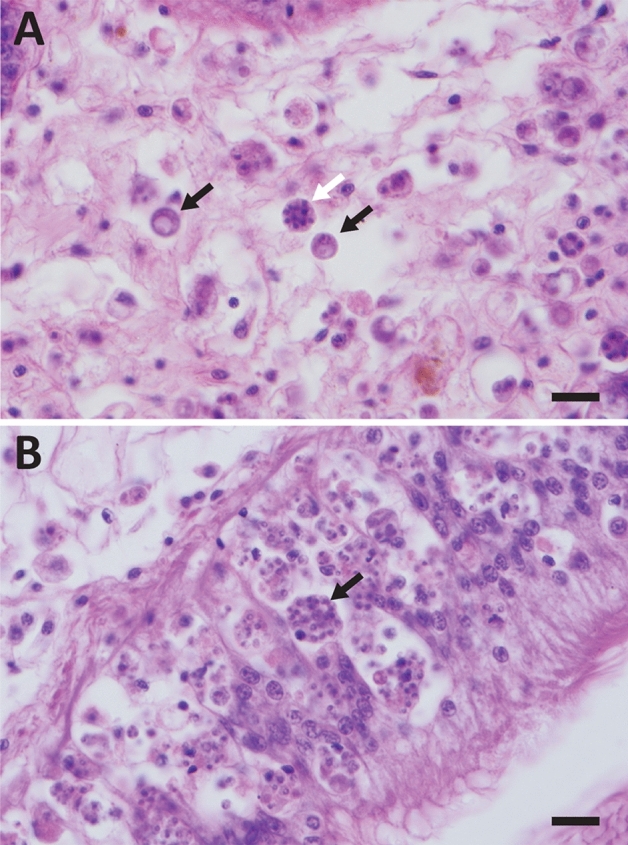
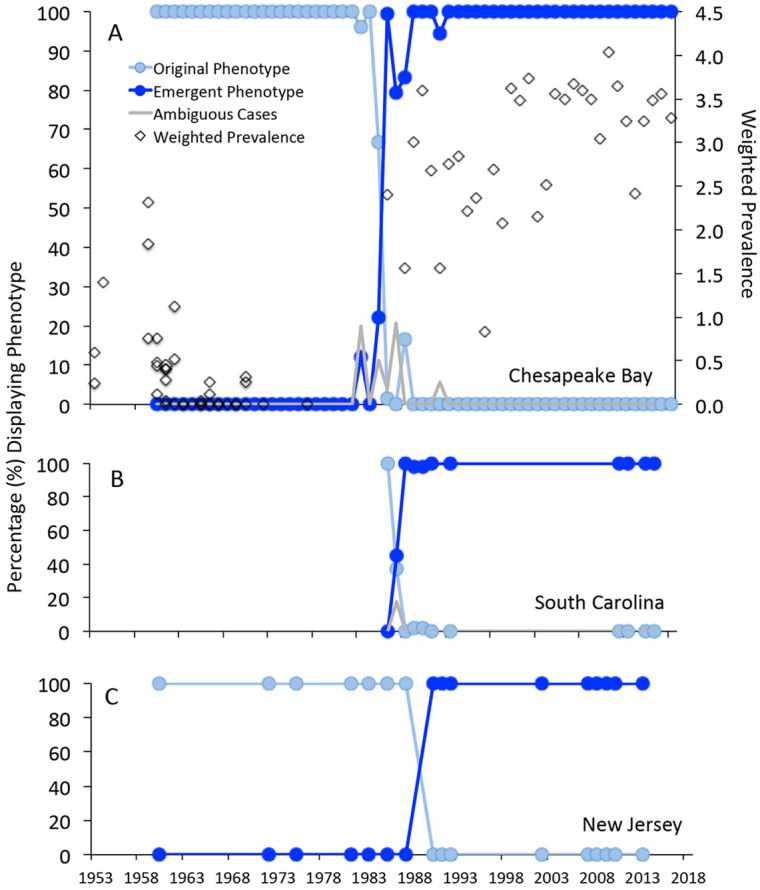
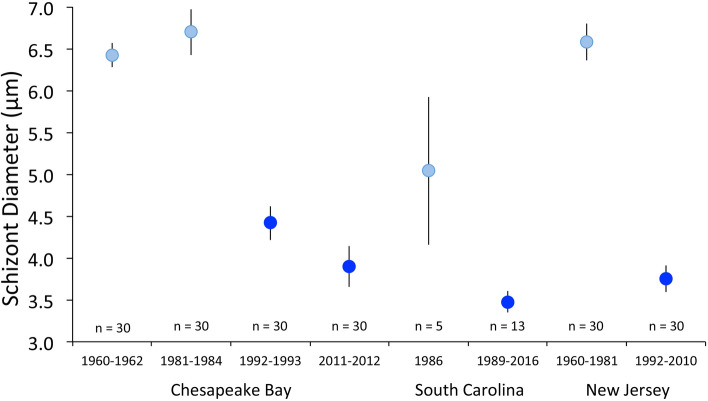
The protozoan parasite Perkinsus marinus, which causes dermo disease in Crassostrea virginica, is one of the most ecologically important and economically destructive marine pathogens. The rapid and persistent intensification of dermo in the USA in the 1980s has long been enigmatic. Attributed originally to the effects of multi-year drought, climatic factors fail to fully explain the geographic extent of dermo's intensification or the persistence of its intensified activity. Here we show that emergence of a unique, hypervirulent P. marinus phenotype was associated with the increase in prevalence and intensity of this disease and associated mortality. Retrospective histopathology of 8355 archival oysters from 1960 to 2018 spanning Chesapeake Bay, South Carolina, and New Jersey revealed that a new parasite phenotype emerged between 1983 and 1990, concurrent with major historical dermo disease outbreaks. Phenotypic changes included a shortening of the parasite's life cycle and a tropism shift from deeper connective tissues to digestive epithelia. The changes are likely adaptive with regard to the reduced oyster abundance and longevity faced by P. marinus after rapid establishment of exotic pathogen Haplosporidium nelsoni in 1959. Our findings, we hypothesize, illustrate a novel ecosystem response to a marine parasite invasion: an increase in virulence in a native parasite.
海洋原生动物寄生虫 Perkinsus marinus 是导致弗吉尼亚牡蛎出现皮病的病原体之一,它是对生态系统最重要且经济破坏性最大的海洋病原体之一。1980 年代美国皮病的迅速且持续加剧长期以来一直是个谜。最初归因于多年干旱的影响,但气候因素并不能完全解释皮病加剧的地理范围或其加剧活动的持续时间。在这里,我们表明,一种独特的、高致病性 Perkinsus marinus 表型的出现与这种疾病的流行和严重程度以及相关死亡率的增加有关。对 1960 年至 2018 年期间切萨皮克湾、南卡罗来纳州和新泽西州的 8355 个档案牡蛎进行回顾性组织病理学检查,结果显示,1983 年至 1990 年间出现了一种新的寄生虫表型,这与历史上重大的皮病爆发同时发生。表型变化包括寄生虫生命周期的缩短和从深部结缔组织向消化上皮的趋向性转移。这些变化可能是适应性的,因为 1959 年外来病原体 Haplosporidium nelsoni 的快速建立导致 P. marinus 面临牡蛎数量和寿命的减少。我们假设,我们的研究结果说明了一种新的生态系统对海洋寄生虫入侵的反应:一种本地寄生虫的毒力增加。