Johns Hopkins Bloomberg School of Public Health, Baltimore, MA, USA.
International Centre for Diarrheal Disease Research, Bangladesh, Dhaka, Bangladesh.
Lancet Infect Dis. 2021 Oct;21(10):1407-1414. doi: 10.1016/S1473-3099(20)30781-7. Epub 2021 Jun 16.
Killed whole-cell oral cholera vaccines (OCVs) are widely used for prevention of cholera in developing countries. However, few studies have evaluated the protection conferred by internationally recommended OCVs for durations beyond 2 years of follow-up.
In this study, we followed up the participants of a cluster-randomised controlled trial for 2 years after the end of the original trial. Originally, we had randomised 90 geographical clusters in Dhaka slums in Bangladesh in equal numbers (1:1:1) to a two-dose regimen of OCV alone (targeted to people aged 1 year or older), a two-dose regimen of OCV plus a water-sanitation-hygiene (WASH) intervention, or no intervention. There was no masking of group assignment. The WASH intervention conferred little additional protection to OCV and was discontinued at 2 years of follow-up. Surveillance for severe cholera was continued for 4 years. Because of the short duration and effect of the WASH intervention, we combined the two OCV intervention groups. The primary outcomes were OCV overall protection (protection of all members of the intervention clusters) and total protection (protection of individuals who got vaccinated in the intervention clusters) against severe cholera, which we assessed by multivariable survival models appropriate for cluster-randomised trials. This trial is registered on ClinicalTrials.gov, NCT01339845.
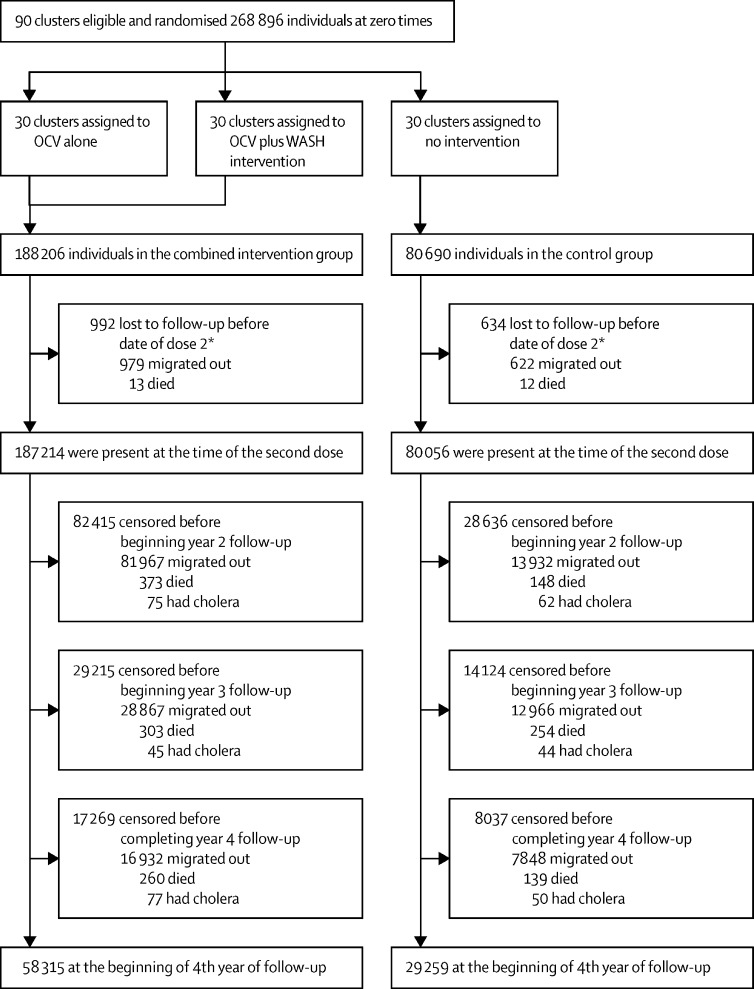
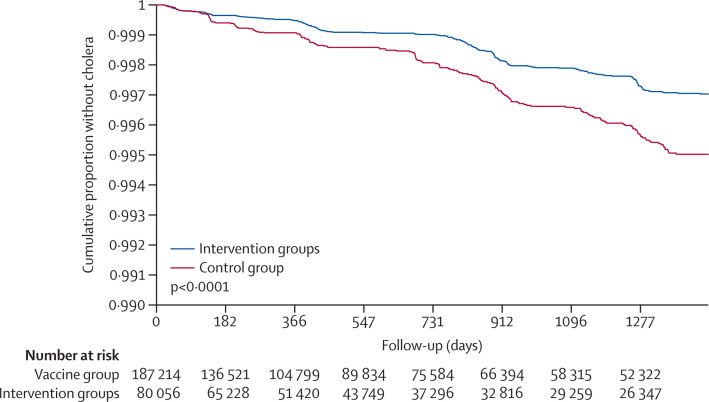
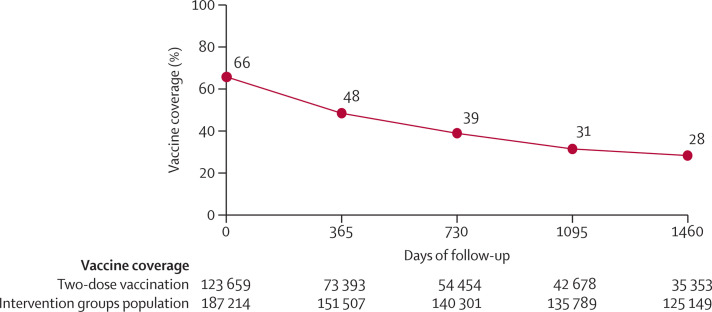
The study was done between April 17, 2011, and Nov 1, 2015. 268 896 participants were present at the time of the first dose, with 188 206 in the intervention group and 80 690 in the control group. OCV coverage of the two groups receiving OCV was 66% (123 659 of 187 214 participants). During 4 years of follow-up, 441 first episodes of severe cholera were detected (243 episodes in the vaccinated groups and as 198 episodes in the unvaccinated group). Overall OCV protection was 36% (95% CI 19 to 49%) and total OCV protection was 46% (95% CI 32 to 58). Cumulative total vaccine protection was notably lower for people vaccinated before the age of 5 years (24%; -30 to 56) than for people vaccinated at age 5 years or older (49%; 35 to 60), although the differences in protection for the two age groups were not significant (p=0·3308). Total vaccine protection dropped notably (p=0·0115) after 3 years in children vaccinated at 1-4 years of age.
These findings provide further evidence of long-term effectiveness of killed whole-cell OCV, and therefore further support for the use of killed whole-cell OCVs to control endemic cholera, but indicate that protection is shorter-lived in children vaccinated before the age of 5 years than in people vaccinated at the age of 5 years or older.
Bill & Melinda Gates Foundation.
For the Bengali translation of the abstract see Supplementary Materials section.
在发展中国家,全细胞灭活口服霍乱疫苗(OCV)被广泛用于预防霍乱。然而,很少有研究评估国际推荐的 OCV 在 2 年以上的随访时间内提供的保护作用。
本研究对一项原试验结束后随访 2 年的群组随机对照试验的参与者进行了随访。最初,我们在孟加拉国达卡贫民窟的 90 个地理群组中以 1:1:1 的比例随机分配到两组:两组均接受两剂 OCV(针对 1 岁或以上的人群),一组接受两剂 OCV 加水卫生-卫生(WASH)干预,另一组不接受干预。分组情况没有掩盖。WASH 干预对 OCV 几乎没有额外的保护作用,在 2 年的随访后停止。对严重霍乱的监测持续了 4 年。由于 WASH 干预的持续时间短且效果有限,我们将这两个 OCV 干预组合并。主要结局是 OCV 总体保护(干预组所有成员的保护)和总保护(在干预组中接种疫苗的个体的保护),我们通过适合群组随机试验的多变量生存模型评估了严重霍乱的情况。该试验在 ClinicalTrials.gov 上注册,编号为 NCT01339845。
该研究于 2011 年 4 月 17 日至 2015 年 11 月 1 日进行。在第一次接种时,有 268896 名参与者,其中 188206 名在干预组,80690 名在对照组。两组接受 OCV 的疫苗接种率为 66%(187214 名参与者中有 123659 名)。在 4 年的随访期间,共发现 441 例严重霍乱首例病例(接种组 243 例,未接种组 198 例)。OCV 总体保护率为 36%(95%CI 19%至 49%),总 OCV 保护率为 46%(95%CI 32%至 58%)。5 岁以下人群的累积总疫苗保护率明显较低(24%;-30%至 56%),而 5 岁及以上人群的疫苗保护率明显较高(49%;35%至 60%),尽管两组的保护差异无统计学意义(p=0.3308)。在 1-4 岁接受疫苗接种的儿童中,总疫苗保护在 3 年后明显下降(p=0.0115)。
这些发现进一步证明了全细胞灭活 OCV 的长期有效性,因此进一步支持使用全细胞灭活 OCV 来控制地方性霍乱,但表明在 5 岁以下儿童中接种疫苗的保护作用比 5 岁及以上儿童更短暂。
比尔和梅琳达·盖茨基金会。