Public Health Emergency Management, Ethiopia Public Health Institute, Addis Ababa, Ethiopia.
Clinical, Assessment, Regulatory, Evaluation (CARE) Unit, International Vaccine Institute, Seoul, Republic of Korea.
Clin Infect Dis. 2024 Jul 12;79(Supplement_1):S20-S32. doi: 10.1093/cid/ciae194.
Cholera outbreaks in Ethiopia necessitate frequent mass oral cholera vaccine (OCV) campaigns. Despite this, there is a notable absence of a comprehensive summary of these campaigns. Understanding national OCV vaccination history is essential to design appropriate and effective cholera control strategies. Here, we aimed to retrospectively review all OCV vaccination campaigns conducted across Ethiopia between 2019 and 2023.
The OCV request records from 2019 to October 2023 and vaccination campaign reports for the period from 2019 to December 2023 were retrospectively accessed from the Ethiopia Public Health Institute (EPHI) database. Descriptive analysis was conducted using the retrospective data collected.
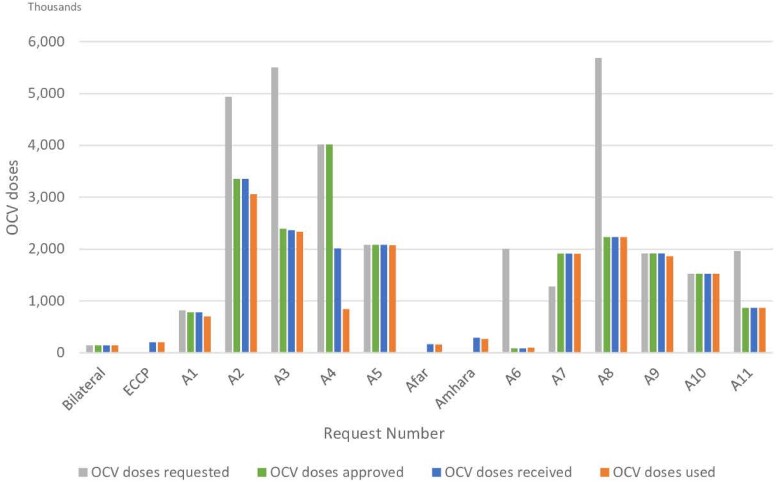
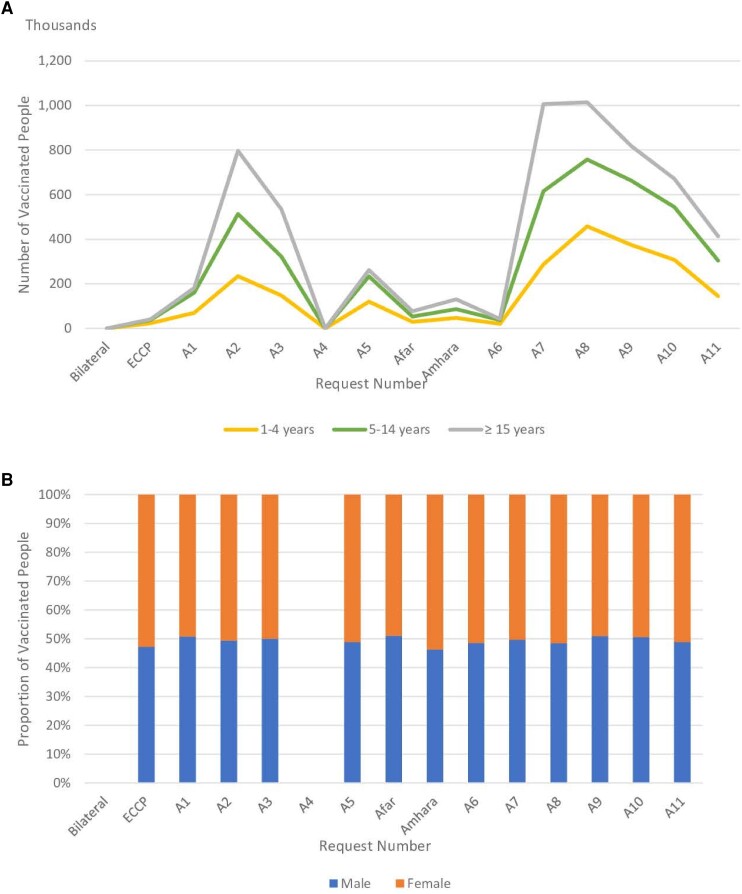
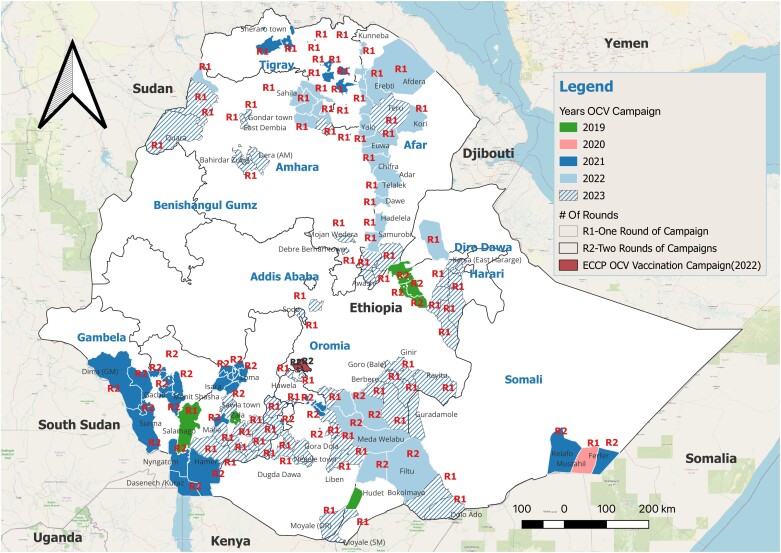
From 2019 to October 2023, Ethiopian government requested 32 044 576 OCV doses (31 899 576 doses to global stockpile; 145 000 doses to outside of stockpile). Around 66.3% of requested doses were approved; of which 90.4% were received. Fifteen OCV campaigns (12 reactive and 3 pre-emptive) were conducted, including five two-dose campaigns with varying dose intervals and single-dose campaigns partially in 2019 and entirely in 2021, 2022 and 2023. Overall vaccine administrative coverage was high; except for Tigray region (41.8% in the 1st round; 2nd round didn't occur). The vaccine administrative coverage records were documented, but no OCV coverage survey data was available.
This study represents the first comprehensive review of OCV campaigns in Ethiopia spanning the last five years. Its findings offer valuable insights into informing future cholera control strategies, underscoring the importance of monitoring and evaluation despite resource constraints. Addressing the limitations in coverage survey data availability is crucial for enhancing the efficacy of future campaigns.
埃塞俄比亚霍乱疫情频发,需要经常开展大规模口服霍乱疫苗(OCV)接种运动。尽管如此,对于这些运动却缺乏全面的总结。了解国家 OCV 免疫接种历史对于设计适当和有效的霍乱控制策略至关重要。在此,我们旨在回顾 2019 年至 2023 年期间在埃塞俄比亚开展的所有 OCV 接种运动。
从埃塞俄比亚公共卫生研究所(EPHI)数据库中检索 2019 年至 10 月 2023 年的 OCV 接种请求记录,以及 2019 年至 2023 年 12 月的疫苗接种运动报告。使用收集的回顾性数据进行描述性分析。
从 2019 年至 10 月 2023 年,埃塞俄比亚政府请求了 32044576 剂 OCV(31899576 剂给全球库存;145000 剂给库存外)。请求的剂量中有 66.3%得到批准;其中 90.4%得到了接收。开展了 15 次 OCV 接种运动(12 次反应性和 3 次先发制人的),包括 5 次不同剂量间隔的两剂接种运动和 2019 年部分、2021 年、2022 年和 2023 年全部开展的一剂接种运动。总体疫苗接种管理覆盖率较高;除提格雷地区外(第一轮为 41.8%;第二轮未发生)。疫苗接种管理覆盖率记录已被记录,但没有 OCV 接种率调查数据。
本研究代表了对过去五年埃塞俄比亚 OCV 接种运动的首次全面回顾。研究结果为未来的霍乱控制策略提供了有价值的见解,强调了尽管资源有限,但监测和评估的重要性。解决覆盖率调查数据可用性方面的限制对于提高未来运动的效果至关重要。