Panneerselvam P, Kumar Virender, Banik Narayan Chandra, Kumar Vivek, Parida Nabakishore, Wasim Iftikar, Das Aurovinda, Pattnaik Sanghamitra, Roul Pravat Kumar, Sarangi Dilip Ranjan, Sagwal Pardeep K, Craufurd Peter, Yadav Ashok, Malik Ram K, Singh Sudhanshu, McDonald Andrew J
International Maize and Wheat Improvement Centre, NASC Complex, New Delhi, India.
International Rice Research Institute, Los Baños, Philippines.
Field Crops Res. 2020 Dec 15;259:107961. doi: 10.1016/j.fcr.2020.107961.
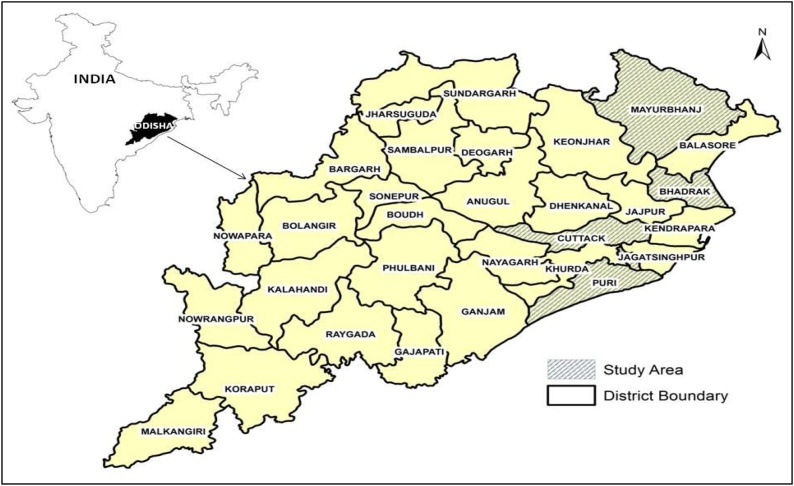
In many parts of Eastern India that have a very high prevalence of rural poverty and food insecurity, the prevailing rice establishment practice of '' is characterized by low yields and modest profitability, while labor and energy inputs are high. consists of broadcasting ungerminated rice seed at high rates (>100 kg ha) prior to the onset of monsoon rain, followed by ploughing at 4-6 weeks after crop emergence to control weeds with subsequent manual gap filling through seedling redistribution to ensure stand uniformity. Dry-direct seeding of rice (DSR), both drill-DSR and precision broadcast-DSR in combination with integrated weed management (IWM) may offer a pathway for simultaneously reducing costs and markedly increasing productivity. On-farm trials were conducted from 2016 to 2018 in four districts of Odisha (Mayurbhanj, Cuttack, Bhadrak, and Puri) to evaluate the yield and economic performance of dry-DSR (drill and precision broadcast), coupled with herbicide-based IWM strategies, in comparison with conventional . Drill-DSR with IWM increased grain yield by 1.7 t ha in Mayurbhanj and 1.3 t ha in Cuttack, but not in Bhadrak, compared to . The combination of increased yield and lower variable cost in drill-DSR increased net benefit by 550, 395, and 166 US$ ha in Mayurbhanj, Cuttack, and Bhadrak, respectively. For farmers without access to seed drills, precision broadcast-DSR with IWM increased yields by 0.91, 1.22 and 0.60 t ha, and net benefits by 270, 312, and 188 US$ ha in Mayurbhanj, Puri, and Bhadrak, respectively. Among the IWM practices evaluated in dry-DSR, application of pretilachlor + safener @ 500 g ha as pre-emergence, followed by bispyribac-sodium @ 20 g ha at 15-25 days after sowing as post-emergence, and then one spot hand weeding at 30-35 days after sowing was effective in controlling weeds. These results suggest that rice yield gaps in eastern India can be reduced, and farmers' income from rice can be increased by more than 50 % by replacing with drill-DSR or precision broadcast-DSR. The results could be applicable to approximately 6.4 million ha of lowland rice where is currently practiced in Eastern India.
在印度东部许多农村贫困和粮食不安全问题极为严重的地区,目前普遍采用的水稻种植方式产量低、利润微薄,而劳动力和能源投入却很高。这种方式的做法是在季风降雨开始前大量播撒未发芽的稻种(播种量超过100公斤/公顷),作物出苗后4至6周进行翻耕以控制杂草,随后通过重新分配秧苗进行人工补苗以确保苗株均匀。水稻旱直播(DSR),包括条播DSR和精量撒播DSR,并结合综合杂草管理(IWM),可能为同时降低成本和显著提高生产力提供一条途径。2016年至2018年在奥里萨邦的四个县(梅奥尔布汉杰、库塔克、巴德拉克和普里)开展了田间试验,以评估旱直播(条播和精量撒播)结合基于除草剂的IWM策略与传统种植方式相比的产量和经济表现。与传统种植方式相比,条播DSR结合IWM在梅奥尔布汉杰使谷物产量提高了1.7吨/公顷,在库塔克提高了1.3吨/公顷,但在巴德拉克没有提高。条播DSR产量增加且可变成本降低,使得梅奥尔布汉杰、库塔克和巴德拉克的净利润分别增加了550美元/公顷、395美元/公顷和166美元/公顷。对于没有条播机的农民来说,精量撒播DSR结合IWM在梅奥尔布汉杰、普里和巴德拉克分别使产量提高了0.91吨/公顷、1.22吨/公顷和0.60吨/公顷,净利润分别增加了270美元/公顷、312美元/公顷和188美元/公顷。在旱直播中评估的IWM措施中,在出苗前施用500克/公顷的丙草胺+安全剂,在播种后15至25天施用20克/公顷的双草醚作为苗后处理,然后在播种后30至35天进行一次人工除草,对控制杂草有效。这些结果表明,通过用条播DSR或精量撒播DSR取代传统种植方式,印度东部的水稻产量差距可以缩小,水稻种植户的收入可以增加50%以上。这些结果可能适用于印度东部目前采用传统种植方式的约640万公顷低地水稻种植区。