Wyatt-Johnson Season K, Sommer Alexandra L, Shim Kevin Y, Brewster Amy L
Department of Psychological Sciences, Purdue University, West Lafayette, IN, United States.
Weldon School of Biomedical Engineering, Purdue University, West Lafayette, IN, United States.
Front Neurol. 2021 Jun 3;12:651096. doi: 10.3389/fneur.2021.651096. eCollection 2021.
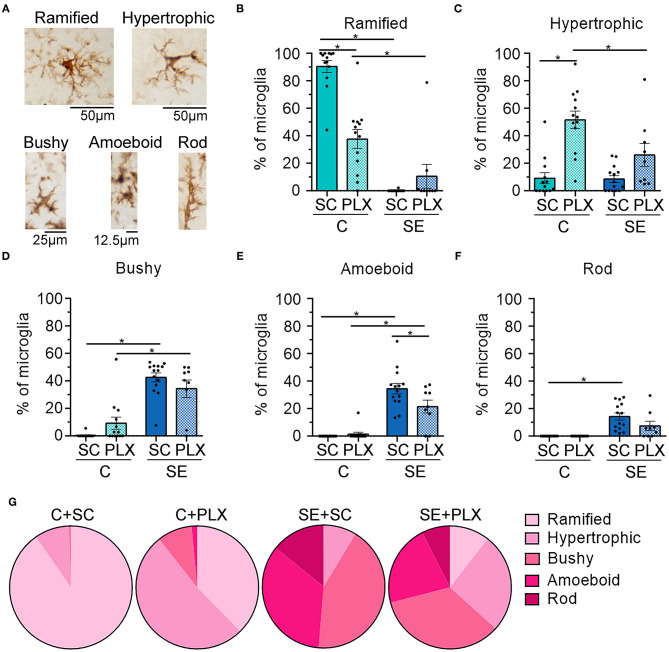
Events of status epilepticus (SE) trigger the development of temporal lobe epilepsy (TLE), a type of focal epilepsy that is commonly drug-resistant and is highly comorbid with cognitive deficits. While SE-induced hippocampal injury, accompanied by gliosis and neuronal loss, typically disrupts cognitive functions resulting in memory defects, it is not definitively known how. Our previous studies revealed extensive hippocampal microgliosis that peaked between 2 and 3 weeks after SE and paralleled the development of cognitive impairments, suggesting a role for reactive microglia in this pathophysiology. Microglial survival and proliferation are regulated by the colony-stimulating factor 1 receptor (CSF1R). The CSF1R inhibitor PLX3397 has been shown to reduce/deplete microglial populations and improve cognitive performance in models of neurodegenerative disorders. Therefore, we hypothesized that suppression of microgliosis with PLX3397 during epileptogenesis may attenuate the hippocampal-dependent spatial learning and memory deficits in the rat pilocarpine model of SE and acquired TLE. Different groups of control and SE rats were fed standard chow (SC) or chow with PLX3397 starting immediately after SE and for 3 weeks. Novel object recognition (NOR) and Barnes maze (BM) were performed to determine memory function between 2 and 3 weeks after SE. Then microglial populations were assessed using immunohistochemistry. Control rats fed with either SC or PLX3397 performed similarly in both NOR and BM tests, differentiating novel vs. familiar objects in NOR, and rapidly learning the location of the hidden platform in BM. In contrast, both SE groups (SC and PLX3397) showed significant deficits in both NOR and BM tests compared to controls. Both PLX3397-treated control and SE groups had significantly decreased numbers of microglia in the hippocampus (60%) compared to those in SC. In parallel, we found that PLX3397 treatment also reduced SE-induced hippocampal astrogliosis. Thus, despite drastic reductions in microglial cells, memory was unaffected in the PLX3397-treated groups compared to those in SC, suggesting that remaining microglia may be sufficient to help maintain hippocampal functions. In sum, PLX3397 did not improve or worsen the memory deficits in rats that sustained pilocarpine-induced SE. Further research is required to determine whether microglia play a role in cognitive decline during epileptogenesis.
癫痫持续状态(SE)事件会引发颞叶癫痫(TLE)的发展,TLE是一种局灶性癫痫,通常具有耐药性,且与认知缺陷高度共病。虽然SE诱导的海马损伤,伴有胶质增生和神经元丢失,通常会破坏认知功能导致记忆缺陷,但具体机制尚不完全清楚。我们之前的研究发现,海马广泛的小胶质细胞增生在SE后2至3周达到峰值,并与认知障碍的发展平行,提示反应性小胶质细胞在这一病理生理过程中发挥作用。小胶质细胞的存活和增殖受集落刺激因子1受体(CSF1R)调节。CSF1R抑制剂PLX3397已被证明在神经退行性疾病模型中可减少/耗尽小胶质细胞数量并改善认知表现。因此,我们假设在癫痫发生过程中用PLX3397抑制小胶质细胞增生可能会减轻大鼠匹罗卡品诱导的SE和获得性TLE模型中海马依赖性空间学习和记忆缺陷。不同组的对照和SE大鼠在SE后立即开始并持续3周喂食标准饲料(SC)或含PLX3397的饲料。在SE后2至3周进行新物体识别(NOR)和巴恩斯迷宫(BM)实验以确定记忆功能。然后使用免疫组织化学评估小胶质细胞数量。喂食SC或PLX3397的对照大鼠在NOR和BM实验中的表现相似,在NOR中区分新物体和熟悉物体,并在BM中快速学习隐藏平台的位置。相比之下,两个SE组(SC和PLX3397)在NOR和BM实验中与对照组相比均表现出明显缺陷。与喂食SC的组相比,PLX3397处理的对照和SE组海马中的小胶质细胞数量均显著减少(60%)。同时,我们发现PLX3397处理也减少了SE诱导的海马星形胶质细胞增生。因此,尽管小胶质细胞数量大幅减少,但与喂食SC的组相比,PLX3397处理组的记忆未受影响,这表明剩余的小胶质细胞可能足以帮助维持海马功能。总之,PLX3397并未改善或加重匹罗卡品诱导的SE大鼠的记忆缺陷。需要进一步研究以确定小胶质细胞在癫痫发生过程中的认知衰退中是否发挥作用。