Institute for Immunodeficiency, Center for Chronic Immunodeficiency, Medical Center, Faculty of Medicine, University of Freiburg, Freiburg, Germany.
Center for Pediatrics and Adolescent Medicine, Medical Center, Faculty of Medicine, University of Freiburg, Freiburg, Germany.
Front Immunol. 2021 Jun 2;12:617925. doi: 10.3389/fimmu.2021.617925. eCollection 2021.
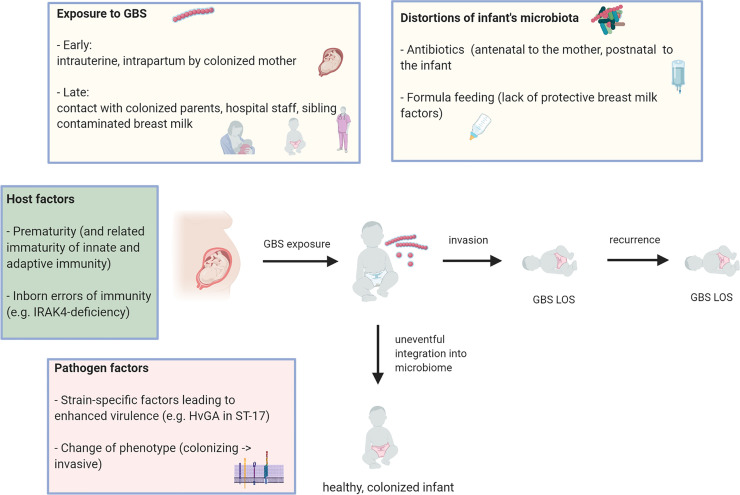
Group B Streptococcus (GBS) is a common intestinal colonizer during the neonatal period, but also may cause late-onset sepsis or meningitis in up to 0.5% of otherwise healthy colonized infants after day 3 of life. Transmission routes and risk factors of this late-onset form of invasive GBS disease (iGBS) are not fully understood. Cases of iGBS with recurrence (n=25) and those occurring in parallel in twins/triplets (n=32) from the UK and Ireland (national surveillance study 2014/15) and from Germany and Switzerland (retrospective case collection) were analyzed to unravel shared (in affected multiples) or fixed (in recurrent disease) risk factors for GBS disease. The risk of iGBS among infants from multiple births was high (17%), if one infant had already developed GBS disease. The interval of onset of iGBS between siblings was 4.5 days and in recurrent cases 12.5 days. Disturbances of the individual microbiome, including persistence of infectious foci are suggested e.g. by high usage of perinatal antibiotics in mothers of affected multiples, and by the association of an increased risk of recurrence with a short term of antibiotics [aOR 4.2 (1.3-14.2), P=0.02]. Identical GBS serotypes in both recurrent infections and concurrently infected multiples might indicate a failed microbiome integration of GBS strains that are generally regarded as commensals in healthy infants. The dynamics of recurrent GBS infections or concurrent infections in multiples suggest individual patterns of exposure and fluctuations in host immunity, causing failure of natural niche occupation.
B 组链球菌(GBS)是新生儿期常见的肠道定植菌,但也可能导致 3 天后健康定植婴儿中多达 0.5%发生迟发性败血症或脑膜炎。这种迟发性侵袭性 GBS 疾病(iGBS)的传播途径和危险因素尚未完全清楚。对来自英国和爱尔兰(国家监测研究 2014/15)以及德国和瑞士(回顾性病例收集)的 25 例 iGBS 复发病例和 32 例双胞胎/三胞胎同时发生的病例进行了分析,以揭示 GBS 疾病的共同(在受影响的多重婴儿中)或固定(在复发性疾病中)危险因素。如果一个婴儿已经患有 GBS 疾病,那么多胎婴儿发生 iGBS 的风险很高(17%)。同胞间 iGBS 的发病间隔为 4.5 天,而复发性病例为 12.5 天。个体微生物组的紊乱,包括感染灶的持续存在,例如受影响的多胎母亲在围产期使用大量抗生素,以及复发风险增加与抗生素使用时间短有关(aOR 4.2(1.3-14.2),P=0.02),都提示了这一点。在复发感染和同时感染的多重婴儿中相同的 GBS 血清型可能表明 GBS 菌株的微生物组整合失败,这些菌株通常被认为是健康婴儿的共生菌。复发性 GBS 感染或多重感染的动态提示个体暴露和宿主免疫波动的模式,导致自然生态位占据失败。