Boontip Thanawat, Waditee-Sirisattha Rungaroon, Honda Kohsuke, Napathorn Suchada Chanprateep
Department of Microbiology, Faculty of Science, Chulalongkorn University, Bangkok, Thailand.
International Center for Biotechnology, Osaka University, Suita, Japan.
Front Bioeng Biotechnol. 2021 Jun 3;9:666036. doi: 10.3389/fbioe.2021.666036. eCollection 2021.
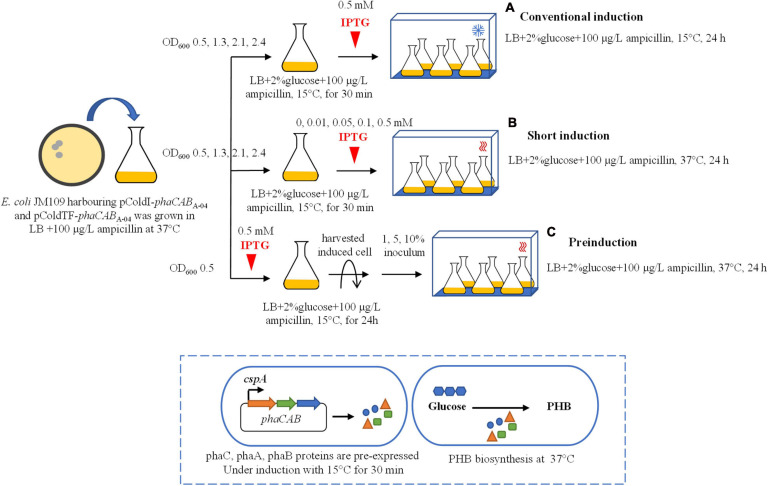
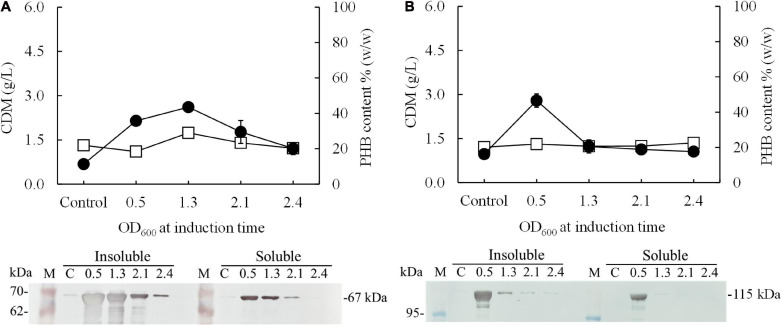
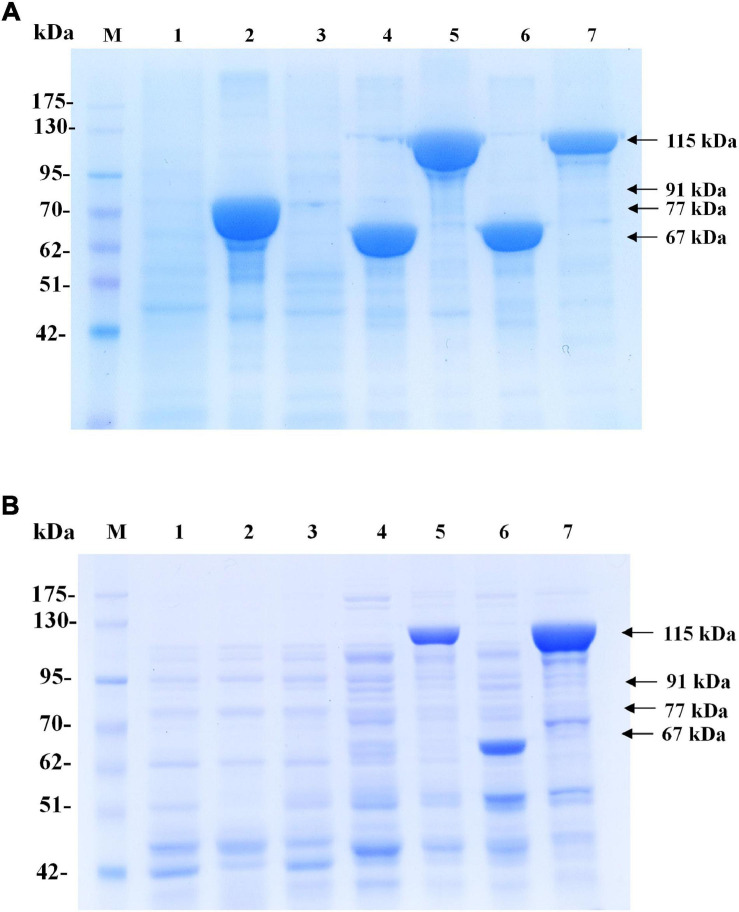
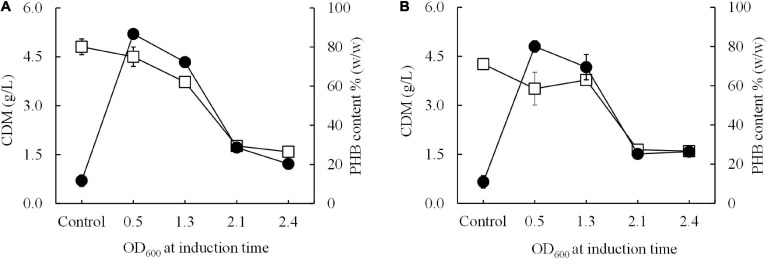
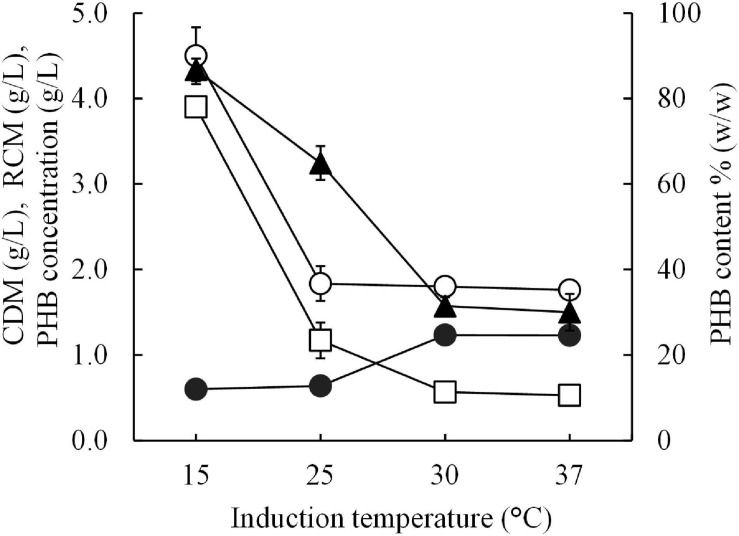
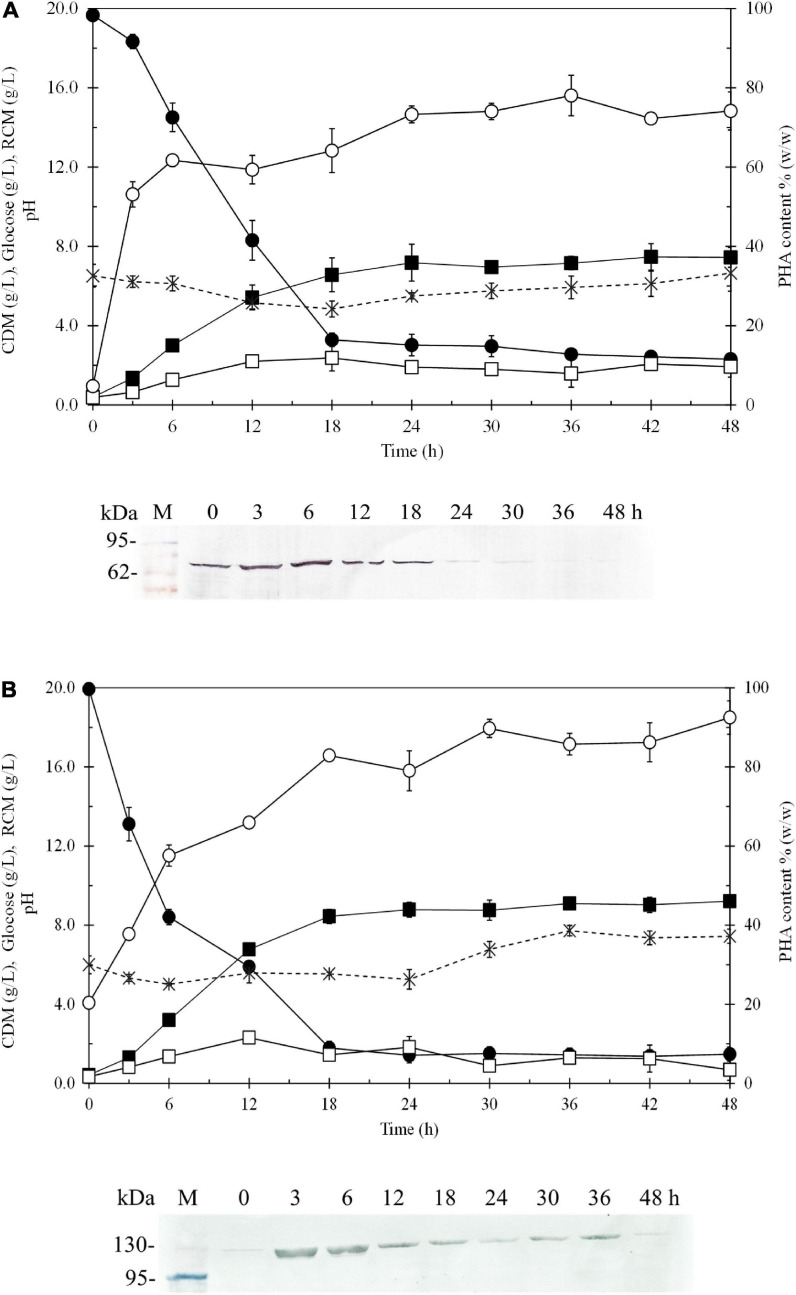
The present study attempted to increase poly(3-hydroxybutyrate) (PHB) production by improving expression of PHB biosynthesis operon derived from strain A-04 using various types of promoters. The intact PHB biosynthesis operon of A-04, an alkaline tolerant strain isolated in Thailand with a high degree of 16S rRNA sequence similarity with H16, was subcloned into pGEX-6P-1, pColdI, pColdTF, pBAD/Thio-TOPO, and pUC19 (native promoter) and transformed into JM109. While the gene was insoluble in most expression systems tested, it became soluble when it was expressed as a fusion protein with trigger factor (TF), a ribosome associated bacterial chaperone, under the control of a cold shock promoter. Careful optimization indicates that the cold-shock cspA promoter enhanced phaC protein expression and the chaperone function of TF play critical roles in increasing soluble phaC protein. Induction strategies and parameters in flask experiments were optimized to obtain high expression of soluble PhaC protein with high Y and PHB productivity. Soluble phaC was purified through immobilized metal affinity chromatography (IMAC). The results demonstrated that the soluble phaC from pColdTF- was expressed at a level of as high as 47.4 ± 2.4% of total protein and pColdTF- enhanced soluble protein formation to approximately 3.09-4.1 times higher than that from pColdI- by both conventional method and short induction method developed in this study. Cultivation in a 5-L fermenter led to PHB production of 89.8 ± 2.3% PHB content, a Y value of 0.38 g PHB/g glucose and a productivity of 0.43 g PHB/(L.h) using pColdTF- . The PHB film exhibited high optical transparency and possessed M 5.79 × 10 Da, M 1.86 × 10 Da, and PDI 3.11 with normal melting temperature and mechanical properties.
本研究试图通过使用各种类型的启动子来提高源自A-04菌株的聚(3-羟基丁酸酯)(PHB)生物合成操纵子的表达,从而增加PHB的产量。A-04是一株在泰国分离得到的耐碱性菌株,其16S rRNA序列与H16具有高度相似性,该菌株完整的PHB生物合成操纵子被亚克隆到pGEX-6P-1、pColdI、pColdTF、pBAD/Thio-TOPO和pUC19(天然启动子)中,并转化到JM109中。虽然在大多数测试的表达系统中,phaC基因是不溶性的,但当它在冷休克启动子的控制下与触发因子(TF,一种核糖体相关的细菌伴侣蛋白)融合表达时,它变得可溶。仔细优化表明,冷休克cspA启动子增强了phaC蛋白的表达,并且TF的伴侣功能在增加可溶性phaC蛋白方面起着关键作用。对摇瓶实验中的诱导策略和参数进行了优化,以获得高表达的可溶性PhaC蛋白,并具有高Y值和PHB生产率。通过固定化金属亲和色谱(IMAC)纯化了可溶性phaC。结果表明,来自pColdTF-phaC的可溶性phaC表达水平高达总蛋白的47.4±2.4%,并且通过本研究开发的常规方法和短诱导方法,pColdTF-phaC使可溶性蛋白的形成比来自pColdI-phaC的提高了约3.09-4.1倍。使用pColdTF-phaC在5-L发酵罐中培养,PHB产量的PHB含量为89.8±2.3%,Y值为0.38 g PHB/g葡萄糖,生产率为0.43 g PHB/(L·h)。PHB薄膜表现出高光学透明度,分子量Mw为5.79×10 Da,Mn为1.86×10 Da,多分散指数(PDI)为3.11,具有正常的熔点温度和机械性能。