Functional Neuromodulation Ltd., Minneapolis MN, USA.
Memory and Alzheimer's Treatment Center & Alzheimer's Disease Research Center, Division of Geriatric Psychiatry and Neuropsychiatry, Department of Psychiatry and Behavioral Sciences, Johns Hopkins University School of Medicine, Baltimore, MD, USA.
J Alzheimers Dis. 2021;82(3):1243-1257. doi: 10.3233/JAD-210530.
Age may affect treatment outcome in trials of mild probable Alzheimer's disease (AD).
We examined age as a moderator of outcome in an exploratory study of deep brain stimulation targeting the fornix (DBS-f) region in participants with AD.
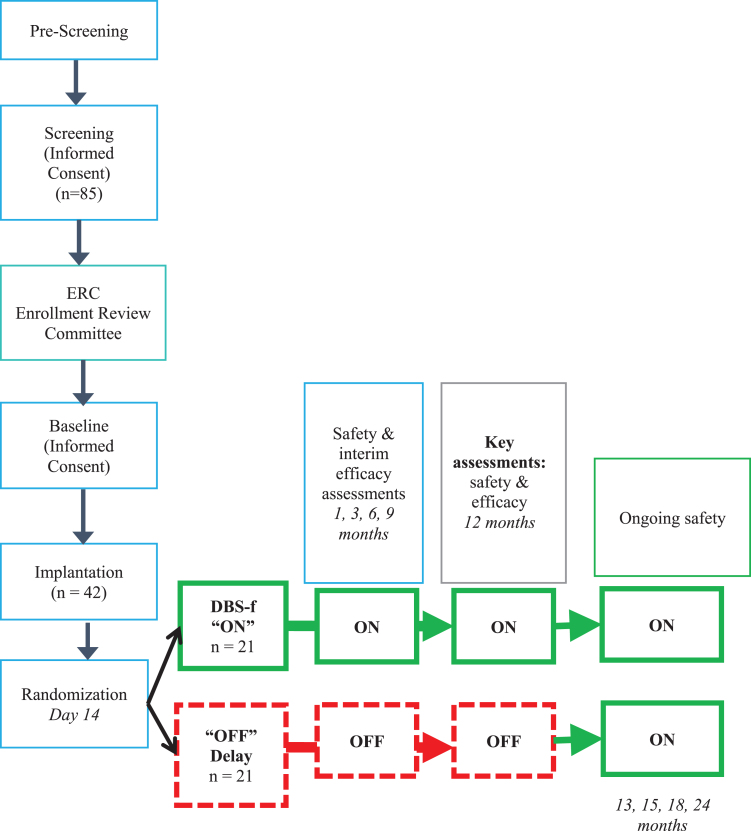
Forty-two participants were implanted with DBS electrodes and randomized to double-blind DBS-f stimulation ("on") or sham DBS-f ("off") for 12 months.
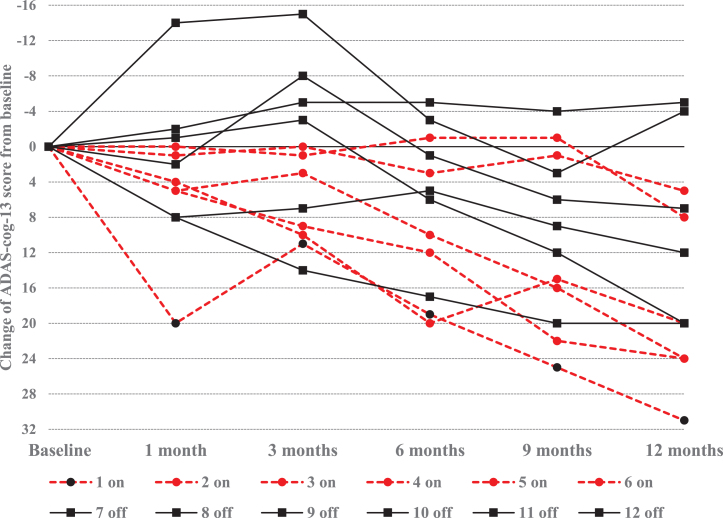
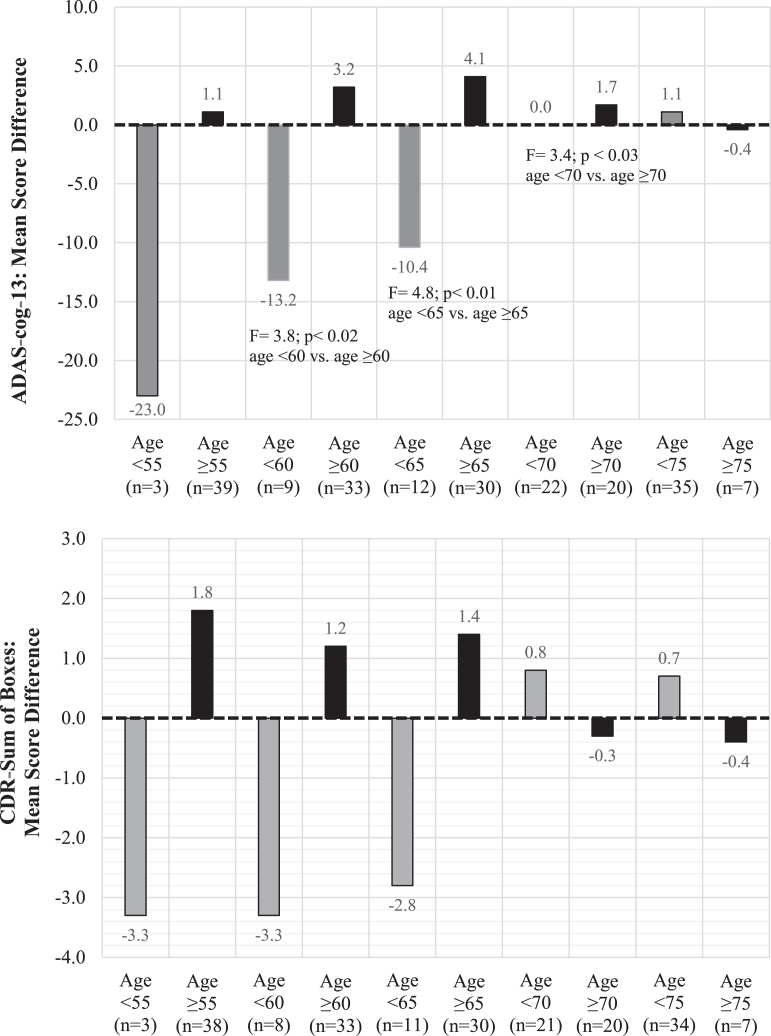
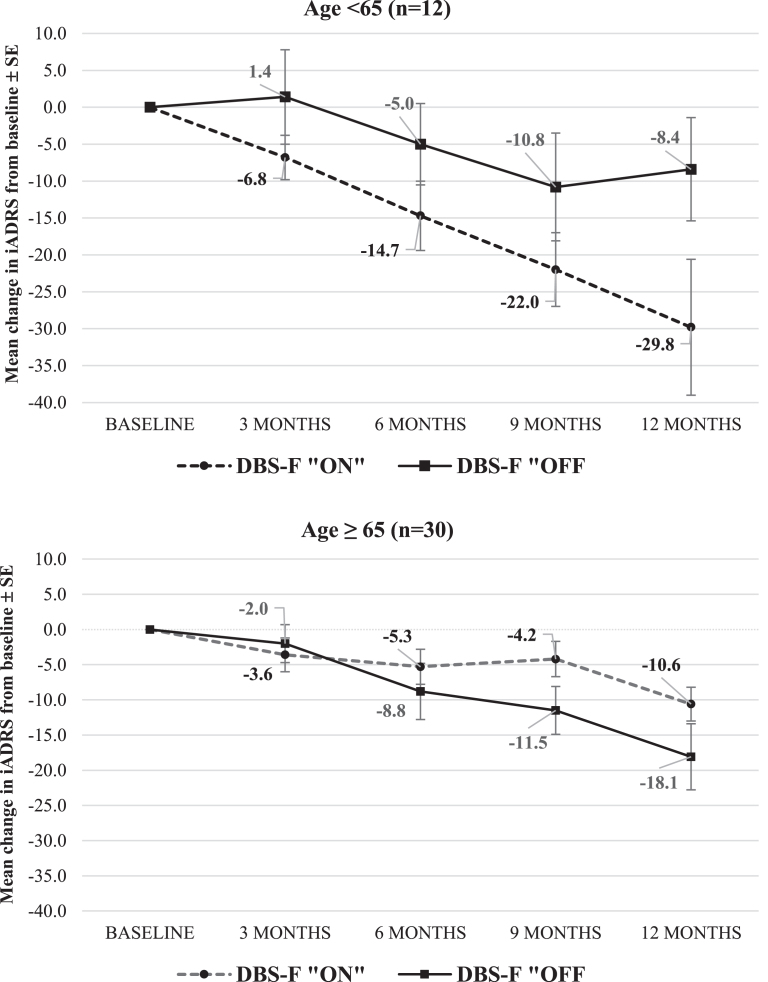
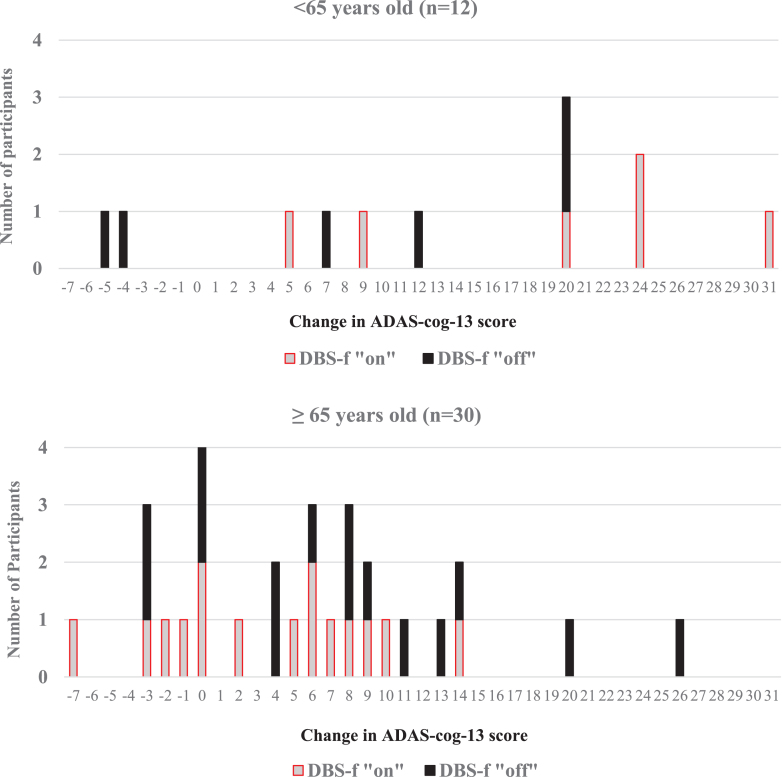
The intervention was safe and well tolerated. However, the selected clinical measures did not differentiate between the "on" and "off" groups in the intent to treat (ITT) population. There was a significant age by time interaction with the Alzheimer's Disease Assessment Scale; ADAS-cog-13 (p = 0.028). Six of the 12 enrolled participants < 65 years old (50%) markedly declined on the ADAS-cog-13 versus only 6.7%of the 30 participants≥65 years old regardless of treatment assignment (p = 0.005). While not significant, post-hoc analyses favored DBS-f "off" versus "on" over 12 months in the < 65 age group but favored DBS-f "on" versus "off" in the≥65 age group on all clinical metrics. On the integrated Alzheimer's Disease rating scale (iADRS), the effect size contrasting DBS-f "on" versus "off" changed from +0.2 (favoring "off") in the < 65 group to -0.52 (favoring "on") in the≥65 age group.
The findings highlight issues with subject selection in clinical trials for AD. Faster disease progression in younger AD participants with different AD sub-types may influence the results. Biomarker confirmation and genotyping to differentiate AD subtypes is important for future clinical trials.
年龄可能会影响轻度疑似阿尔茨海默病(AD)临床试验的治疗结果。
我们研究了年龄作为 AD 患者穹窿深部脑刺激(DBS-f)试验中结果的调节剂。
42 名参与者被植入 DBS 电极,并随机分为双盲 DBS-f 刺激(“开”)或假 DBS-f(“关”)12 个月。
该干预措施安全且耐受良好。然而,所选的临床措施并不能在意向治疗(ITT)人群中区分“开”和“关”组。阿尔茨海默病评估量表;ADAS-cog-13(p=0.028)有显著的年龄与时间交互作用。12 名入组参与者中有 6 名(50%)年龄<65 岁的患者在 ADAS-cog-13 上明显下降,而无论治疗分配如何,年龄≥65 岁的 30 名参与者中只有 6.7%(p=0.005)。虽然没有统计学意义,但事后分析在<65 岁年龄组中,DBS-f“关”比“开”更有利,但在≥65 岁年龄组中,DBS-f“开”比“关”更有利。在综合阿尔茨海默病评定量表(iADRS)上,DBS-f“开”与“关”对比的效应大小从<65 岁组的+0.2(支持“关”)变为≥65 岁组的-0.52(支持“开”)。
这些发现强调了 AD 临床试验中受试者选择的问题。不同 AD 亚型的年轻 AD 参与者疾病进展更快可能会影响结果。区分 AD 亚型的生物标志物确认和基因分型对未来的临床试验很重要。