
人体血液代谢组学的生理极限:糖酵解、氧化和合成代谢运动员的代谢组学分析。
Physiological extremes of the human blood metabolome: A metabolomics analysis of highly glycolytic, oxidative, and anabolic athletes.
机构信息
Exercise Biology, Department of Sport and Health Sciences, Technische Universität München, Munich, Germany.
Institute of Computational Biology, Helmholtz Zentrum München, Neuherberg, Germany.
出版信息
Physiol Rep. 2021 Jun;9(12):e14885. doi: 10.14814/phy2.14885.
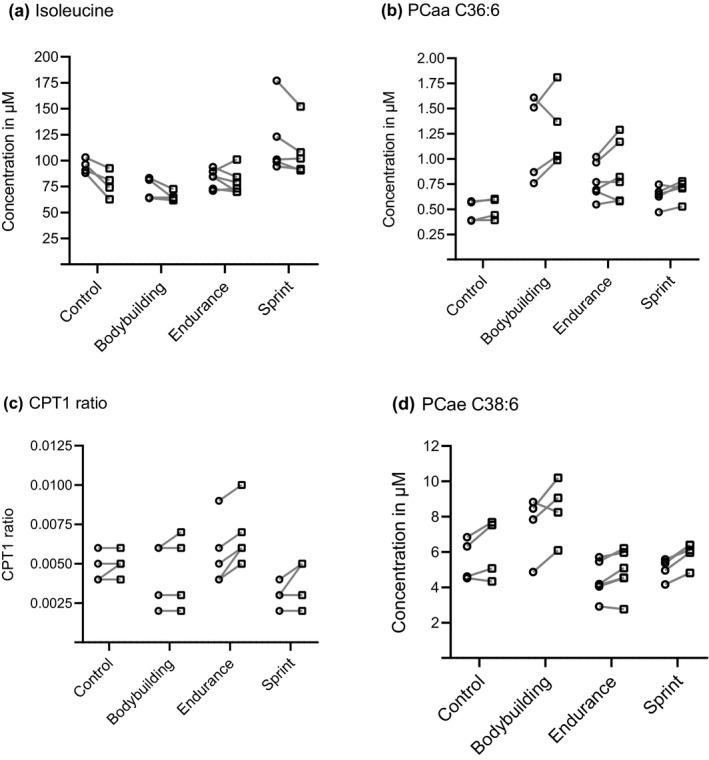
Human metabolism is highly variable. At one end of the spectrum, defects of enzymes, transporters, and metabolic regulation result in metabolic diseases such as diabetes mellitus or inborn errors of metabolism. At the other end of the spectrum, favorable genetics and years of training combine to result in physiologically extreme forms of metabolism in athletes. Here, we investigated how the highly glycolytic metabolism of sprinters, highly oxidative metabolism of endurance athletes, and highly anabolic metabolism of natural bodybuilders affect their serum metabolome at rest and after a bout of exercise to exhaustion. We used targeted mass spectrometry-based metabolomics to measure the serum concentrations of 151 metabolites and 43 metabolite ratios or sums in 15 competitive male athletes (6 endurance athletes, 5 sprinters, and 4 natural bodybuilders) and 4 untrained control subjects at fasted rest and 5 minutes after a maximum graded bicycle test to exhaustion. The analysis of all 194 metabolite concentrations, ratios and sums revealed that natural bodybuilders and endurance athletes had overall different metabolite profiles, whereas sprinters and untrained controls were more similar. Specifically, natural bodybuilders had 1.5 to 1.8-fold higher concentrations of specific phosphatidylcholines and lower levels of branched chain amino acids than all other subjects. Endurance athletes had 1.4-fold higher levels of a metabolite ratio showing the activity of carnitine-palmitoyl-transferase I and 1.4-fold lower levels of various alkyl-acyl-phosphatidylcholines. When we compared the effect of exercise between groups, endurance athletes showed 1.3-fold higher increases of hexose and of tetradecenoylcarnitine (C14:1). In summary, physiologically extreme metabolic capacities of endurance athletes and natural bodybuilders are associated with unique blood metabolite concentrations, ratios, and sums at rest and after exercise. Our results suggest that long-term specific training, along with genetics and other athlete-specific factors systematically change metabolite concentrations at rest and after exercise.
人类的新陈代谢具有高度的可变性。在光谱的一端,酶、转运体和代谢调节的缺陷导致代谢疾病,如糖尿病或先天性代谢错误。在光谱的另一端,有利的遗传和多年的训练相结合,导致运动员的生理代谢达到极端形式。在这里,我们研究了短跑运动员高度糖酵解代谢、耐力运动员高度氧化代谢和自然健美运动员高度合成代谢如何影响他们在休息和运动后耗尽时的血清代谢组。我们使用基于靶向质谱的代谢组学方法测量了 151 种代谢物的血清浓度和 43 种代谢物比值或总和,在 15 名有竞争力的男性运动员(6 名耐力运动员、5 名短跑运动员和 4 名自然健美运动员)和 4 名未经训练的对照者中,在空腹休息时和最大分级自行车测试后 5 分钟时进行测量,直至耗尽。对所有 194 种代谢物浓度、比值和总和的分析表明,自然健美运动员和耐力运动员的代谢物谱总体上不同,而短跑运动员和未经训练的对照组更相似。具体而言,自然健美运动员的特定磷脂酰胆碱浓度高出 1.5 至 1.8 倍,支链氨基酸水平较低。耐力运动员的肉碱棕榈酰转移酶 I 活性的代谢物比值高出 1.4 倍,各种烷基酰基磷脂酰胆碱水平低 1.4 倍。当我们比较组间运动的影响时,耐力运动员的己糖和十四烯酰肉碱(C14:1)的增加幅度高出 1.3 倍。总之,耐力运动员和自然健美运动员的生理极端代谢能力与休息和运动后的独特血液代谢物浓度、比值和总和有关。我们的结果表明,长期的特定训练,以及遗传和其他与运动员相关的因素,会系统性地改变休息和运动后的代谢物浓度。



 Zotero 插件