Department of Bioengineering, California NanoSystems Institute and Center for Minimally Invasive Therapeutics, University of California, Los Angeles, Los Angeles, CA 90095, USA; School of Pharmacy, Xi'an Jiaotong University, Xi'an 710061, China.
Department of Bioengineering, California NanoSystems Institute and Center for Minimally Invasive Therapeutics, University of California, Los Angeles, Los Angeles, CA 90095, USA; Department of Pharmaceutical Sciences, University of Michigan, Ann Arbor, MI 48109, USA.
Adv Drug Deliv Rev. 2021 Sep;176:113839. doi: 10.1016/j.addr.2021.113839. Epub 2021 Jun 19.
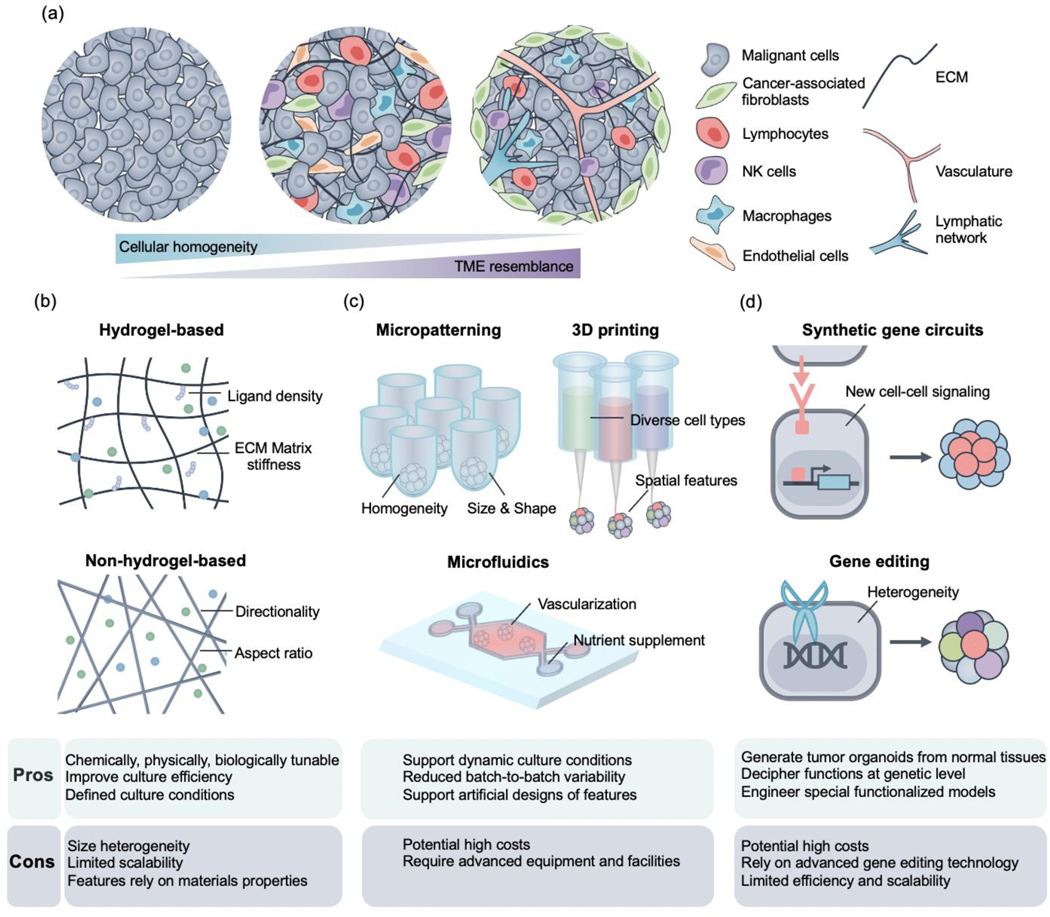
Cancer remains a leading health burden worldwide. One of the challenges hindering cancer therapy development is the substantial discrepancies between the existing cancer models and the tumor microenvironment (TME) of human patients. Constructing tumor organoids represents an emerging approach to recapitulate the pathophysiological features of the TME in vitro. Over the past decade, various approaches have been demonstrated to engineer tumor organoids as in vitro cancer models, such as incorporating multiple cellular populations, reconstructing biophysical and chemical traits, and even recapitulating structural features. In this review, we focus on engineering approaches for building tumor organoids, including biomaterial-based, microfabrication-assisted, and synthetic biology-facilitated strategies. Furthermore, we summarize the applications of engineered tumor organoids in basic cancer research, cancer drug discovery, and personalized medicine. We also discuss the challenges and future opportunities in using tumor organoids for broader applications.
癌症仍然是全球主要的健康负担之一。阻碍癌症治疗发展的一个挑战是现有的癌症模型与人类患者的肿瘤微环境(TME)之间存在很大差异。构建肿瘤类器官是体外重现 TME 病理生理特征的一种新兴方法。在过去的十年中,已经证明了多种方法可以将肿瘤类器官作为体外癌症模型进行工程设计,例如纳入多种细胞群体、重建生物物理和化学特性,甚至重现结构特征。在这篇综述中,我们重点介绍了构建肿瘤类器官的工程方法,包括基于生物材料、微制造辅助和合成生物学辅助的策略。此外,我们总结了工程化肿瘤类器官在基础癌症研究、癌症药物发现和个性化医学中的应用。我们还讨论了使用肿瘤类器官进行更广泛应用所面临的挑战和未来机遇。