Department of Computer Science, Stony Brook University, New York, USA.
Program in Public Health, Stony Brook University, New York, USA.
Psychol Med. 2023 Feb;53(3):918-926. doi: 10.1017/S0033291721002294. Epub 2021 Jun 22.
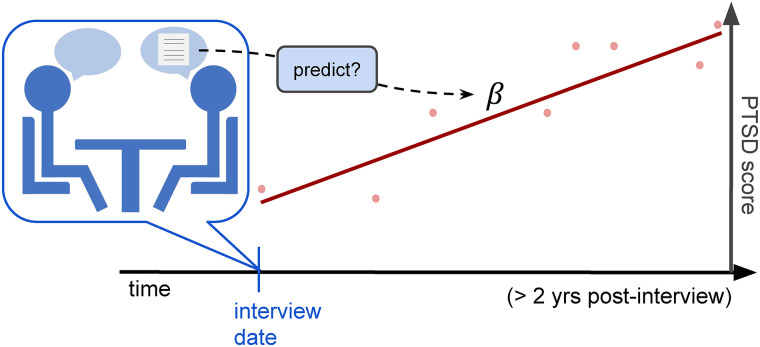
Oral histories from 9/11 responders to the World Trade Center (WTC) attacks provide rich narratives about distress and resilience. Artificial Intelligence (AI) models promise to detect psychopathology in natural language, but they have been evaluated primarily in non-clinical settings using social media. This study sought to test the ability of AI-based language assessments to predict PTSD symptom trajectories among responders.
Participants were 124 responders whose health was monitored at the Stony Brook WTC Health and Wellness Program who completed oral history interviews about their initial WTC experiences. PTSD symptom severity was measured longitudinally using the PTSD Checklist (PCL) for up to 7 years post-interview. AI-based indicators were computed for depression, anxiety, neuroticism, and extraversion along with dictionary-based measures of linguistic and interpersonal style. Linear regression and multilevel models estimated associations of AI indicators with concurrent and subsequent PTSD symptom severity (significance adjusted by false discovery rate).
Cross-sectionally, greater depressive language ( = 0.32; = 0.049) and first-person singular usage ( = 0.31; = 0.049) were associated with increased symptom severity. Longitudinally, anxious language predicted future worsening in PCL scores ( = 0.30; = 0.049), whereas first-person plural usage ( = -0.36; = 0.014) and longer words usage ( = -0.35; = 0.014) predicted improvement.
This is the first study to demonstrate the value of AI in understanding PTSD in a vulnerable population. Future studies should extend this application to other trauma exposures and to other demographic groups, especially under-represented minorities.
来自世界贸易中心(WTC)袭击事件的 9/11 响应者的口述历史提供了有关痛苦和适应力的丰富叙述。人工智能(AI)模型有望在自然语言中检测出精神病理学,但它们主要在使用社交媒体的非临床环境中进行了评估。本研究旨在测试基于 AI 的语言评估在预测响应者 PTSD 症状轨迹方面的能力。
参与者是 124 名在 Stony Brook WTC 健康与健康计划中接受监测的响应者,他们完成了有关其最初 WTC 经历的口述历史访谈。使用 PTSD 检查表(PCL)在访谈后长达 7 年的时间内对 PTSD 症状严重程度进行了纵向测量。计算了基于 AI 的抑郁、焦虑、神经质和外向性指标以及基于词典的语言和人际风格指标。线性回归和多层次模型估计了 AI 指标与并发和随后的 PTSD 症状严重程度之间的关联(通过虚假发现率进行调整)。
在横截面分析中,更多的抑郁性语言( = 0.32; = 0.049)和第一人称单数用法( = 0.31; = 0.049)与症状严重程度增加有关。纵向分析表明,焦虑性语言预示着 PCL 评分的未来恶化( = 0.30; = 0.049),而第一人称复数用法( = -0.36; = 0.014)和更长的单词用法( = -0.35; = 0.014)预示着改善。
这是第一项证明 AI 在理解弱势群体中 PTSD 方面具有价值的研究。未来的研究应将这种应用扩展到其他创伤暴露和其他人群,尤其是代表性不足的少数族裔。