Mangalik Siddharth, Eichstaedt Johannes C, Giorgi Salvatore, Mun Jihu, Ahmed Farhan, Gill Gilvir, V Ganesan Adithya, Subrahmanya Shashanka, Soni Nikita, Clouston Sean A P, Schwartz H Andrew
Department of Computer Science, Stony Brook University, Stony Brook, NY, USA.
Department of Psychology, Stanford University, Stanford, CA, USA.
NPJ Digit Med. 2024 May 2;7(1):109. doi: 10.1038/s41746-024-01100-0.
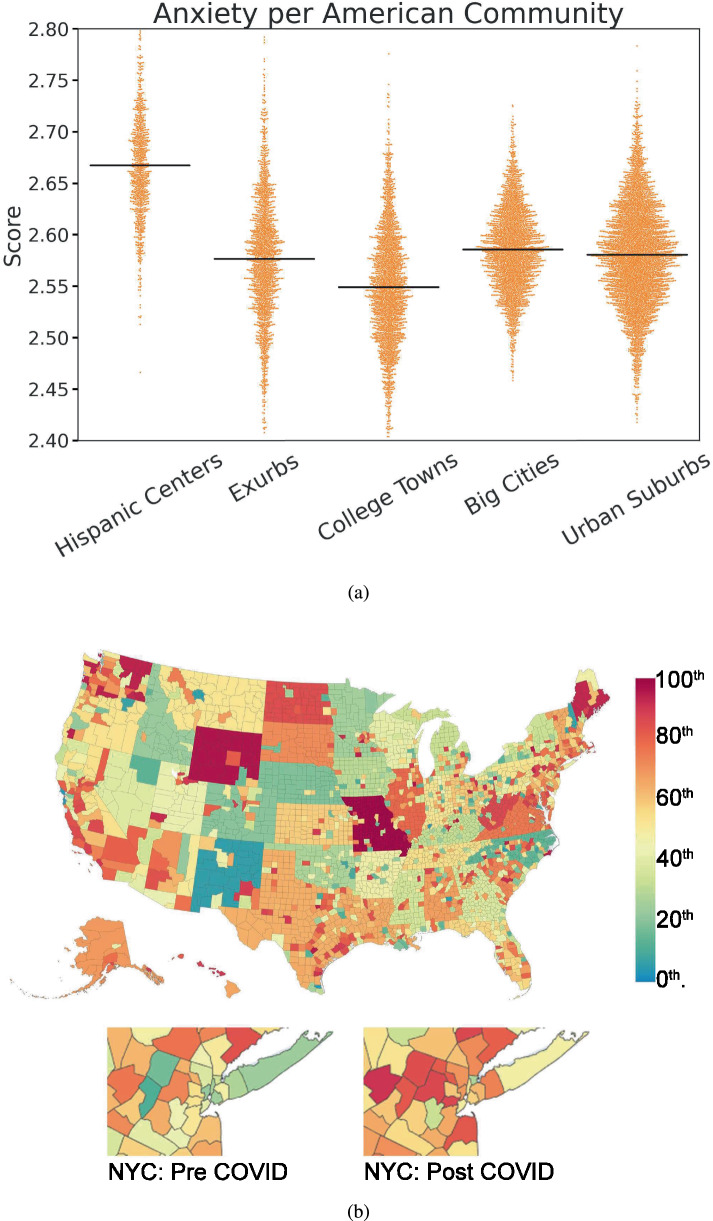
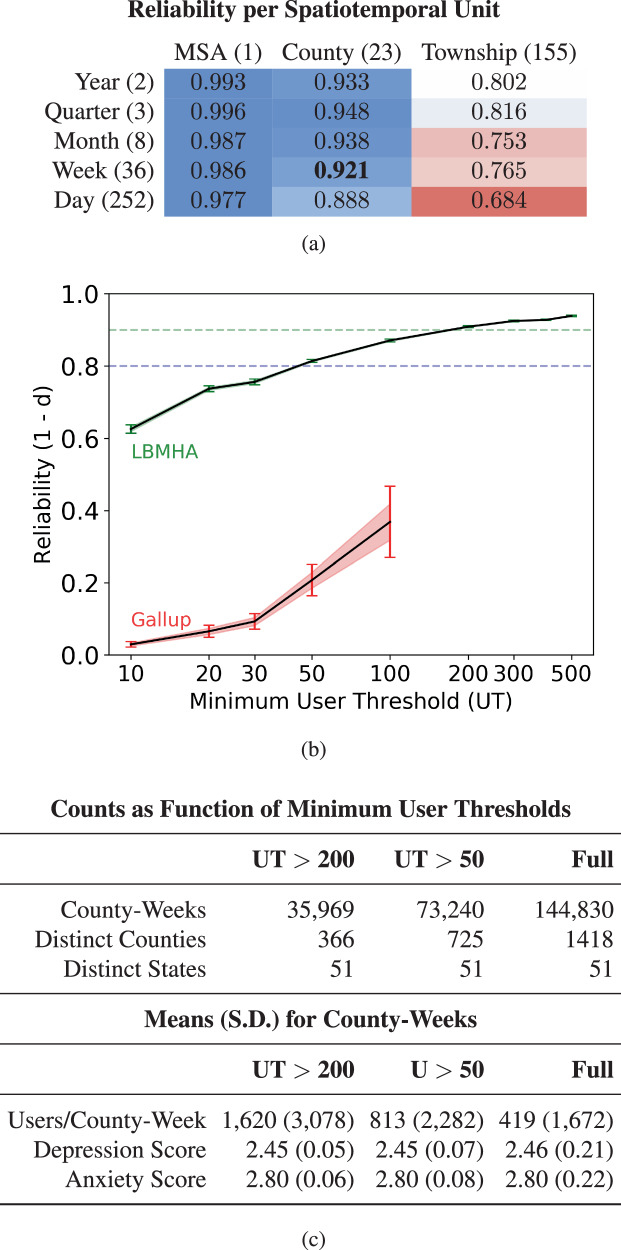
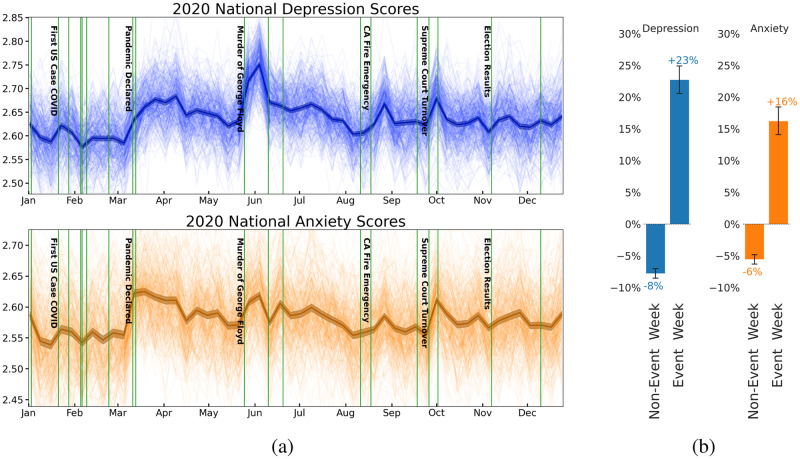
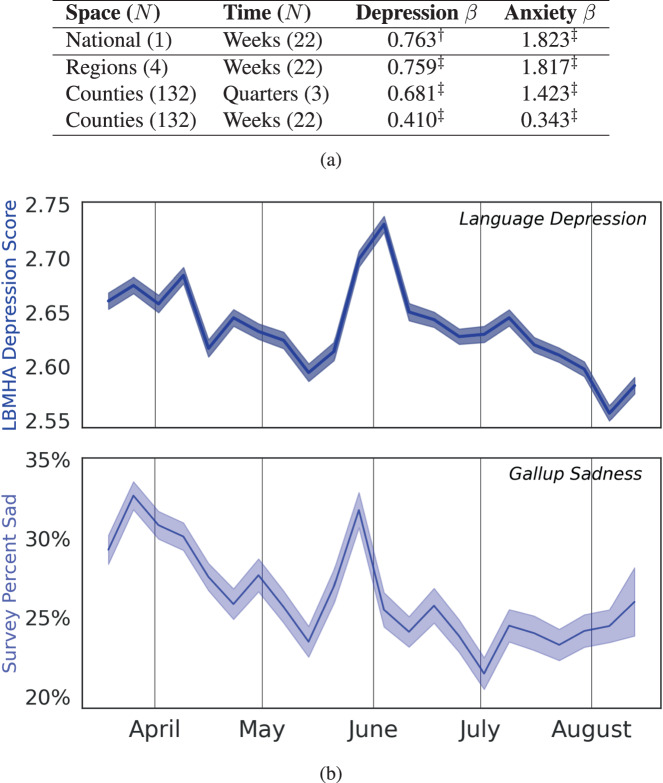
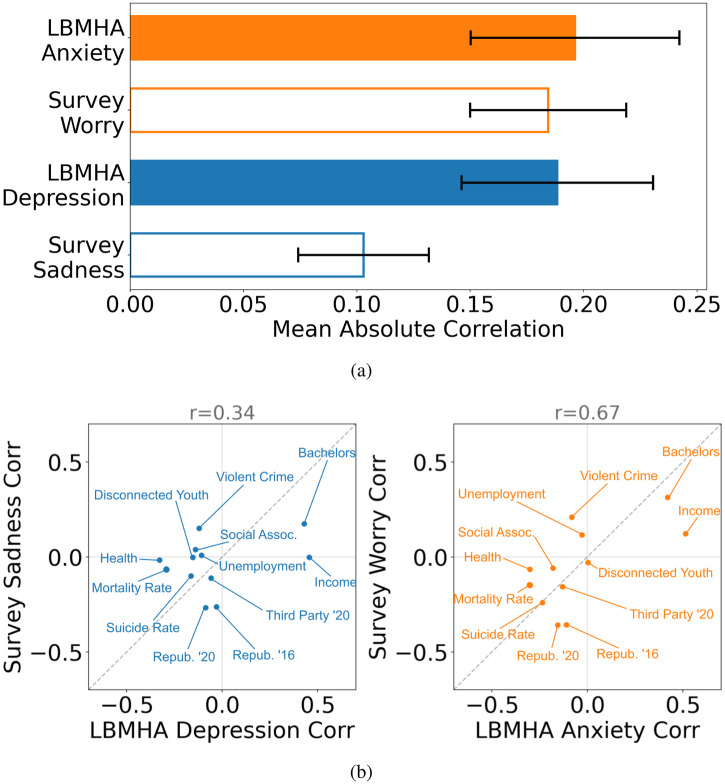
In the most comprehensive population surveys, mental health is only broadly captured through questionnaires asking about "mentally unhealthy days" or feelings of "sadness." Further, population mental health estimates are predominantly consolidated to yearly estimates at the state level, which is considerably coarser than the best estimates of physical health. Through the large-scale analysis of social media, robust estimation of population mental health is feasible at finer resolutions. In this study, we created a pipeline that used ~1 billion Tweets from 2 million geo-located users to estimate mental health levels and changes for depression and anxiety, the two leading mental health conditions. Language-based mental health assessments (LBMHAs) had substantially higher levels of reliability across space and time than available survey measures. This work presents reliable assessments of depression and anxiety down to the county-weeks level. Where surveys were available, we found moderate to strong associations between the LBMHAs and survey scores for multiple levels of granularity, from the national level down to weekly county measurements (fixed effects β = 0.34 to 1.82; p < 0.001). LBMHAs demonstrated temporal validity, showing clear absolute increases after a list of major societal events (+23% absolute change for depression assessments). LBMHAs showed improved external validity, evidenced by stronger correlations with measures of health and socioeconomic status than population surveys. This study shows that the careful aggregation of social media data yields spatiotemporal estimates of population mental health that exceed the granularity achievable by existing population surveys, and does so with generally greater reliability and validity.
在最全面的人口调查中,心理健康仅通过询问“精神不健康天数”或“悲伤”情绪的问卷大致体现。此外,人口心理健康评估主要汇总为州一级的年度估计数,这比身体健康的最佳估计数要粗略得多。通过对社交媒体的大规模分析,可以以更精细的分辨率对人口心理健康进行可靠估计。在本研究中,我们创建了一个流程,使用来自200万地理位置用户的约10亿条推文来估计抑郁症和焦虑症这两种主要心理健康状况的心理健康水平及变化。基于语言的心理健康评估(LBMHA)在空间和时间上的可靠性水平比现有的调查方法要高得多。这项工作提供了精确到县周水平的抑郁症和焦虑症可靠评估。在有调查数据的地方,我们发现从国家层面到县级每周测量的多个粒度级别上,LBMHA与调查分数之间存在中度到强的关联(固定效应β = 0.34至1.82;p < 0.001)。LBMHA显示出时间有效性,在一系列重大社会事件之后呈现出明显的绝对增加(抑郁症评估的绝对变化为 +23%)。LBMHA显示出更高的外部有效性,与健康和社会经济地位指标的相关性比人口调查更强就是证明。这项研究表明,对社交媒体数据的精心汇总能够得出人口心理健康的时空估计,其粒度超过了现有人口调查所能达到的水平,而且通常具有更高的可靠性和有效性。