Department of Molecular and Cellular Biochemistry, University of Kentucky, Lexington, Kentucky, USA.
Division of Infectious Diseases, Department of Medicine, Washington University School of Medicine in St Louis, St Louis, Missouri, USA.
J Biol Chem. 2021 Jul;297(1):100902. doi: 10.1016/j.jbc.2021.100902. Epub 2021 Jun 20.
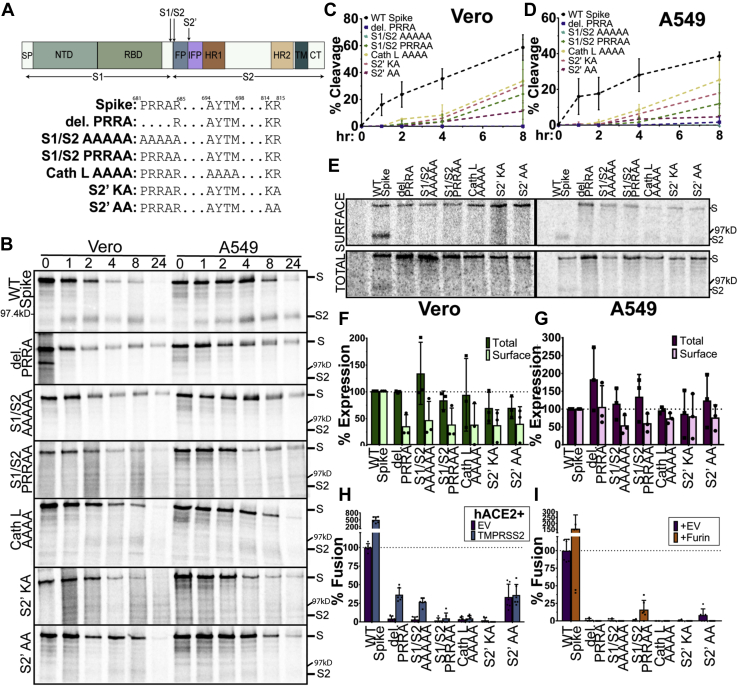
The trimeric severe acute respiratory syndrome coronavirus 2 (SARS-CoV-2) spike protein (S) is the sole viral protein responsible for both viral binding to a host cell and the membrane fusion event needed for cell entry. In addition to facilitating fusion needed for viral entry, S can also drive cell-cell fusion, a pathogenic effect observed in the lungs of SARS-CoV-2-infected patients. While several studies have investigated S requirements involved in viral particle entry, examination of S stability and factors involved in S cell-cell fusion remain limited. A furin cleavage site at the border between the S1 and S2 subunits (S1/S2) has been identified, along with putative cathepsin L and transmembrane serine protease 2 cleavage sites within S2. We demonstrate that S must be processed at the S1/S2 border in order to mediate cell-cell fusion and that mutations at potential cleavage sites within the S2 subunit alter S processing at the S1/S2 border, thus preventing cell-cell fusion. We also identify residues within the internal fusion peptide and the cytoplasmic tail that modulate S-mediated cell-cell fusion. In addition, we examined S stability and protein cleavage kinetics in a variety of mammalian cell lines, including a bat cell line related to the likely reservoir species for SARS-CoV-2, and provide evidence that proteolytic processing alters the stability of the S trimer. This work therefore offers insight into S stability, proteolytic processing, and factors that mediate S cell-cell fusion, all of which help give a more comprehensive understanding of this high-profile therapeutic target.
三聚体严重急性呼吸综合征冠状病毒 2(SARS-CoV-2)刺突蛋白(S)是唯一负责病毒与宿主细胞结合以及膜融合事件以实现细胞进入的病毒蛋白。除了促进病毒进入所需的融合外,S 还可以驱动细胞-细胞融合,这是在 SARS-CoV-2 感染患者肺部观察到的一种致病效应。虽然已经有几项研究调查了病毒粒子进入所需的 S 要求,但对 S 稳定性和参与 S 细胞-细胞融合的因素的检查仍然有限。在 S1 和 S2 亚基(S1/S2)之间的边界处发现了一个弗林蛋白酶切割位点,以及 S2 内潜在的组织蛋白酶 L 和跨膜丝氨酸蛋白酶 2 切割位点。我们证明,S 必须在 S1/S2 边界处进行加工才能介导细胞-细胞融合,并且 S2 亚基内潜在切割位点的突变改变了 S 在 S1/S2 边界处的加工,从而阻止了细胞-细胞融合。我们还确定了内部融合肽和细胞质尾部内调节 S 介导的细胞-细胞融合的残基。此外,我们在各种哺乳动物细胞系中检查了 S 的稳定性和蛋白切割动力学,包括与 SARS-CoV-2 可能的储存物种有关的蝙蝠细胞系,并提供了证据表明蛋白水解加工改变了 S 三聚体的稳定性。因此,这项工作深入了解了 S 的稳定性、蛋白水解加工以及介导 S 细胞-细胞融合的因素,所有这些都有助于更全面地了解这一备受瞩目的治疗靶点。