Reiter Andrea M F, Moutoussis Michael, Vanes Lucy, Kievit Rogier, Bullmore Edward T, Goodyer Ian M, Fonagy Peter, Jones Peter B, Dolan Raymond J
Max Planck UCL Centre for Computational Psychiatry and Ageing Research, University College London, London, UK.
Wellcome Centre for Human Neuroimaging, University College London, London, UK.
Nat Commun. 2021 Jun 22;12(1):3823. doi: 10.1038/s41467-021-23671-2.
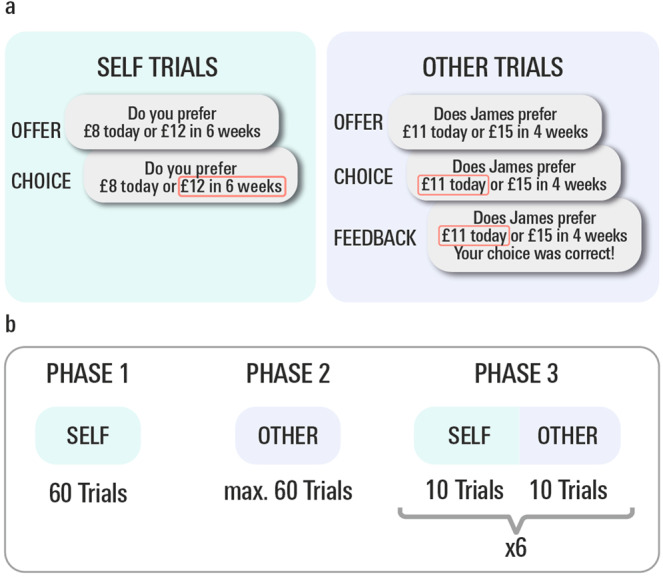
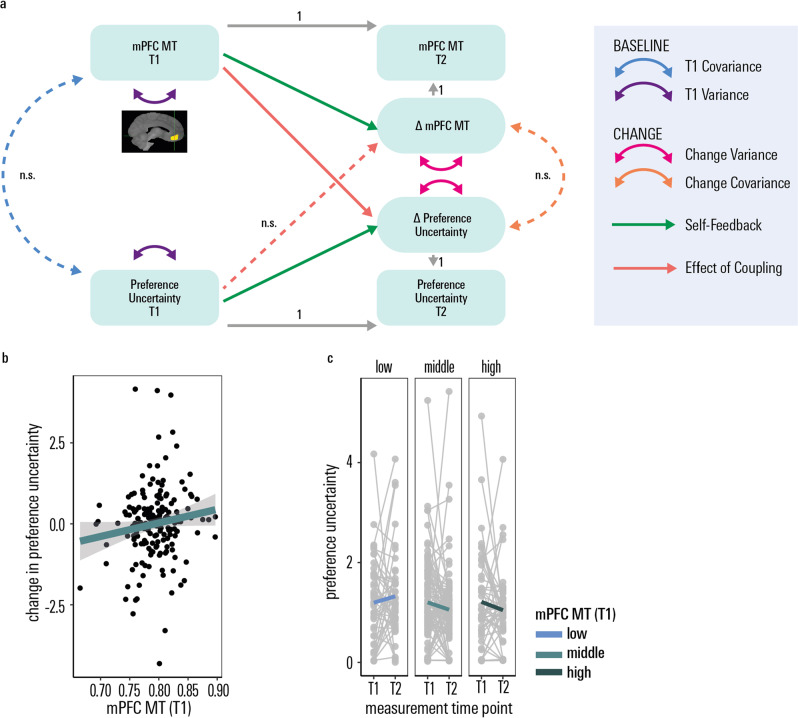
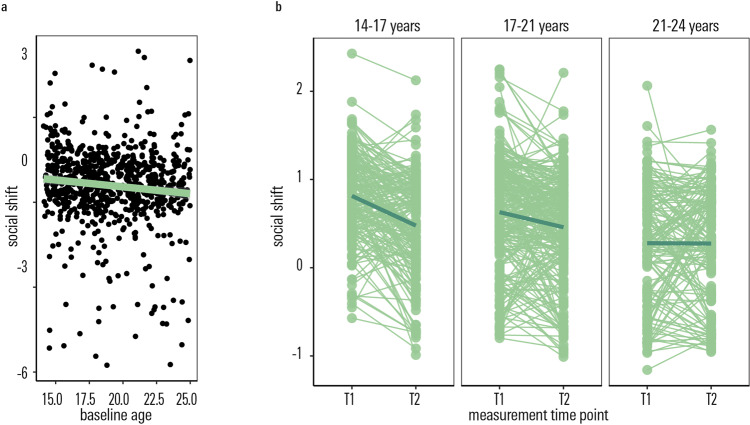
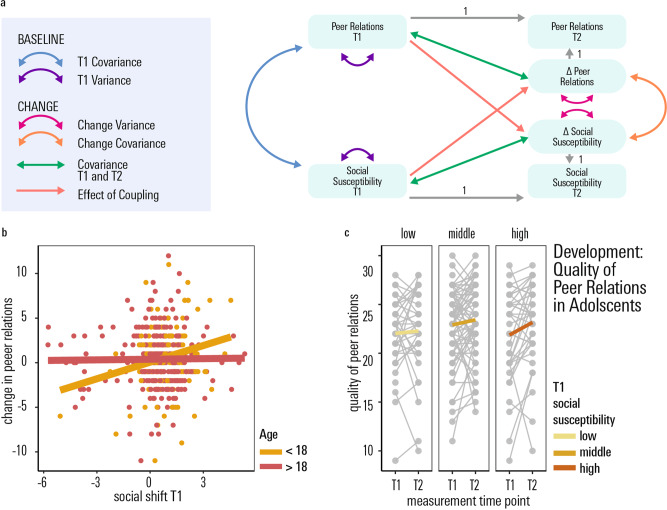
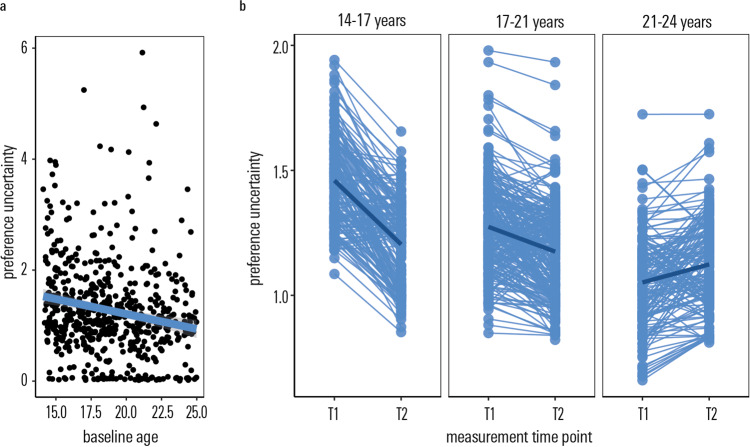
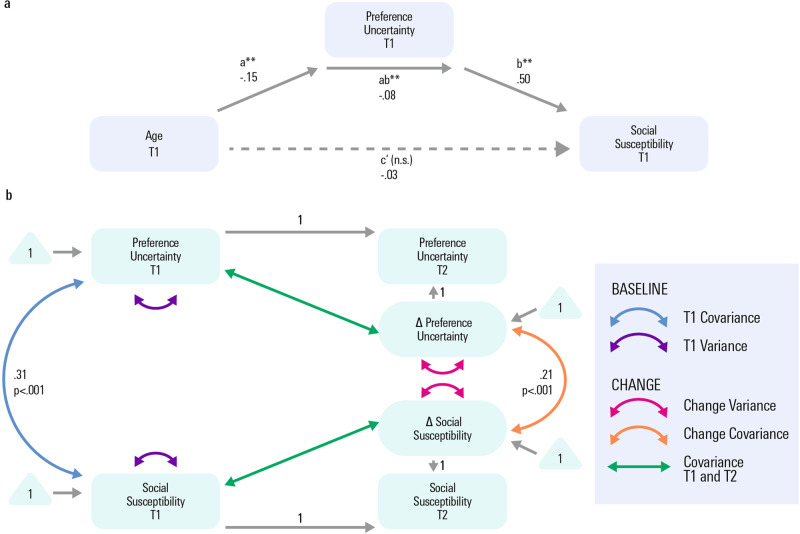
Adolescents are prone to social influence from peers, with implications for development, both adaptive and maladaptive. Here, using a computer-based paradigm, we replicate a cross-sectional effect of more susceptibility to peer influence in a large dataset of adolescents 14 to 24 years old. Crucially, we extend this finding by adopting a longitudinal perspective, showing that a within-person susceptibility to social influence decreases over a 1.5 year follow-up time period. Exploiting this longitudinal design, we show that susceptibility to social influences at baseline predicts an improvement in peer relations over the follow-up period. Using a Bayesian computational model, we demonstrate that in younger adolescents a greater tendency to adopt others' preferences arises out of a higher uncertainty about their own preferences in the paradigmatic case of delay discounting (a phenomenon called 'preference uncertainty'). This preference uncertainty decreases over time and, in turn, leads to a reduced susceptibility of one's own behaviour to an influence from others. Neuro-developmentally, we show that a measure of myelination within medial prefrontal cortex, estimated at baseline, predicts a developmental decrease in preference uncertainty at follow-up. Thus, using computational and neural evidence, we reveal adaptive mechanisms underpinning susceptibility to social influence during adolescence.
青少年容易受到同伴的社会影响,这对其发展有着适应性和适应不良两方面的影响。在此,我们使用基于计算机的范式,在一个包含14至24岁青少年的大型数据集中重现了对同伴影响更易感性的横断面效应。至关重要的是,我们通过采用纵向视角扩展了这一发现,表明在1.5年的随访时间段内,个体对社会影响的易感性会降低。利用这种纵向设计,我们表明基线时对社会影响的易感性可预测随访期间同伴关系的改善。使用贝叶斯计算模型,我们证明在较年轻的青少年中,在典型的延迟折扣案例(一种称为“偏好不确定性”的现象)中,由于对自身偏好的更高不确定性,导致更倾向于采纳他人偏好。这种偏好不确定性会随着时间降低,进而导致个体行为受他人影响的易感性降低。在神经发育方面,我们表明在基线时估计的内侧前额叶皮质髓鞘形成指标可预测随访时偏好不确定性的发育性降低。因此,通过计算和神经学证据,我们揭示了青春期对社会影响易感性背后的适应性机制。