Department of Forensic and Neurodevelopmental Sciences, Institute of Psychiatry, Psychology & Neuroscience, King's College London, London, United Kingdom.
Institute of Systems Neuroscience, University Medical Center Hamburg-Eppendorf, Hamburg, Germany.
PLoS Biol. 2020 Oct 27;18(10):e3000908. doi: 10.1371/journal.pbio.3000908. eCollection 2020 Oct.
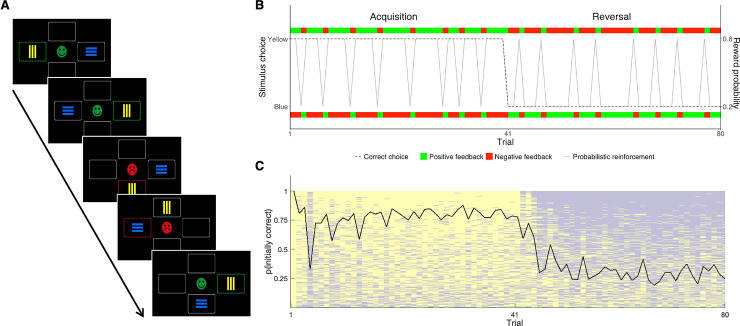
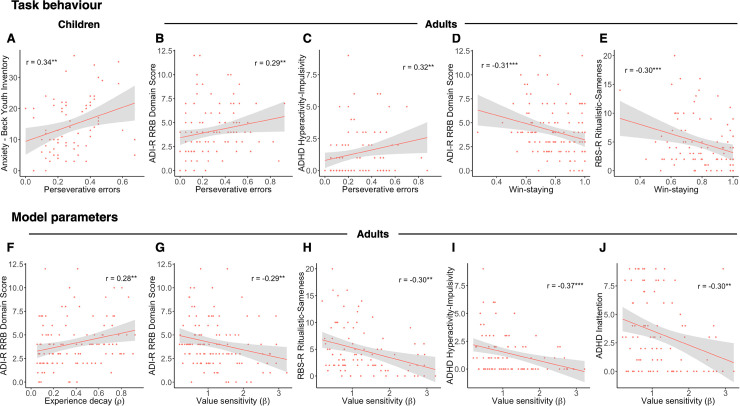
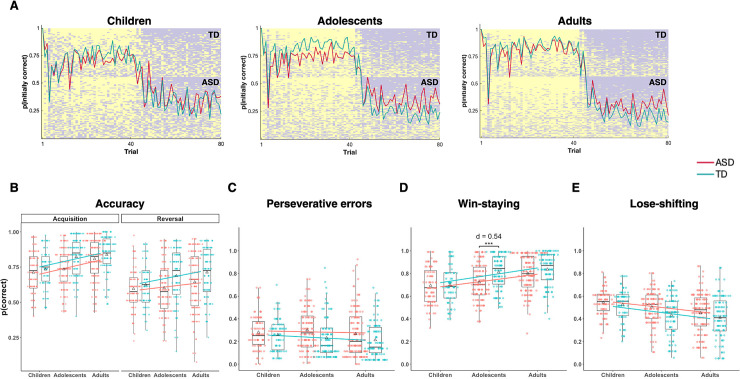
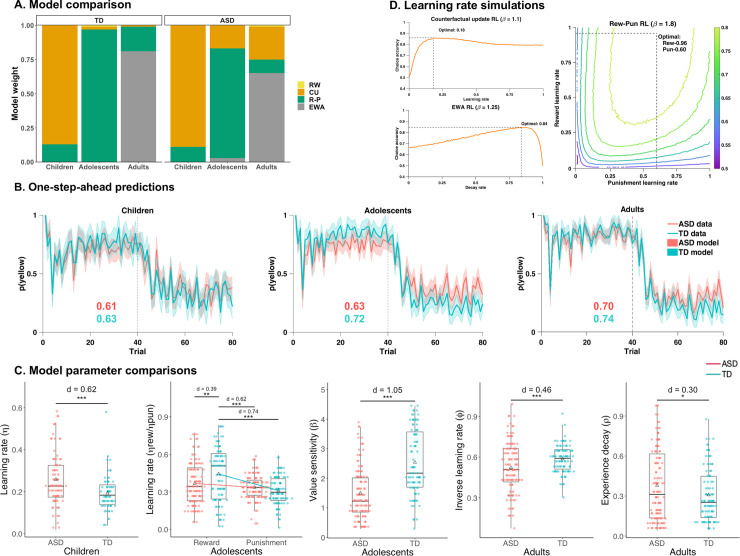
Flexible behavior is critical for everyday decision-making and has been implicated in restricted, repetitive behaviors (RRB) in autism spectrum disorder (ASD). However, how flexible behavior changes developmentally in ASD remains largely unknown. Here, we used a developmental approach and examined flexible behavior on a probabilistic reversal learning task in 572 children, adolescents, and adults (ASD N = 321; typical development [TD] N = 251). Using computational modeling, we quantified latent variables that index mechanisms underlying perseveration and feedback sensitivity. We then assessed these variables in relation to diagnosis, developmental stage, core autism symptomatology, and associated psychiatric symptoms. Autistic individuals showed on average more perseveration and less feedback sensitivity than TD individuals, and, across cases and controls, older age groups showed more feedback sensitivity than younger age groups. Computational modeling revealed that dominant learning mechanisms underpinning flexible behavior differed across developmental stages and reduced flexible behavior in ASD was driven by less optimal learning on average within each age group. In autistic children, perseverative errors were positively related to anxiety symptoms, and in autistic adults, perseveration (indexed by both task errors and model parameter estimates) was positively related to RRB. These findings provide novel insights into reduced flexible behavior in relation to clinical symptoms in ASD.
灵活行为对于日常决策至关重要,并且与自闭症谱系障碍(ASD)中的受限、重复行为(RRB)有关。然而,ASD 中灵活行为如何随发育而变化在很大程度上尚不清楚。在这里,我们使用了一种发展方法,在 572 名儿童、青少年和成年人(ASD N = 321;典型发育 [TD] N = 251)中检查了概率反转学习任务上的灵活行为。我们使用计算模型量化了索引坚持和反馈敏感性背后机制的潜在变量。然后,我们评估了这些变量与诊断、发育阶段、核心自闭症症状和相关精神症状的关系。与 TD 个体相比,自闭症个体平均表现出更多的坚持和更少的反馈敏感性,并且在所有病例和对照组中,年龄较大的组比年龄较小的组表现出更高的反馈敏感性。计算模型表明,支撑灵活行为的主导学习机制因发育阶段而异,并且 ASD 中灵活行为的减少是由每个年龄组中平均学习效果不佳驱动的。在自闭症儿童中,坚持性错误与焦虑症状呈正相关,而在自闭症成人中,坚持性(由任务错误和模型参数估计共同索引)与 RRB 呈正相关。这些发现为 ASD 中与临床症状相关的灵活行为减少提供了新的见解。