Ruan Hao, Yu Chen, Niu Xiaogang, Zhang Weilin, Liu Hanzhong, Chen Limin, Xiong Ruoyao, Sun Qi, Jin Changwen, Liu Ying, Lai Luhua
BNLMS, State Key Laboratory for Structural Chemistry of Unstable and Stable Species, College of Chemistry and Molecular Engineering, Peking University Beijing 100871 China
College of Chemistry and Molecular Engineering, Peking University Beijing 100871 China.
Chem Sci. 2020 Dec 28;12(8):3004-3016. doi: 10.1039/d0sc04670a.
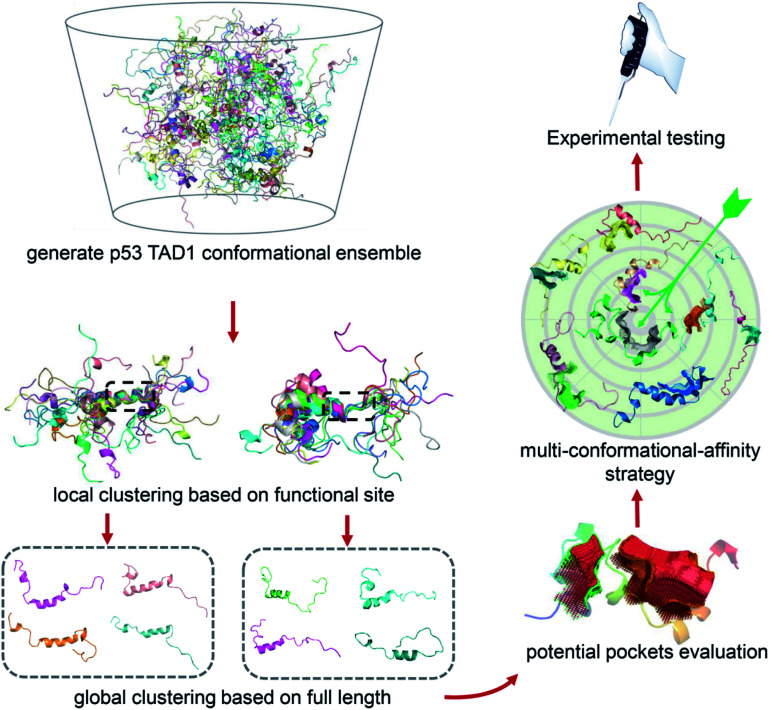
Intrinsically disordered proteins or intrinsically disordered regions (IDPs) have gained much attention in recent years due to their vital roles in biology and prevalence in various human diseases. Although IDPs are perceived as attractive therapeutic targets, rational drug design targeting IDPs remains challenging because of their conformational heterogeneity. Here, we propose a hierarchical computational strategy for IDP drug virtual screening (IDPDVS) and applied it in the discovery of p53 transactivation domain I (TAD1) binding compounds. IDPDVS starts from conformation sampling of the IDP target, then it combines stepwise conformational clustering with druggability evaluation to identify potential ligand binding pockets, followed by multiple docking screening runs and selection of compounds that can bind multi-conformations. p53 is an important tumor suppressor and restoration of its function provides an opportunity to inhibit cancer cell growth. TAD1 locates at the N-terminus of p53 and plays key roles in regulating p53 function. No compounds that directly bind to TAD1 have been reported due to its highly disordered structure. We successfully used IDPDVS to identify two compounds that bind p53 TAD1 and restore wild-type p53 function in cancer cells. Our study demonstrates that IDPDVS is an efficient strategy for IDP drug discovery and p53 TAD1 can be directly targeted by small molecules.
近年来,内在无序蛋白质或内在无序区域(IDP)因其在生物学中的重要作用以及在各种人类疾病中的普遍性而备受关注。尽管IDP被视为有吸引力的治疗靶点,但由于其构象异质性,针对IDP的合理药物设计仍然具有挑战性。在此,我们提出了一种用于IDP药物虚拟筛选(IDPDVS)的分层计算策略,并将其应用于发现p53反式激活结构域I(TAD1)结合化合物。IDPDVS从IDP靶点的构象采样开始,然后将逐步构象聚类与成药性评估相结合,以识别潜在的配体结合口袋,接着进行多次对接筛选运行,并选择能够结合多种构象的化合物。p53是一种重要的肿瘤抑制因子,其功能的恢复为抑制癌细胞生长提供了机会。TAD1位于p53的N端,在调节p53功能中起关键作用。由于其高度无序的结构,尚未有直接与TAD1结合的化合物被报道。我们成功地使用IDPDVS鉴定出两种与p53 TAD1结合并在癌细胞中恢复野生型p53功能的化合物。我们的研究表明,IDPDVS是一种用于IDP药物发现的有效策略,并且p53 TAD1可以被小分子直接靶向。