• 文献检索
  • 文档翻译
  • 深度研究
  • 学术资讯
  • Suppr Zotero 插件Zotero 插件
  • 邀请有礼
  • 套餐&价格
  • 历史记录
应用&插件
Suppr Zotero 插件Zotero 插件浏览器插件Mac 客户端Windows 客户端微信小程序
定价
高级版会员购买积分包购买API积分包
服务
文献检索文档翻译深度研究API 文档MCP 服务
关于我们
关于 Suppr公司介绍联系我们用户协议隐私条款
关注我们

Suppr 超能文献

核心技术专利:CN118964589B侵权必究
粤ICP备2023148730 号-1Suppr @ 2026

文献检索

告别复杂PubMed语法,用中文像聊天一样搜索,搜遍4000万医学文献。AI智能推荐,让科研检索更轻松。

立即免费搜索

文件翻译

保留排版,准确专业,支持PDF/Word/PPT等文件格式,支持 12+语言互译。

免费翻译文档

深度研究

AI帮你快速写综述,25分钟生成高质量综述,智能提取关键信息,辅助科研写作。

立即免费体验

逆合成可及性分数(RAscore)——基于人工智能驱动的逆合成规划的快速机器学习合成性分类。

Retrosynthetic accessibility score (RAscore) - rapid machine learned synthesizability classification from AI driven retrosynthetic planning.

作者信息

Thakkar Amol, Chadimová Veronika, Bjerrum Esben Jannik, Engkvist Ola, Reymond Jean-Louis

机构信息

Hit Discovery, Discovery Sciences, R&D, AstraZeneca Gothenburg 431 50 Sweden

Department of Chemistry and Biochemistry, University of Bern Bern CH-3012 Switzerland

出版信息

Chem Sci. 2021 Jan 22;12(9):3339-3349. doi: 10.1039/d0sc05401a.

DOI:10.1039/d0sc05401a
PMID:34164104
原文链接:https://pmc.ncbi.nlm.nih.gov/articles/PMC8179384/
Abstract

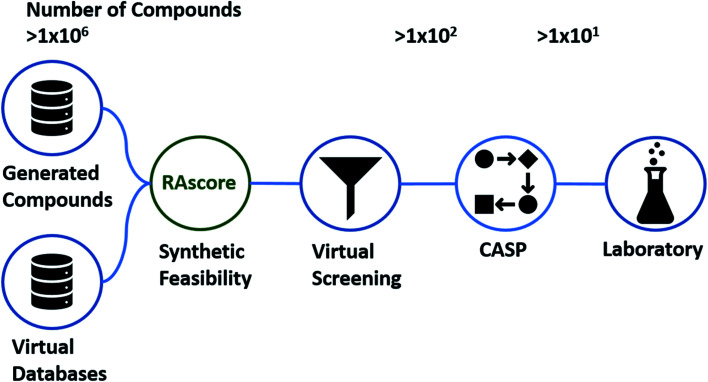
Computer aided synthesis planning (CASP) is part of a suite of artificial intelligence (AI) based tools that are able to propose synthesis routes to a wide range of compounds. However, at present they are too slow to be used to screen the synthetic feasibility of millions of generated or enumerated compounds before identification of potential bioactivity by virtual screening (VS) workflows. Herein we report a machine learning (ML) based method capable of classifying whether a synthetic route can be identified for a particular compound or not by the CASP tool AiZynthFinder. The resulting ML models return a retrosynthetic accessibility score (RAscore) of any molecule of interest, and computes at least 4500 times faster than retrosynthetic analysis performed by the underlying CASP tool. The RAscore should be useful for pre-screening millions of virtual molecules from enumerated databases or generative models for synthetic accessibility and produce higher quality databases for virtual screening of biological activity.

摘要

计算机辅助合成规划(CASP)是一套基于人工智能(AI)的工具的一部分,这些工具能够为多种化合物提出合成路线。然而,目前它们速度太慢,无法在通过虚拟筛选(VS)工作流程识别潜在生物活性之前,用于筛选数百万个生成或枚举化合物的合成可行性。在此,我们报告一种基于机器学习(ML)的方法,该方法能够通过CASP工具AiZynthFinder对特定化合物是否可以确定合成路线进行分类。所得的ML模型返回任何感兴趣分子的逆合成可及性分数(RAscore),并且计算速度比底层CASP工具进行的逆合成分析快至少4500倍。RAscore对于从枚举数据库或生成模型中预筛选数百万个虚拟分子的合成可及性应该是有用的,并为生物活性的虚拟筛选生成更高质量的数据库。
https://cdn.ncbi.nlm.nih.gov/pmc/blobs/3357/8179384/f6da9e9e2542/d0sc05401a-f7.jpg
https://cdn.ncbi.nlm.nih.gov/pmc/blobs/3357/8179384/e8f9d7d204ab/d0sc05401a-f1.jpg
https://cdn.ncbi.nlm.nih.gov/pmc/blobs/3357/8179384/0478227a4a46/d0sc05401a-f2.jpg
https://cdn.ncbi.nlm.nih.gov/pmc/blobs/3357/8179384/e902c724b1e8/d0sc05401a-f3.jpg
https://cdn.ncbi.nlm.nih.gov/pmc/blobs/3357/8179384/50f050bda338/d0sc05401a-f4.jpg
https://cdn.ncbi.nlm.nih.gov/pmc/blobs/3357/8179384/e81470fcf5e9/d0sc05401a-f5.jpg
https://cdn.ncbi.nlm.nih.gov/pmc/blobs/3357/8179384/b6cd87d636f6/d0sc05401a-f6.jpg
https://cdn.ncbi.nlm.nih.gov/pmc/blobs/3357/8179384/f6da9e9e2542/d0sc05401a-f7.jpg
https://cdn.ncbi.nlm.nih.gov/pmc/blobs/3357/8179384/e8f9d7d204ab/d0sc05401a-f1.jpg
https://cdn.ncbi.nlm.nih.gov/pmc/blobs/3357/8179384/0478227a4a46/d0sc05401a-f2.jpg
https://cdn.ncbi.nlm.nih.gov/pmc/blobs/3357/8179384/e902c724b1e8/d0sc05401a-f3.jpg
https://cdn.ncbi.nlm.nih.gov/pmc/blobs/3357/8179384/50f050bda338/d0sc05401a-f4.jpg
https://cdn.ncbi.nlm.nih.gov/pmc/blobs/3357/8179384/e81470fcf5e9/d0sc05401a-f5.jpg
https://cdn.ncbi.nlm.nih.gov/pmc/blobs/3357/8179384/b6cd87d636f6/d0sc05401a-f6.jpg
https://cdn.ncbi.nlm.nih.gov/pmc/blobs/3357/8179384/f6da9e9e2542/d0sc05401a-f7.jpg

相似文献

1
Retrosynthetic accessibility score (RAscore) - rapid machine learned synthesizability classification from AI driven retrosynthetic planning.逆合成可及性分数(RAscore)——基于人工智能驱动的逆合成规划的快速机器学习合成性分类。
Chem Sci. 2021 Jan 22;12(9):3339-3349. doi: 10.1039/d0sc05401a.
2
Integrating synthetic accessibility with AI-based generative drug design.将合成可及性与基于人工智能的生成式药物设计相结合。
J Cheminform. 2023 Sep 19;15(1):83. doi: 10.1186/s13321-023-00742-8.
3
Critical assessment of synthetic accessibility scores in computer-assisted synthesis planning.计算机辅助合成规划中合成可及性分数的批判性评估
J Cheminform. 2023 Jan 14;15(1):6. doi: 10.1186/s13321-023-00678-z.
4
Machine Learning in Computer-Aided Synthesis Planning.计算机辅助合成规划中的机器学习
Acc Chem Res. 2018 May 15;51(5):1281-1289. doi: 10.1021/acs.accounts.8b00087. Epub 2018 May 1.
5
DFRscore: Deep Learning-Based Scoring of Synthetic Complexity with Drug-Focused Retrosynthetic Analysis for High-Throughput Virtual Screening.DFRscore:基于深度学习的药物靶向反合成分析合成复杂度评分方法,用于高通量虚拟筛选。
J Chem Inf Model. 2024 Apr 8;64(7):2432-2444. doi: 10.1021/acs.jcim.3c01134. Epub 2023 Aug 31.
6
Enhancing Retrosynthetic Reaction Prediction with Deep Learning Using Multiscale Reaction Classification.利用多尺度反应分类增强深度学习的逆合成反应预测
J Chem Inf Model. 2019 Feb 25;59(2):673-688. doi: 10.1021/acs.jcim.8b00801. Epub 2019 Feb 1.
7
AI-Driven Synthetic Route Design Incorporated with Retrosynthesis Knowledge.人工智能驱动的合成路线设计与反合成知识相结合。
J Chem Inf Model. 2022 Mar 28;62(6):1357-1367. doi: 10.1021/acs.jcim.1c01074. Epub 2022 Mar 8.
8
Automatic retrosynthetic route planning using template-free models.使用无模板模型的自动逆合成路线规划。
Chem Sci. 2020 Mar 3;11(12):3355-3364. doi: 10.1039/c9sc03666k.
9
Applications of Artificial Intelligence in Drug Design: Opportunities and Challenges.人工智能在药物设计中的应用:机遇与挑战。
Methods Mol Biol. 2022;2390:1-59. doi: 10.1007/978-1-0716-1787-8_1.
10
Planning chemical syntheses with deep neural networks and symbolic AI.用深度神经网络和符号人工智能规划化学合成。
Nature. 2018 Mar 28;555(7698):604-610. doi: 10.1038/nature25978.

引用本文的文献

1
Identification of nanomolar adenosine A receptor ligands using reinforcement learning and structure-based drug design.利用强化学习和基于结构的药物设计鉴定纳摩尔级别的腺苷 A 受体配体。
Nat Commun. 2025 Jul 1;16(1):5485. doi: 10.1038/s41467-025-60629-0.
2
SAVI Space-combinatorial encoding of the billion-size synthetically accessible virtual inventory.SAVI:十亿规模可合成获取虚拟库的空间组合编码
Sci Data. 2025 Jun 23;12(1):1064. doi: 10.1038/s41597-025-05384-z.
3
Guided multi-objective generative AI to enhance structure-based drug design.

本文引用的文献

1
SYBA: Bayesian estimation of synthetic accessibility of organic compounds.SYBA:有机化合物合成可及性的贝叶斯估计
J Cheminform. 2020 May 20;12(1):35. doi: 10.1186/s13321-020-00439-2.
2
Molecular Sets (MOSES): A Benchmarking Platform for Molecular Generation Models.分子集(MOSES):分子生成模型的基准测试平台。
Front Pharmacol. 2020 Dec 18;11:565644. doi: 10.3389/fphar.2020.565644. eCollection 2020.
3
AiZynthFinder: a fast, robust and flexible open-source software for retrosynthetic planning.人工智能合成路线搜索工具(AiZynthFinder):一款用于逆合成规划的快速、强大且灵活的开源软件。
引导式多目标生成式人工智能增强基于结构的药物设计。
Chem Sci. 2025 May 29. doi: 10.1039/d5sc01778e.
4
From Patterns to Pills: How Informatics Is Shaping Medicinal Chemistry.从模式到药丸:信息学如何塑造药物化学
Pharmaceutics. 2025 May 5;17(5):612. doi: 10.3390/pharmaceutics17050612.
5
A View on Molecular Complexity from the GDB Chemical Space.从GDB化学空间看分子复杂性
J Chem Inf Model. 2025 Aug 25;65(16):8405-8410. doi: 10.1021/acs.jcim.5c00334. Epub 2025 May 15.
6
Integrating Pharmacokinetics and Quantitative Systems Pharmacology Approaches in Generative Drug Design.在生成式药物设计中整合药代动力学和定量系统药理学方法。
J Chem Inf Model. 2025 May 26;65(10):4783-4796. doi: 10.1021/acs.jcim.5c00107. Epub 2025 May 9.
7
MolSnapper: Conditioning Diffusion for Structure-Based Drug Design.MolSnapper:基于结构的药物设计中的条件扩散
J Chem Inf Model. 2025 May 12;65(9):4263-4273. doi: 10.1021/acs.jcim.4c02008. Epub 2025 Apr 18.
8
Generate what you can make: achieving in-house synthesizability with readily available resources in de novo drug design.利用现有资源实现从头药物设计中的内部合成可行性:生成你所能制备的物质。
J Cheminform. 2025 Mar 28;17(1):41. doi: 10.1186/s13321-024-00910-4.
9
Directly optimizing for synthesizability in generative molecular design using retrosynthesis models.利用逆合成模型在生成式分子设计中直接优化可合成性。
Chem Sci. 2025 Mar 21;16(16):6943-6956. doi: 10.1039/d5sc01476j. eCollection 2025 Apr 16.
10
Spectra-descriptor-based machine learning for predicting protein-ligand interactions.基于光谱描述符的机器学习用于预测蛋白质-配体相互作用。
Chem Sci. 2025 Mar 13;16(15):6355-6365. doi: 10.1039/d5sc00451a. eCollection 2025 Apr 9.
J Cheminform. 2020 Nov 17;12(1):70. doi: 10.1186/s13321-020-00472-1.
4
REINVENT 2.0: An AI Tool for De Novo Drug Design.REINVENT 2.0:一种用于从头设计药物的人工智能工具。
J Chem Inf Model. 2020 Dec 28;60(12):5918-5922. doi: 10.1021/acs.jcim.0c00915. Epub 2020 Oct 29.
5
Computational planning of the synthesis of complex natural products.复杂天然产物合成的计算规划。
Nature. 2020 Dec;588(7836):83-88. doi: 10.1038/s41586-020-2855-y. Epub 2020 Oct 13.
6
The Synthesizability of Molecules Proposed by Generative Models.生成式模型提出的分子可合成性。
J Chem Inf Model. 2020 Dec 28;60(12):5714-5723. doi: 10.1021/acs.jcim.0c00174. Epub 2020 Apr 17.
7
Current and Future Roles of Artificial Intelligence in Medicinal Chemistry Synthesis.人工智能在药物化学合成中的当前和未来作用。
J Med Chem. 2020 Aug 27;63(16):8667-8682. doi: 10.1021/acs.jmedchem.9b02120. Epub 2020 Apr 14.
8
ChEMBL-Likeness Score and Database GDBChEMBL.ChEMBL类药性评分与数据库GDBChEMBL
Front Chem. 2020 Feb 4;8:46. doi: 10.3389/fchem.2020.00046. eCollection 2020.
9
Datasets and their influence on the development of computer assisted synthesis planning tools in the pharmaceutical domain.数据集及其对制药领域计算机辅助合成规划工具发展的影响。
Chem Sci. 2019 Nov 5;11(1):154-168. doi: 10.1039/c9sc04944d. eCollection 2020 Jan 7.
10
De novo generation of hit-like molecules from gene expression signatures using artificial intelligence.利用人工智能从基因表达特征生成类似命中的新分子。
Nat Commun. 2020 Jan 3;11(1):10. doi: 10.1038/s41467-019-13807-w.