Department of Nursing, Maternal Health Nursing, College of Medical Sciences, Kathmandu University, Chitwan, Nepal.
Department of Nursing, Medical-Surgical Nursing, Manmohan Memorial Institute of Health Sciences, Tribhuvan University, Kathmandu, Nepal.
PLoS One. 2021 Jun 24;16(6):e0253651. doi: 10.1371/journal.pone.0253651. eCollection 2021.
In present days, the use of information technology (IT) in education is unquestionable. The mounting advancement of IT has changed the scenario of education. With the emergence of the current COVID-19 situation, it has undoubtedly provided a solution to most of our educational needs when all educational institutions remained closed due to the pandemic. This study aims to identify the nursing students' attitude towards the practice of e-learning amidst COVID-19.
A descriptive web-based cross-sectional study was conducted among nursing students with a sample size of 470. A self-administered validated questionnaire along with a standard tool to measure the attitude was used for data collection. Data were analyzed using SPSS.
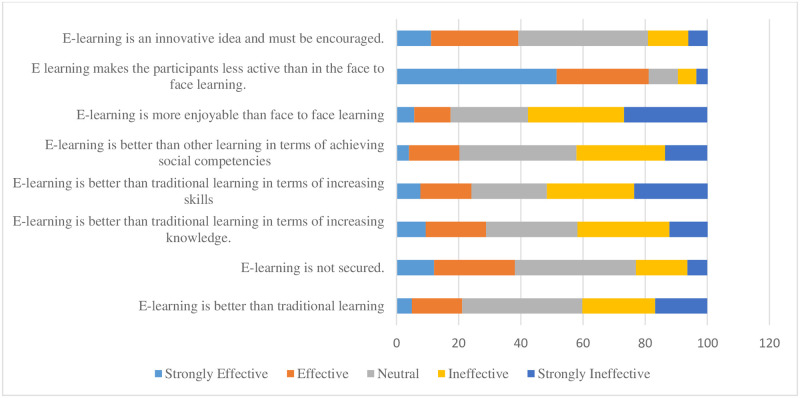
The mean ± SD age of the respondents was 20.91± 1.55 years. The majority (76.4%) of the respondents used mobile for their study and 90.4% used Wi-Fi for the internet source. The main advantage of e-learning was stated as the ability to stay at home (72.1%) followed by the reduced cost of accommodation and transport (51.3%) whereas the internet problem (81.7%) was the major disadvantage followed by technical issues (65.5%). Only about 34% of the students found e-learning as effective as traditional face-to-face learning. The mean scores for the domains: perceived usefulness, intention to adapt, distant use of e-learning, ease of learning, technical support, and learning stressors were 3.1, 3.1, 3.8, 2.9, 2.9, and 2.5 respectively. Overall, 58.9% had a favorable attitude regarding e-learning. There was no significant association of overall attitude regarding e-learning with selected socio-demographic variables whereas it was positively associated with all of its six domains. All the domains were positively correlated with each other except for ease of learning with technical support and distant use, and technical support with learning stressor and distant use. Learning stressor versus distant use was negatively correlated with each other.
Though e-learning was implemented as a substitute during the pandemic, almost half of the nursing students showed a positive attitude regarding e-learning. The majority of the students had internet problems and technological issues. If e-learning can be made user-friendly with reduced technical barriers supplemented with programs that can enhance practical learning abilities, e-learning can be the vital alternative teaching method and learning in the nursing field.
如今,信息技术(IT)在教育中的应用是毋庸置疑的。IT 的飞速发展改变了教育的格局。随着当前 COVID-19 疫情的出现,当所有教育机构因疫情关闭时,它无疑为我们的大部分教育需求提供了一个解决方案。本研究旨在确定护理学生在 COVID-19 期间对电子学习实践的态度。
采用描述性网络横断面研究,对 470 名护理学生进行了样本量调查。使用自我管理的验证问卷和衡量态度的标准工具进行数据收集。使用 SPSS 进行数据分析。
受访者的平均年龄±标准差为 20.91±1.55 岁。大多数(76.4%)受访者使用手机进行学习,90.4%使用 Wi-Fi 作为互联网来源。电子学习的主要优势是能够呆在家里(72.1%),其次是住宿和交通费用的降低(51.3%),而互联网问题(81.7%)是最大的劣势,其次是技术问题(65.5%)。只有约 34%的学生认为电子学习与传统的面对面学习一样有效。对六个领域的感知有用性、适应意愿、远程使用电子学习、学习易用性、技术支持和学习压力的平均得分分别为 3.1、3.1、3.8、2.9、2.9 和 2.5。总体而言,58.9%的学生对电子学习持有利态度。电子学习的整体态度与所选社会人口统计学变量之间没有显著关联,而与六个领域中的所有领域都呈正相关。除了学习易用性与技术支持和远程使用、技术支持与学习压力和远程使用之外,所有领域之间均呈正相关。学习压力与远程使用之间呈负相关。
尽管电子学习是在大流行期间作为替代方案实施的,但近一半的护理学生对电子学习持积极态度。大多数学生都存在互联网问题和技术问题。如果电子学习能够通过减少技术障碍变得更加用户友好,并辅以可以提高实践学习能力的程序,那么电子学习可以成为护理领域重要的替代教学方法和学习方式。