Mock Andreas, Plath Michaela, Moratin Julius, Tapken Maria Johanna, Jäger Dirk, Krauss Jürgen, Fröhling Stefan, Hess Jochen, Zaoui Karim
Department of Medical Oncology, National Center for Tumor Diseases (NCT) Heidelberg, Heidelberg University Hospital, Heidelberg, Germany.
Division of Translational Medical Oncology, NCT Heidelberg, German Cancer Center (DKFZ), Heidelberg, Germany.
Front Oncol. 2021 Jun 11;11:678966. doi: 10.3389/fonc.2021.678966. eCollection 2021.
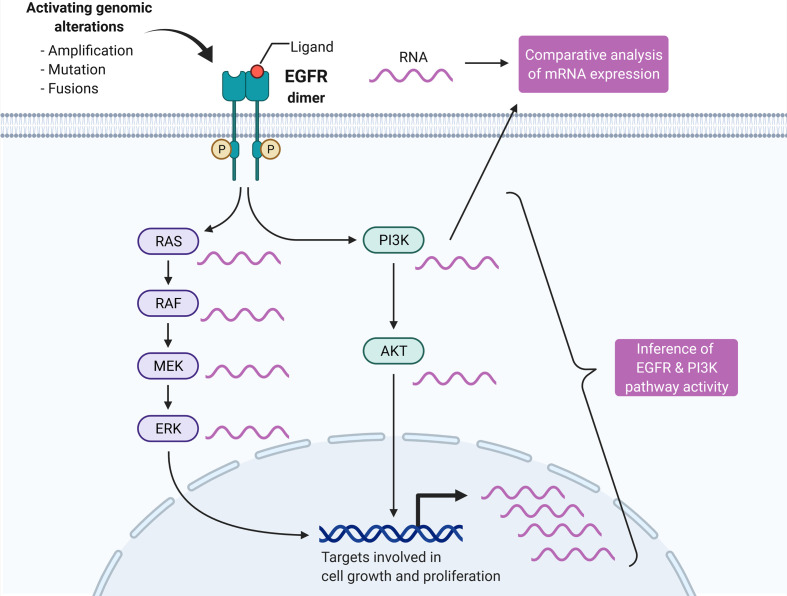
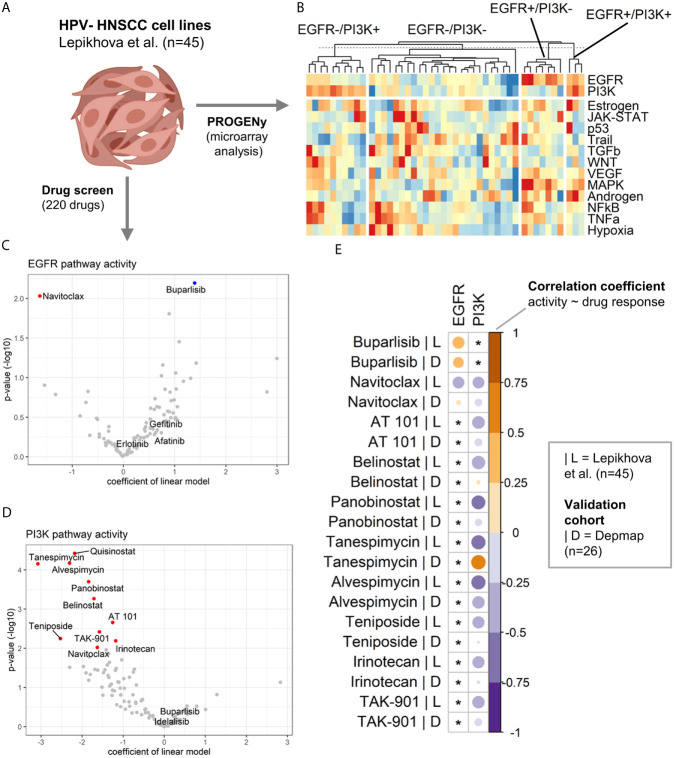
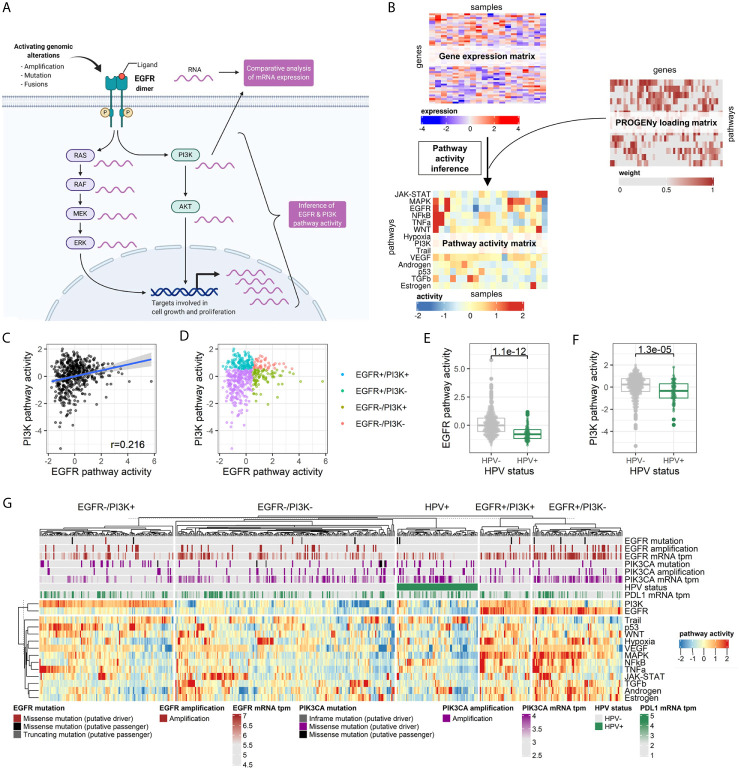
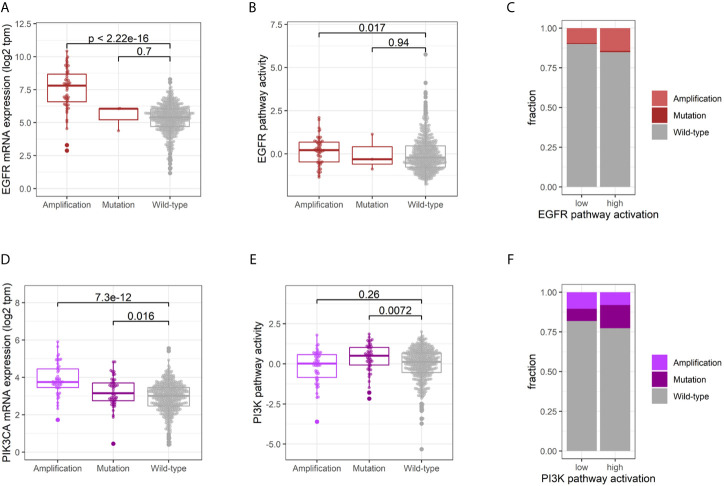
While genetic alterations in Epidermal growth factor receptor (EGFR) and PI3K are common in head and neck squamous cell carcinomas (HNSCC), their impact on oncogenic signaling and cancer drug sensitivities remains elusive. To determine their consequences on the transcriptional network, pathway activities of EGFR, PI3K, and 12 additional oncogenic pathways were inferred in 498 HNSCC samples of using PROGENy. More than half of HPV-negative HNSCC showed a pathway activation in EGFR or PI3K. An amplification in EGFR and a mutation in PI3KCA resulted in a significantly higher activity of the respective pathway (p = 0.017 and p = 0.007). Interestingly, both pathway activations could only be explained by genetic alterations in less than 25% of cases indicating additional molecular events involved in the downstream signaling. Suitable pathway models could be identified in a published drug screen of 45 HPV-negative HNSCC cell lines. An active EGFR pathway was predictive for the response to the PI3K inhibitor buparlisib (p = 6.36E-03) and an inactive EGFR and PI3K pathway was associated with efficacy of the B-cell lymphoma (BCL) inhibitor navitoclax (p = 9.26E-03). In addition, an inactive PI3K pathway correlated with a response to multiple Histone deacetylase inhibitor (HDAC) inhibitors. These findings require validation in preclinical models and clinical studies.
虽然表皮生长因子受体(EGFR)和PI3K的基因改变在头颈部鳞状细胞癌(HNSCC)中很常见,但其对致癌信号传导和癌症药物敏感性的影响仍不清楚。为了确定它们对转录网络的影响,使用PROGENy在498个HNSCC样本中推断了EGFR、PI3K和另外12条致癌途径的通路活性。超过一半的HPV阴性HNSCC显示出EGFR或PI3K通路激活。EGFR扩增和PI3KCA突变导致各自通路的活性显著更高(p = 0.017和p = 0.007)。有趣的是,在不到25%的病例中,两种通路激活只能由基因改变来解释,这表明下游信号传导涉及其他分子事件。在已发表的45个HPV阴性HNSCC细胞系的药物筛选中可以鉴定出合适的通路模型。活跃的EGFR通路可预测对PI3K抑制剂布帕利西布的反应(p = 6.36E - 03),而无活性的EGFR和PI3K通路与B细胞淋巴瘤(BCL)抑制剂纳维托克司的疗效相关(p = 9.26E - 03)。此外,无活性的PI3K通路与对多种组蛋白去乙酰化酶抑制剂(HDAC)的反应相关。这些发现需要在临床前模型和临床研究中进行验证。