Sun Li, Du Meijun, Kohli Manish, Huang Chiang-Ching, Chen Xiaoxiang, Xu Mu, Shen Hongbing, Wang Shukui, Wang Liang
Laboratory Medicine Center, the Second Affiliated Hospital, Nanjing Medical University, Nanjing, China.
Department of General Clinical Research Center, Nanjing First Hospital, Nanjing Medical University, Nanjing, China.
Front Oncol. 2021 Jun 11;11:691798. doi: 10.3389/fonc.2021.691798. eCollection 2021.
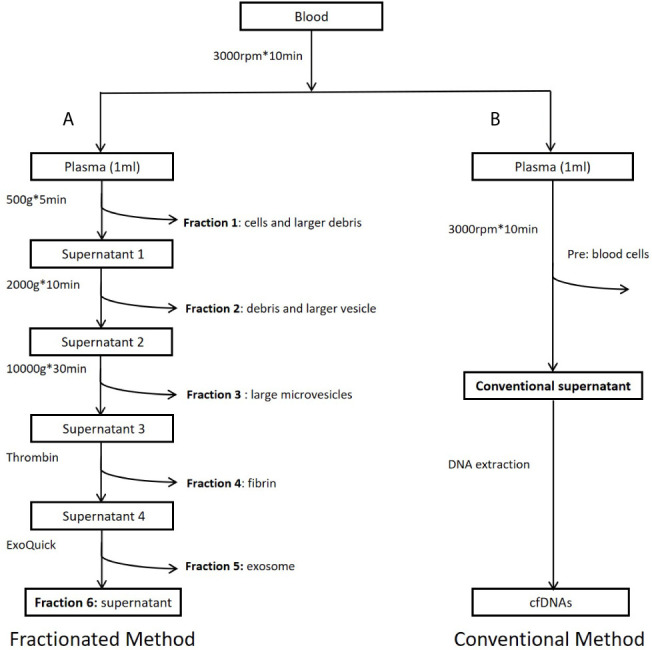
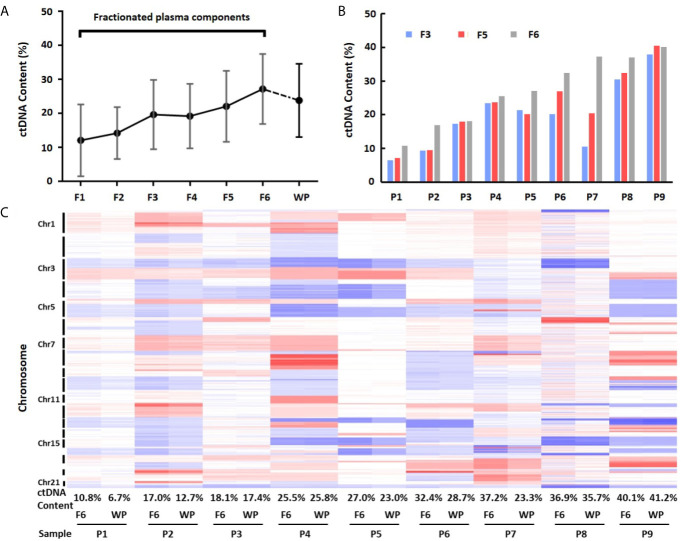
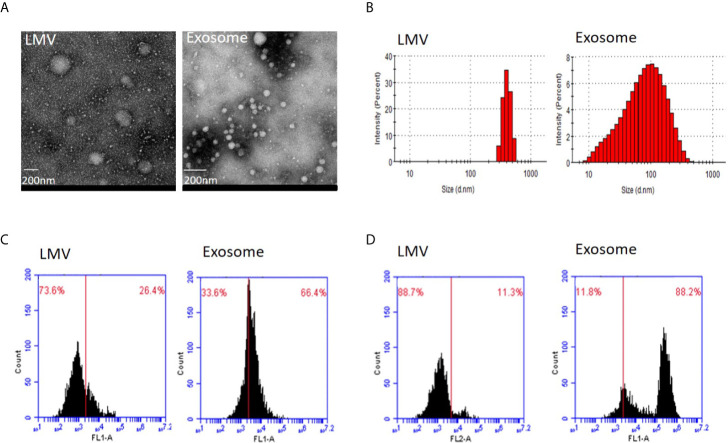
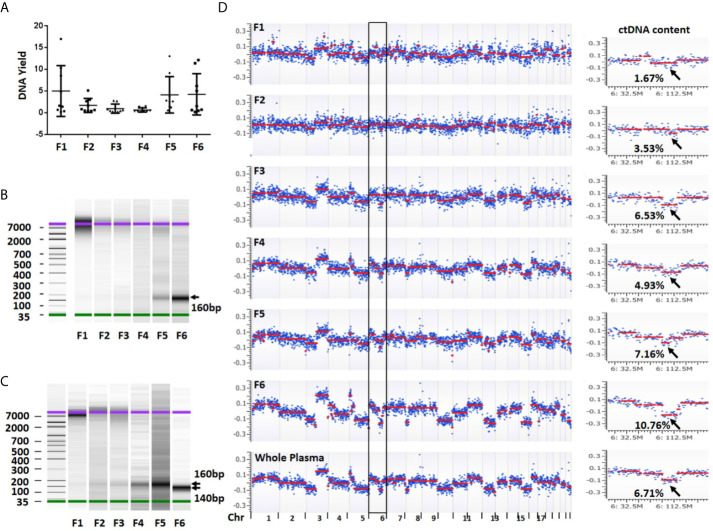
Circulating tumor DNA (ctDNA) in plasma has been used as a biomarker for cancer detection and outcome prediction. In this study, we collected the five precipitates (fractions 1-5) and leftover supernatant plasma component (fraction 6) by a sequential centrifugation in plasma samples from nine small cell lung cancer (SCLC) patients. The fractions 3, 5 and 6 were large vesicles, exosomes and extracellular vesicles (EVs)-depleted plasma, respectively. Fragment size analysis using DNAs from these fractions showed dramatical differences from a peak of 7-10 kb in fraction 1 to 140-160 bp in fraction 6. To determine ctDNA content, we performed whole genome sequencing and applied copy number-based algorithm to calculate ctDNA percentage. This analysis showed the highest ctDNA content in EV-depleted plasma (average = 27.22%), followed by exosomes (average = 22.09%) and large vesicles (average = 19.70%). Comparatively, whole plasma, which has been used in most ctDNA studies, showed an average of 23.84% ctDNA content in the same group of patients. To further demonstrate higher ctDNA content in fraction 6, we performed mutational analysis in the plasma samples from 22 non-small cell lung cancer (NSCLC) patients with known EGFR mutations. This analysis confirmed higher mutation detection rates in fraction 6 (14/22) than whole plasma (10/22). This study provides a new insight into potential application of using fractionated plasma for an improved ctDNA detection.
血浆中的循环肿瘤DNA(ctDNA)已被用作癌症检测和预后预测的生物标志物。在本研究中,我们通过对9例小细胞肺癌(SCLC)患者的血浆样本进行连续离心,收集了五个沉淀物(组分1-5)和剩余的上清血浆成分(组分6)。组分3、5和6分别为大囊泡、外泌体和无细胞外囊泡(EVs)的血浆。对这些组分的DNA进行片段大小分析,结果显示从组分1中7-10 kb的峰值到组分6中140-160 bp存在显著差异。为了确定ctDNA含量,我们进行了全基因组测序,并应用基于拷贝数的算法来计算ctDNA百分比。该分析显示,无细胞外囊泡的血浆中ctDNA含量最高(平均=27.22%),其次是外泌体(平均=22.09%)和大囊泡(平均=19.70%)。相比之下,大多数ctDNA研究中使用的全血浆在同一组患者中的ctDNA含量平均为23.84%。为了进一步证明组分6中ctDNA含量更高,我们对22例已知EGFR突变的非小细胞肺癌(NSCLC)患者的血浆样本进行了突变分析。该分析证实,组分6(14/22)中的突变检测率高于全血浆(10/22)。本研究为分级血浆在改善ctDNA检测中的潜在应用提供了新的见解。