Department of Hematology, Shanghai Jiao Tong University Affiliated Sixth People's Hospital, Shanghai, China.
Cell Death Dis. 2021 Jun 28;12(7):655. doi: 10.1038/s41419-021-03573-3.
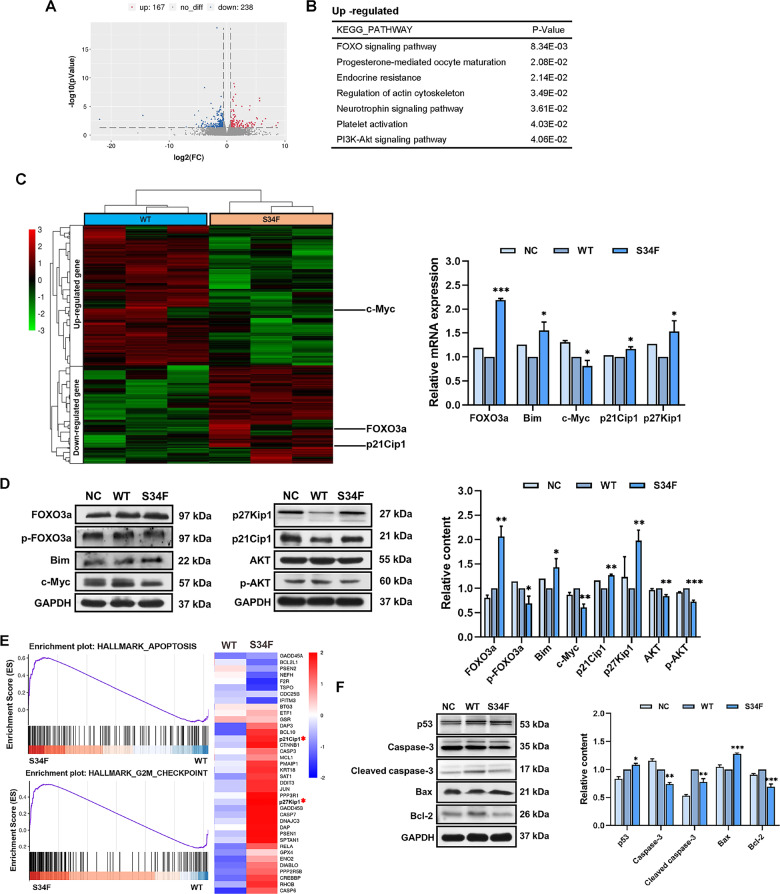
Mutations in the U2 small nuclear RNA auxiliary factor 1 (U2AF1) gene are the common feature of a major subset in myelodysplastic syndromes (MDS). However, the genetic landscape and molecular pathogenesis of oncogenic U2AF1 mutation in MDS are not totally understood. We performed comprehensive analysis for prognostic significance of U2AF1 mutations in acute myeloid leukemia (AML) cohort based on The Cancer Genome Atlas (TCGA) database. Functional analysis of U2AF1 mutation was performed in vitro. Differentially expressed genes (DEGs) and significantly enriched pathways were identified by RNA sequencing. The forkhead box protein O3a (FOXO3a) was investigated to mediate the function of U2AF1 mutation in cell models using lentivirus. Chromatin immunoprecipitation, immunoblotting analyses, and immunofluorescence assays were also conducted. U2AF1 mutations were associated with poor prognosis in MDS and AML samples, which significantly inhibited cell proliferation and induced cellular apoptosis in cell models. Our data identified that U2AF1-mutant cell lines undergo FOXO3a-dependent apoptosis and NLRP3 inflammasome activation, which induces pyroptotic cell death. Particularly, an increase in the level of FOXO3a promoted the progression of MDS in association with restored autophagy program leading to NLRP3 inflammasome activation in response to U2AF1 mutation. Based on the result that U2AF1 mutation promoted the transcriptional activity of Bim through upregulating FOXO3a with transactivation of cell cycle regulators p21 and p27, FOXO3a, a potentially cancer-associated transcription factor, was identified as the key molecule on which these pathways converge. Overall, our studies provide new insights that U2AF1 mutation functions the crucial roles in mediating MDS disease progression via FOXO3a activation, and demonstrate novel targets of U2AF1 mutations to the pathogenesis of MDS.
U2 小核 RNA 辅助因子 1(U2AF1)基因突变是骨髓增生异常综合征(MDS)的一个主要亚群的共同特征。然而,致癌 U2AF1 突变在 MDS 中的遗传景观和分子发病机制尚不完全清楚。我们基于癌症基因组图谱(TCGA)数据库对急性髓细胞白血病(AML)队列中 U2AF1 突变的预后意义进行了综合分析。在体外进行了 U2AF1 突变的功能分析。通过 RNA 测序鉴定差异表达基因(DEGs)和显著富集途径。使用慢病毒研究叉头框蛋白 O3a(FOXO3a)来介导 U2AF1 突变在细胞模型中的功能。还进行了染色质免疫沉淀、免疫印迹分析和免疫荧光分析。U2AF1 突变与 MDS 和 AML 样本的不良预后相关,在细胞模型中显著抑制细胞增殖并诱导细胞凋亡。我们的数据表明,U2AF1 突变细胞系经历 FOXO3a 依赖性凋亡和 NLRP3 炎性体激活,从而诱导细胞焦亡。特别是,FOXO3a 水平的增加促进了 MDS 的进展,与恢复的自噬程序相关联,导致 NLRP3 炎性体激活以响应 U2AF1 突变。基于 U2AF1 突变通过上调 FOXO3a 促进 Bim 的转录活性,同时激活细胞周期调节剂 p21 和 p27 的转录激活的结果,FOXO3a,一种潜在的癌症相关转录因子,被确定为这些途径汇聚的关键分子。总的来说,我们的研究提供了新的见解,即 U2AF1 突变通过 FOXO3a 激活在介导 MDS 疾病进展中发挥关键作用,并证明了 U2AF1 突变在 MDS 发病机制中的新靶点。