Liu Yan, Zhang Wenfeng, Wu Xiaoling, Gong Jianping
Department of Digestive System, Second Affiliated Hospital of Chongqing Medical University, Chongqing, 400010, P.R. China.
Department of Gastroenterology, the Fifth people's Hospital of Chengdu, Chengdu, Sichuan, 611130, P.R. China.
Oncotarget. 2017 May 23;8(21):34258-34267. doi: 10.18632/oncotarget.15946.
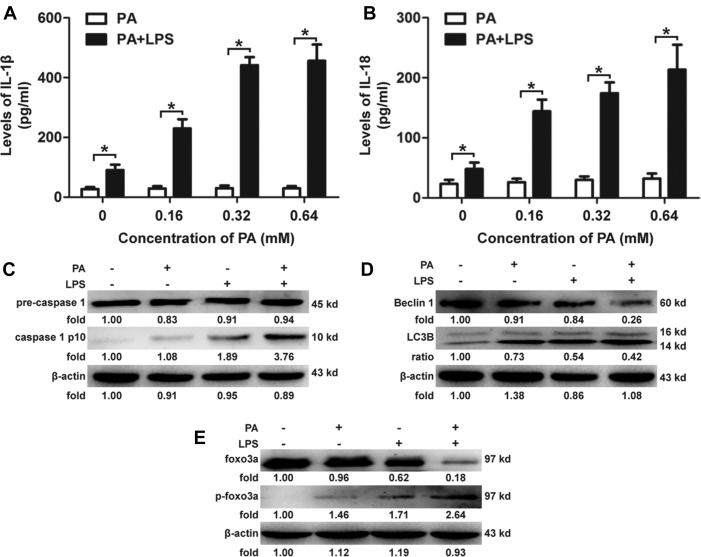
The role of Foxo3a in the regulation of autophagy flux and activation of the NLRP3 inflammasome in KCs suffering from HFD conditions is unknown.
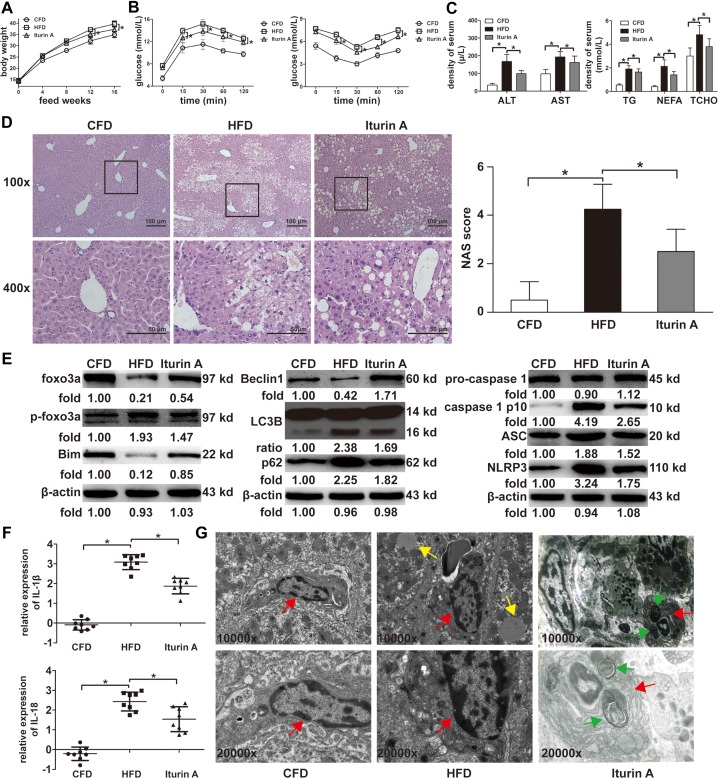
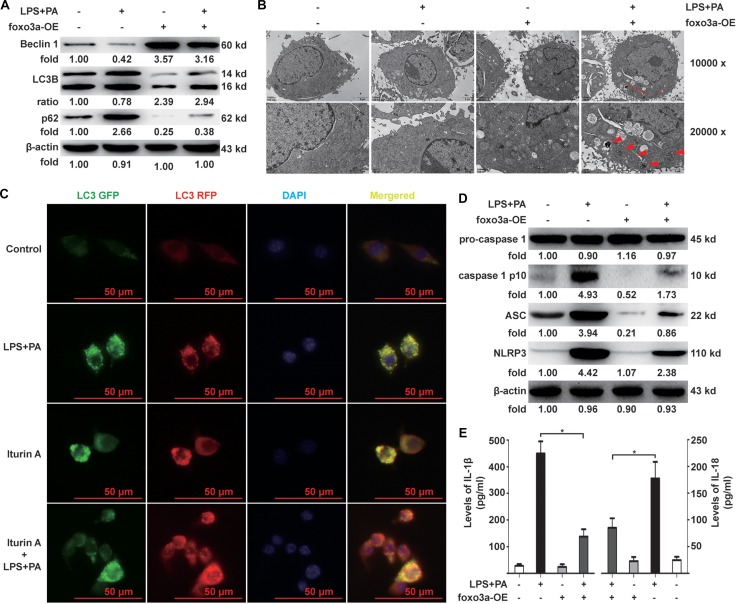
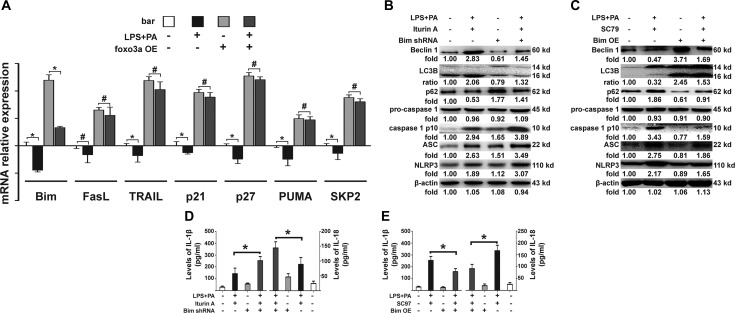
Up-regulation of Foxo3a restored autophagy flux and dampened the activation of the NLRP3 inflammasome in KCs stimulated with PA and LPS. In contrast, down-regulation of Foxo3a increased blockage of autophagy flux and promoted NLRP3 inflammasome activation. Additionally, mRNA levels of Bim were significantly changed with the alteration of Foxo3a in KCs under PA and LPS stimulation among foxo3a targeted genes. Overexpression of Bim restored autophagy influx and attenuated NLRP3 inflammasome pathway activation. In addition, autophagy formation was restored, and activation of NLRP3 inflammasome was inhibited in KCs isolated from mice treated with Iturin A and fed with a HFD.
Autophagy flux in KCs and activation levels of NLRP3 inflammasome were evaluated after altering the expression of Foxo3a in KCs before stimulation with PA and LPS. Additionally, various target genes of Foxo3a were measured in KCs pretreated with an agonist (Iturin A) or inhibitor (SC97) of Foxo3a after KCs stimulation with PA and LPS in order to hunt for targets of Foxo3a. Activation levels of NLRP3 inflammasome in isolated KCs, as well as autophagy flux, were measured after mice were treated with Iturin A and fed with a HFD for 16 weeks.
Foxo3a restores autophagy flux and attenuates the activation of the NLRP3 inflammasome by promoting the transcription of Bim, suggesting a potential therapeutic target in NAFLD and other obesity-related diseases.
在高脂饮食条件下的肝星状细胞(KCs)中,Foxo3a在自噬通量调节和NLRP3炎性小体激活方面的作用尚不清楚。
Foxo3a的上调恢复了自噬通量,并抑制了在棕榈酸(PA)和脂多糖(LPS)刺激下的肝星状细胞中NLRP3炎性小体的激活。相反,Foxo3a的下调增加了自噬通量的阻断,并促进了NLRP3炎性小体的激活。此外,在PA和LPS刺激下的肝星状细胞中,在Foxo3a靶向基因中,Bim的mRNA水平随着Foxo3a的改变而显著变化。Bim的过表达恢复了自噬流入并减弱了NLRP3炎性小体途径的激活。此外,在用伊曲康唑A处理并喂食高脂饮食的小鼠分离的肝星状细胞中,自噬形成得以恢复,NLRP3炎性小体的激活受到抑制。
在用PA和LPS刺激之前,改变肝星状细胞中Foxo3a的表达后,评估肝星状细胞中的自噬通量和NLRP3炎性小体的激活水平。此外,在用PA和LPS刺激肝星状细胞后,用Foxo3a的激动剂(伊曲康唑A)或抑制剂(SC97)预处理肝星状细胞,以寻找Foxo3a的靶标,测量Foxo3a的各种靶基因。在用伊曲康唑A处理并喂食高脂饮食16周的小鼠后,测量分离的肝星状细胞中NLRP3炎性小体的激活水平以及自噬通量。
Foxo3a通过促进Bim的转录恢复自噬通量并减弱NLRP3炎性小体的激活,提示其在非酒精性脂肪性肝病(NAFLD)和其他肥胖相关疾病中具有潜在的治疗靶点。