van der Haar Sandra, Hoevenaars Femke P M, van den Brink Willem J, van den Broek Tim, Timmer Mariëlle, Boorsma André, Doets Esmée L
Wageningen Food & Biobased Research, Wageningen University & Research, Wageningen, Netherlands.
Microbiology & Systems Biology Department, TNO, Netherlands Organization for Applied Scientific Research, Zeist, Netherlands.
JMIR Form Res. 2021 Jun 24;5(6):e25043. doi: 10.2196/25043.
Dietary quality plays an essential role in the prevention and management of metabolic syndrome (MetS).
The aim of this pilot study is to organize personalized dietary advice in a real-life setting and to explore the effects on dietary intake, metabolic health, and perceived health.
We followed a one-group pretest-posttest design and included 37 individuals at risk of MetS, who indicated motivation to change dietary behavior. For a period of 16 weeks, participants received personalized advice (t=0 and t=8) and feedback (t=0, t=4, t=8, t=12 and t=16) on dietary quality and metabolic health (ie, waist circumference, BMI, blood pressure, lipid profile, fasting glucose levels, and C-peptide). Personalized advice was generated in a two-stage process. In stage 1, an automated algorithm generated advice per food group, integrating data on individual dietary quality (Dutch Healthy Diet Index; total score 8-80) and metabolic health parameters. Stage 2 included a telephone consultation with a trained dietitian to define a personal dietary behavior change strategy and to discuss individual preferences. Dietary quality and metabolic health markers were assessed at t=0, t=8, and t=16. Self-perceived health was evaluated on 7-point Likert scales at t=0 and t=16.
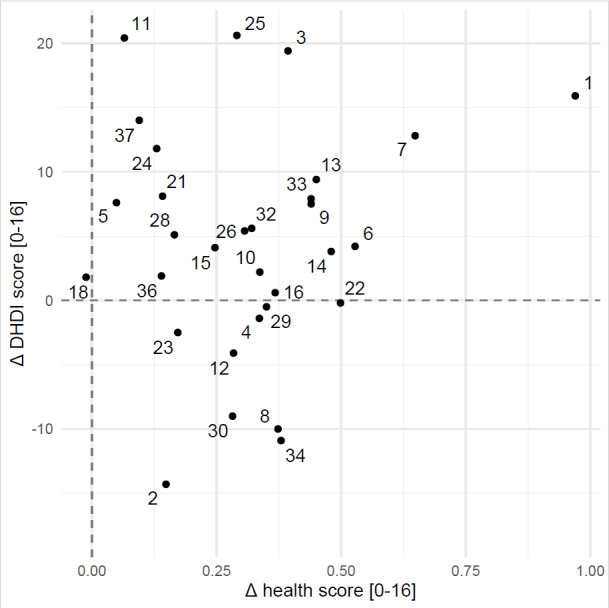
At the end of the study period, dietary quality was significantly improved compared with the baseline (Dutch Healthy Diet Index +4.3; P<.001). In addition, lipid profile (triglycerides, P=.02; total cholesterol, P=.01; high-density lipoprotein, P<.001; and low-density lipoprotein, P<.001), BMI (P<.001), waist circumference (P=.01), and C-peptide (P=.01) were all significantly improved, whereas plasma glucose increased by 0.23 nmol/L (P=.04). In line with these results, self-perceived health scores were higher at t=16 weeks than at baseline (+0.67; P=.005).
This exploratory study showed that personalized dietary advice resulted in positive effects on dietary behavior, metabolic health, and self-perceived health in motivated pre-MetS adults. The study was performed in a do-it-yourself setting, highlighting the potential of at-home health improvement through dietary changes.
ClinicalTrials.gov NCT04595669; https://clinicaltrials.gov/ct2/show/NCT04595669.
饮食质量在代谢综合征(MetS)的预防和管理中起着至关重要的作用。
本试点研究的目的是在现实生活环境中提供个性化饮食建议,并探讨其对饮食摄入、代谢健康和自我感知健康的影响。
我们采用单组前后测设计,纳入了37名有MetS风险且表示有改变饮食行为动机的个体。在16周的时间里,参与者收到了关于饮食质量和代谢健康(即腰围、体重指数、血压、血脂谱、空腹血糖水平和C肽)的个性化建议(t = 0和t = 8)以及反馈(t = 0、t = 4、t = 8、t = 12和t = 16)。个性化建议分两个阶段生成。在第一阶段,一个自动化算法根据个体饮食质量(荷兰健康饮食指数;总分8 - 80)和代谢健康参数为每个食物组生成建议。第二阶段包括与一名经过培训的营养师进行电话咨询,以确定个人饮食行为改变策略并讨论个人偏好。在t = 0、t = 8和t = 16时评估饮食质量和代谢健康指标。在t = 0和t = 16时,通过7点李克特量表评估自我感知健康。
在研究期结束时,与基线相比,饮食质量有显著改善(荷兰健康饮食指数 +4.3;P <.001)。此外,血脂谱(甘油三酯,P =.02;总胆固醇,P =.01;高密度脂蛋白,P <.001;低密度脂蛋白,P <.001)、体重指数(P <.001)、腰围(P =.01)和C肽(P =.01)均有显著改善,而血糖水平升高了0.23 nmol/L(P =.04)。与这些结果一致,在16周时自我感知健康得分高于基线(+0.67;P =.005)。
这项探索性研究表明,个性化饮食建议对有动机的MetS前期成年人的饮食行为、代谢健康和自我感知健康产生了积极影响。该研究是在自助环境中进行的,突出了通过饮食改变在家中改善健康的潜力。
ClinicalTrials.gov NCT04595669;https://clinicaltrials.gov/ct2/show/NCT04595669 。