• 文献检索
  • 文档翻译
  • 深度研究
  • 学术资讯
  • Suppr Zotero 插件Zotero 插件
  • 邀请有礼
  • 套餐&价格
  • 历史记录
应用&插件
Suppr Zotero 插件Zotero 插件浏览器插件Mac 客户端Windows 客户端微信小程序
定价
高级版会员购买积分包购买API积分包
服务
文献检索文档翻译深度研究API 文档MCP 服务
关于我们
关于 Suppr公司介绍联系我们用户协议隐私条款
关注我们

Suppr 超能文献

核心技术专利:CN118964589B侵权必究
粤ICP备2023148730 号-1Suppr @ 2026

文献检索

告别复杂PubMed语法,用中文像聊天一样搜索,搜遍4000万医学文献。AI智能推荐,让科研检索更轻松。

立即免费搜索

文件翻译

保留排版,准确专业,支持PDF/Word/PPT等文件格式,支持 12+语言互译。

免费翻译文档

深度研究

AI帮你快速写综述,25分钟生成高质量综述,智能提取关键信息,辅助科研写作。

立即免费体验

一项旨在实现瑞士个性化健康网络内研究的健康数据二次使用互操作性的全国性、语义驱动的三支柱战略:方法学研究。

A National, Semantic-Driven, Three-Pillar Strategy to Enable Health Data Secondary Usage Interoperability for Research Within the Swiss Personalized Health Network: Methodological Study.

作者信息

Gaudet-Blavignac Christophe, Raisaro Jean Louis, Touré Vasundra, Österle Sabine, Crameri Katrin, Lovis Christian

机构信息

Division of Medical Information Sciences, Geneva University Hospitals, Geneva, Switzerland.

Department of Radiology and Medical Informatics, University of Geneva, Geneva, Switzerland.

出版信息

JMIR Med Inform. 2021 Jun 24;9(6):e27591. doi: 10.2196/27591.

DOI:10.2196/27591
PMID:34185008
原文链接:https://pmc.ncbi.nlm.nih.gov/articles/PMC8277320/
Abstract

BACKGROUND

Interoperability is a well-known challenge in medical informatics. Current trends in interoperability have moved from a data model technocentric approach to sustainable semantics, formal descriptive languages, and processes. Despite many initiatives and investments for decades, the interoperability challenge remains crucial. The need for data sharing for most purposes ranging from patient care to secondary uses, such as public health, research, and quality assessment, faces unmet problems.

OBJECTIVE

This work was performed in the context of a large Swiss Federal initiative aiming at building a national infrastructure for reusing consented data acquired in the health care and research system to enable research in the field of personalized medicine in Switzerland. The initiative is the Swiss Personalized Health Network (SPHN). This initiative is providing funding to foster use and exchange of health-related data for research. As part of the initiative, a national strategy to enable a semantically interoperable clinical data landscape was developed and implemented.

METHODS

A deep analysis of various approaches to address interoperability was performed at the start, including large frameworks in health care, such as Health Level Seven (HL7) and Integrating Healthcare Enterprise (IHE), and in several domains, such as regulatory agencies (eg, Clinical Data Interchange Standards Consortium [CDISC]) and research communities (eg, Observational Medical Outcome Partnership [OMOP]), to identify bottlenecks and assess sustainability. Based on this research, a strategy composed of three pillars was designed. It has strong multidimensional semantics, descriptive formal language for exchanges, and as many data models as needed to comply with the needs of various communities.

RESULTS

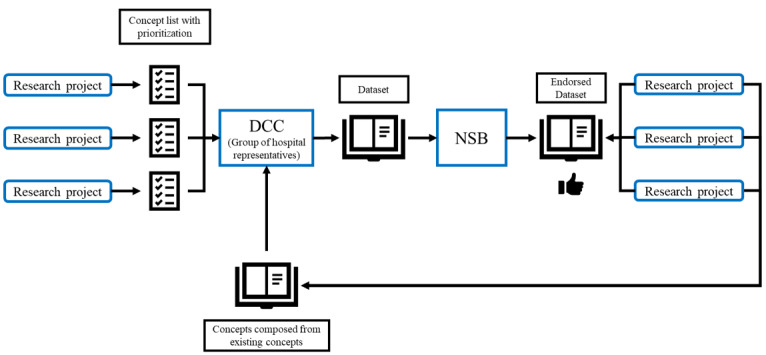
This strategy has been implemented stepwise in Switzerland since the middle of 2019 and has been adopted by all university hospitals and high research organizations. The initiative is coordinated by a central organization, the SPHN Data Coordination Center of the SIB Swiss Institute of Bioinformatics. The semantics is mapped by domain experts on various existing standards, such as Systematized Nomenclature of Medicine Clinical Terms (SNOMED CT), Logical Observation Identifiers Names and Codes (LOINC), and International Classification of Diseases (ICD). The resource description framework (RDF) is used for storing and transporting data, and to integrate information from different sources and standards. Data transformers based on SPARQL query language are implemented to convert RDF representations to the numerous data models required by the research community or bridge with other systems, such as electronic case report forms.

CONCLUSIONS

The SPHN strategy successfully implemented existing standards in a pragmatic and applicable way. It did not try to build any new standards but used existing ones in a nondogmatic way. It has now been funded for another 4 years, bringing the Swiss landscape into a new dimension to support research in the field of personalized medicine and large interoperable clinical data.

https://cdn.ncbi.nlm.nih.gov/pmc/blobs/2edb/8277320/3fd142ed82b2/medinform_v9i6e27591_fig2.jpg
https://cdn.ncbi.nlm.nih.gov/pmc/blobs/2edb/8277320/08dd4b22b9f4/medinform_v9i6e27591_fig1.jpg
https://cdn.ncbi.nlm.nih.gov/pmc/blobs/2edb/8277320/3fd142ed82b2/medinform_v9i6e27591_fig2.jpg
https://cdn.ncbi.nlm.nih.gov/pmc/blobs/2edb/8277320/08dd4b22b9f4/medinform_v9i6e27591_fig1.jpg
https://cdn.ncbi.nlm.nih.gov/pmc/blobs/2edb/8277320/3fd142ed82b2/medinform_v9i6e27591_fig2.jpg
摘要

背景

互操作性是医学信息学中一个众所周知的挑战。当前互操作性的趋势已从以数据模型为中心的技术方法转向可持续语义、形式化描述语言和流程。尽管数十年来有许多举措和投资,但互操作性挑战仍然至关重要。从患者护理到公共卫生、研究和质量评估等二次利用等大多数目的的数据共享需求面临着尚未解决的问题。

目的

这项工作是在瑞士联邦一项大型倡议的背景下开展的,该倡议旨在建立一个国家基础设施,以重用在医疗保健和研究系统中获取的已获同意的数据,从而推动瑞士个性化医疗领域的研究。该倡议即瑞士个性化健康网络(SPHN)。该倡议正在提供资金,以促进与健康相关的数据用于研究的使用和交换。作为该倡议的一部分,制定并实施了一项实现语义互操作临床数据格局的国家战略。

方法

一开始对各种解决互操作性的方法进行了深入分析,包括医疗保健领域的大型框架,如健康级别七(HL7)和整合医疗企业(IHE),以及几个领域,如监管机构(如临床数据交换标准协会[CDISC])和研究团体(如观察性医疗结果合作组织[OMOP]),以识别瓶颈并评估可持续性。基于这项研究,设计了一个由三个支柱组成的战略。它具有强大的多维度语义、用于交换的描述性形式语言,以及满足各个团体需求所需的尽可能多的数据模型。

结果

自2019年年中以来,该战略已在瑞士逐步实施,并已被所有大学医院和高级研究机构采用。该倡议由一个中央组织协调,即瑞士生物信息学研究所的SPHN数据协调中心(SIB)。语义由领域专家映射到各种现有标准上,如医学临床术语系统命名法(SNOMED CT)、逻辑观察标识符名称和代码(LOINC)以及国际疾病分类(ICD)。资源描述框架(RDF)用于存储和传输数据,并整合来自不同来源和标准的信息。基于SPARQL查询语言的数据转换器得以实现,以将RDF表示形式转换为研究团体所需的众多数据模型,或与其他系统(如电子病例报告表)进行对接。

结论

SPHN战略以务实且适用的方式成功实施了现有标准。它没有试图构建任何新的标准,而是以非教条的方式使用现有标准。现在它又获得了4年的资金支持,为瑞士的格局带来了新的维度,以支持个性化医疗领域的研究和大型可互操作临床数据。

相似文献

1
A National, Semantic-Driven, Three-Pillar Strategy to Enable Health Data Secondary Usage Interoperability for Research Within the Swiss Personalized Health Network: Methodological Study.一项旨在实现瑞士个性化健康网络内研究的健康数据二次使用互操作性的全国性、语义驱动的三支柱战略:方法学研究。
JMIR Med Inform. 2021 Jun 24;9(6):e27591. doi: 10.2196/27591.
2
Integrating clinical research with the Healthcare Enterprise: from the RE-USE project to the EHR4CR platform.将临床研究与医疗保健企业相结合:从 RE-USE 项目到 EHR4CR 平台。
J Biomed Inform. 2011 Dec;44 Suppl 1:S94-S102. doi: 10.1016/j.jbi.2011.07.007. Epub 2011 Aug 25.
3
Semantic data interoperability, digital medicine, and e-health in infectious disease management: a review.语义数据互操作性、数字医学和传染病管理中的电子健康:综述。
Eur J Clin Microbiol Infect Dis. 2019 Jun;38(6):1023-1034. doi: 10.1007/s10096-019-03501-6. Epub 2019 Feb 15.
4
FAIRification of health-related data using semantic web technologies in the Swiss Personalized Health Network.利用语义网技术在瑞士个性化健康网络中实现健康相关数据的 FAIR 化。
Sci Data. 2023 Mar 10;10(1):127. doi: 10.1038/s41597-023-02028-y.
5
The future of Cochrane Neonatal.考克兰新生儿协作网的未来。
Early Hum Dev. 2020 Nov;150:105191. doi: 10.1016/j.earlhumdev.2020.105191. Epub 2020 Sep 12.
6
Creation of Standardized Common Data Elements for Diagnostic Tests in Infectious Disease Studies: Semantic and Syntactic Mapping.创建传染病研究中诊断测试的标准化通用数据元素:语义和句法映射。
J Med Internet Res. 2024 Jun 10;26:e50049. doi: 10.2196/50049.
7
An Automatic Ontology-Based Approach to Support Logical Representation of Observable and Measurable Data for Healthy Lifestyle Management: Proof-of-Concept Study.一种基于本体的自动方法,用于支持健康生活方式管理中可观察和可测量数据的逻辑表示:概念验证研究。
J Med Internet Res. 2021 Apr 9;23(4):e24656. doi: 10.2196/24656.
8
Building a Comprehensive Clinical Data Repository Using FHIR, LOINC and SNOMED.利用 FHIR、LOINC 和 SNOMED 构建全面的临床数据仓库。
Stud Health Technol Inform. 2022 May 25;294:563-564. doi: 10.3233/SHTI220524.
9
Smart Medical Information Technology for Healthcare (SMITH).医疗保健智能医学信息技术(SMITH)。
Methods Inf Med. 2018 Jul;57(S 01):e92-e105. doi: 10.3414/ME18-02-0004. Epub 2018 Jul 17.
10
Semantic Interoperability of Electronic Health Records: Systematic Review of Alternative Approaches for Enhancing Patient Information Availability.电子健康记录的语义互操作性:增强患者信息可用性的替代方法系统评价
JMIR Med Inform. 2024 Apr 25;12:e53535. doi: 10.2196/53535.

引用本文的文献

1
The SPHN Schema Forge - transform healthcare semantics from human-readable to machine-readable by leveraging semantic web technologies.SPHN 模式生成器 - 通过利用语义网技术将医疗保健语义从人类可读转换为机器可读。
J Biomed Semantics. 2025 May 8;16(1):9. doi: 10.1186/s13326-025-00330-9.
2
Semantics in action: a guide for representing clinical data elements with SNOMED CT.实践中的语义学:使用SNOMED CT表示临床数据元素的指南。
J Biomed Semantics. 2025 Mar 27;16(1):7. doi: 10.1186/s13326-025-00326-5.
3
Monitoring low-value care in medical patients from Swiss university hospitals using a Findable, Accessible, Interoperable, Reusable (FAIR) national data stream and patient and public involvement: LUCID study protocol.

本文引用的文献

1
Use of the Systematized Nomenclature of Medicine Clinical Terms (SNOMED CT) for Processing Free Text in Health Care: Systematic Scoping Review.系统医学术语命名法(SNOMED CT)在医疗保健中处理自由文本的应用:系统范围综述。
J Med Internet Res. 2021 Jan 26;23(1):e24594. doi: 10.2196/24594.
2
MDCalc Medical Calculator App Review.MDCalc医学计算器应用程序评测。
J Digit Imaging. 2019 Oct;32(5):682-684. doi: 10.1007/s10278-019-00218-y.
3
Automated Population of an i2b2 Clinical Data Warehouse using FHIR.使用FHIR自动填充i2b2临床数据仓库
利用可查找、可访问、可互操作、可重用(FAIR)的国家数据流以及患者和公众参与,监测瑞士大学医院内科患者的低价值医疗:LUCID研究方案。
BMJ Open. 2024 Dec 27;14(12):e089662. doi: 10.1136/bmjopen-2024-089662.
4
The Role of Informatics in Advancing Emergency Medicine: A Comprehensive Review.信息学在推进急诊医学发展中的作用:全面综述
Cureus. 2024 Jul 6;16(7):e63979. doi: 10.7759/cureus.63979. eCollection 2024 Jul.
5
Electronic Health Record and Semantic Issues Using Fast Healthcare Interoperability Resources: Systematic Mapping Review.电子健康记录与 Fast Healthcare Interoperability Resources 的语义问题:系统映射综述。
J Med Internet Res. 2024 Jan 30;26:e45209. doi: 10.2196/45209.
6
Visualizing Data Interoperability for Food Systems Sustainability Research-From Spider Webs to Neural Networks.可视化食品系统可持续性研究中的数据互操作性——从蜘蛛网到神经网络
Curr Dev Nutr. 2023 Sep 29;7(11):102006. doi: 10.1016/j.cdnut.2023.102006. eCollection 2023 Nov.
7
The SIB Swiss Institute of Bioinformatics Semantic Web of data.瑞士生物信息学研究所语义网数据。
Nucleic Acids Res. 2024 Jan 5;52(D1):D44-D51. doi: 10.1093/nar/gkad902.
8
Advancing Precision Medicine in South Tyrol, Italy: A Public Health Development Proposal for a Bilingual, Autonomous Province.推进意大利南蒂罗尔的精准医学:一份针对双语自治省的公共卫生发展提案。
J Pers Med. 2023 Jun 9;13(6):972. doi: 10.3390/jpm13060972.
9
The Swiss Pathogen Surveillance Platform - towards a nation-wide One Health data exchange platform for bacterial, viral and fungal genomics and associated metadata.瑞士病原体监测平台 - 迈向全国性的细菌、病毒和真菌基因组学及相关元数据的 One Health 数据交换平台。
Microb Genom. 2023 May;9(5). doi: 10.1099/mgen.0.001001.
10
Interactive process mining of cancer treatment sequences with melanoma real-world data.利用黑色素瘤真实世界数据对癌症治疗序列进行交互式过程挖掘。
Front Oncol. 2023 Mar 21;13:1043683. doi: 10.3389/fonc.2023.1043683. eCollection 2023.
AMIA Annu Symp Proc. 2018 Dec 5;2018:979-988. eCollection 2018.
4
Data model harmonization for the All Of Us Research Program: Transforming i2b2 data into the OMOP common data model.All Of Us 研究计划的数据模型协调:将 i2b2 数据转换为 OMOP 通用数据模型。
PLoS One. 2019 Feb 19;14(2):e0212463. doi: 10.1371/journal.pone.0212463. eCollection 2019.
5
Metadata Import from RDF to i2b2.从资源描述框架(RDF)到整合生物学信息库(i2b2)的元数据导入。
Stud Health Technol Inform. 2018;253:40-44.
6
A Semantic Transformation Methodology for the Secondary Use of Observational Healthcare Data in Postmarketing Safety Studies.一种用于上市后安全性研究中观察性医疗保健数据二次利用的语义转换方法。
Front Pharmacol. 2018 Apr 30;9:435. doi: 10.3389/fphar.2018.00435. eCollection 2018.
7
The Protégé Project: A Look Back and a Look Forward.Protégé项目:回顾与展望。
AI Matters. 2015 Jun;1(4):4-12. doi: 10.1145/2757001.2757003.
8
Current applications and future directions for the CDISC Operational Data Model standard: A methodological review.CDISC操作数据模型标准的当前应用与未来方向:方法学综述
J Biomed Inform. 2016 Apr;60:352-62. doi: 10.1016/j.jbi.2016.02.016. Epub 2016 Mar 2.
9
Ontology-based data integration between clinical and research systems.临床与研究系统之间基于本体的数据集成。
PLoS One. 2015 Jan 14;10(1):e0116656. doi: 10.1371/journal.pone.0116656. eCollection 2015.
10
The Arden Syntax standard for clinical decision support: experiences and directions.阿登语法临床决策支持标准:经验与方向。
J Biomed Inform. 2012 Aug;45(4):711-8. doi: 10.1016/j.jbi.2012.02.001. Epub 2012 Feb 10.