Department of Public Health, University of Helsinki, Helsinki, Finland.
Department of Obstetrics and Gynecology, University of Helsinki and Helsinki University Hospital, Helsinki, Finland.
J Clin Endocrinol Metab. 2021 Oct 21;106(11):e4372-e4388. doi: 10.1210/clinem/dgab475.
Comprehensive assessment of metabolism in maternal obesity and pregnancy disorders can provide information about the shared maternal-fetal milieu and give insight into both maternal long-term health and intergenerational transmission of disease burden.
To assess levels, profiles, and change in the levels of metabolic measures during pregnancies complicated by obesity, gestational diabetes (GDM), or hypertensive disorders.
DESIGN, SETTING AND PARTICIPANTS: A secondary analysis of 2 study cohorts, PREDO and RADIEL, including 741 pregnant women.
We assessed 225 metabolic measures by nuclear magnetic resonance in blood samples collected at median 13 [interquartile range (IQR) 12.4-13.7], 20 (IQR 19.3-23.0), and 28 (27.0-35.0) weeks of gestation.
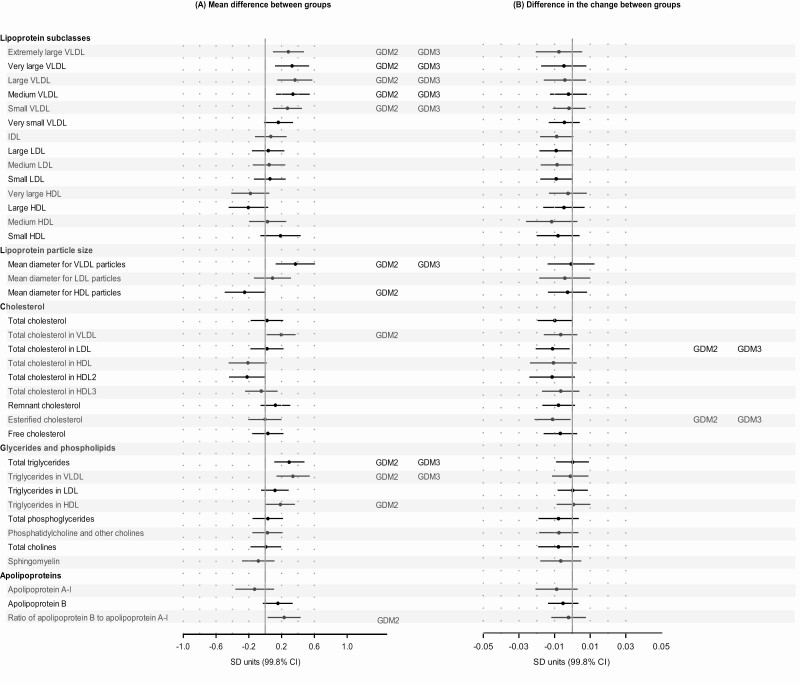
Across all 3 time points women with obesity [body mass index (BMI) ≥ 30kg/m2] in comparison to normal weight (BMI 18.5-24.99 kg/m2) had significantly higher levels of most very-low-density lipoprotein-related measures, many fatty and most amino acids, and more adverse metabolic profiles. The change in the levels of most metabolic measures during pregnancy was smaller in obese than in normal weight women. GDM, preeclampsia, and chronic hypertension were associated with metabolic alterations similar to obesity. The associations of obesity held after adjustment for GDM and hypertensive disorders, but many of the associations with GDM and hypertensive disorders were rendered nonsignificant after adjustment for BMI and the other pregnancy disorders.
This study shows that the pregnancy-related metabolic change is smaller in women with obesity, who display metabolic perturbations already in early pregnancy. Metabolic alterations of obesity and pregnancy disorders resembled each other suggesting a shared metabolic origin.
全面评估肥胖孕妇和妊娠疾病的代谢情况可以提供有关母体-胎儿共同环境的信息,并深入了解母体的长期健康状况和疾病负担的代际传递。
评估肥胖、妊娠糖尿病(GDM)或高血压疾病妊娠中代谢指标的水平、分布和变化。
设计、地点和参与者:对 PREDO 和 RADIEL 这两项研究队列进行二次分析,共纳入 741 名孕妇。
我们通过核磁共振技术在孕妇妊娠 13 周(中位数,12.4-13.7 周)、20 周(中位数,19.3-23.0 周)和 28 周(中位数,27.0-35.0 周)时采集的血样中评估了 225 项代谢指标。
在所有 3 个时间点,与正常体重(BMI 18.5-24.99kg/m2)孕妇相比,肥胖(BMI≥30kg/m2)孕妇的大多数极低密度脂蛋白相关指标、许多脂肪酸和大多数氨基酸水平显著更高,且代谢谱更差。与正常体重孕妇相比,肥胖孕妇在怀孕期间大多数代谢指标的水平变化较小。GDM、子痫前期和慢性高血压与肥胖类似的代谢改变相关。在调整 GDM 和高血压疾病后,肥胖的相关性仍然存在,但在调整 BMI 和其他妊娠疾病后,许多与 GDM 和高血压疾病的相关性变得不显著。
本研究表明,肥胖孕妇的妊娠相关代谢变化较小,且其在妊娠早期就已出现代谢紊乱。肥胖和妊娠疾病的代谢改变相似,提示存在共同的代谢起源。