Department of Orthopedics, The Eighth Affiliated Hospital, Sun Yat-sen University, Shenzhen, P.R. China.
Center for Biotherapy, The Eighth Affiliated Hospital, Sun Yat-sen University, Shenzhen, P.R. China.
Clin Transl Med. 2021 Jun;11(6):e429. doi: 10.1002/ctm2.429.
Mesenchymal stem cells (MSCs) are the major source of osteoblasts. Long noncoding RNAs (lncRNAs) are abundantly expressed RNAs that lack protein-coding potential and play an extensive regulatory role in cellular biological activities. However, the regulatory network of lncRNAs in MSC osteogenesis needs further investigation.
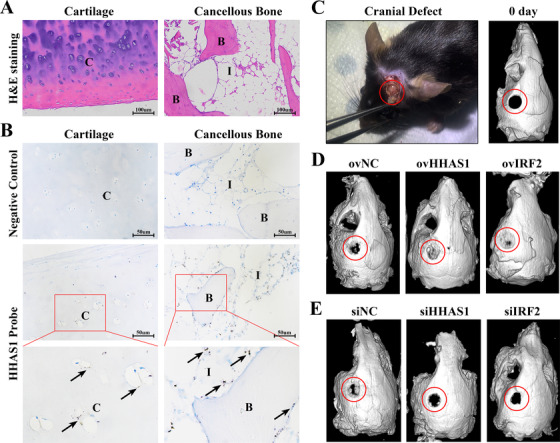
QRT-PCR, western blot, immunofluorescence, and immunohistochemistry assays were used to determine the levels of relevant genes. The osteogenic differentiation capability was evaluated by using Alizarin Red S (ARS) staining, alkaline phosphatase activity assays, hematoxylin & eosin staining or micro-CT. RNA fluorescence in situ hybridization (FISH) and RNAscope were used to detect HHAS1 expression in cells and bone tissue. A microarray assay was performed to identify differentially expressed microRNAs. RNA immunoprecipitation and RNA pull-down were used to explore the interactions between related proteins and nucleic acids.
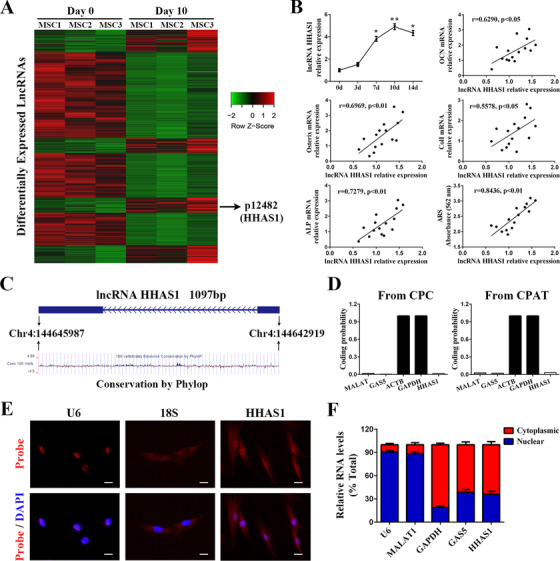
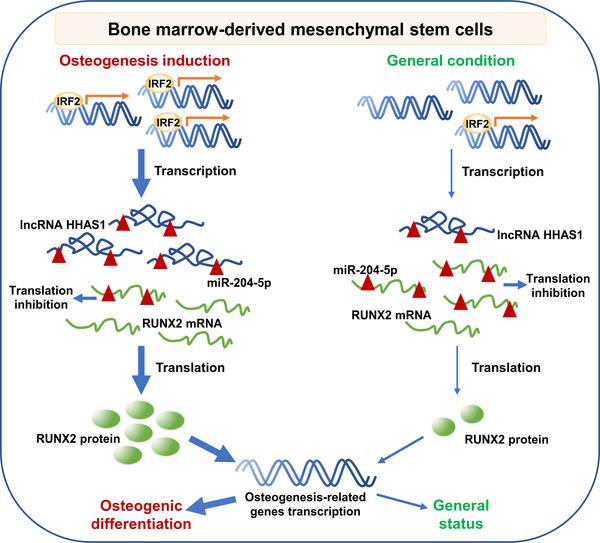
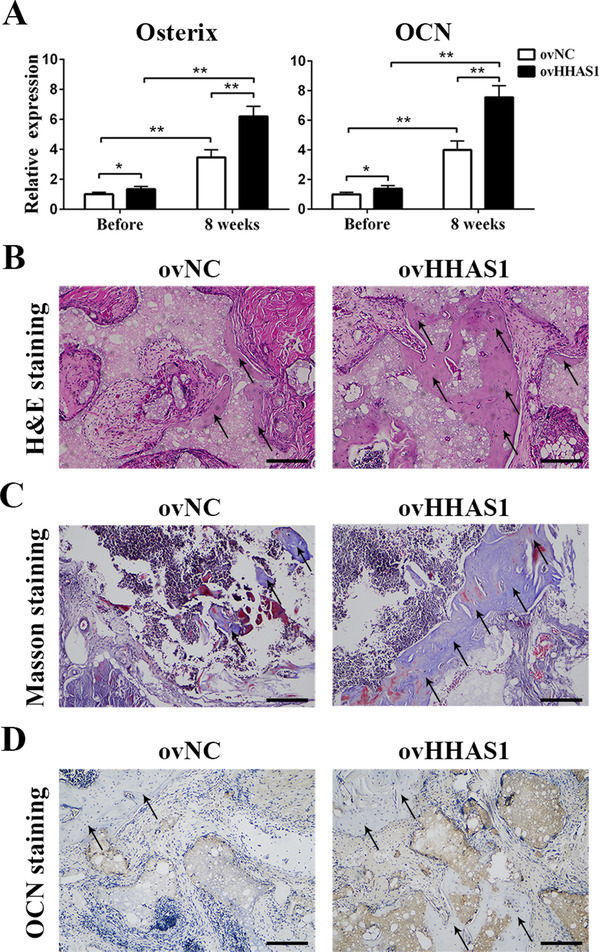
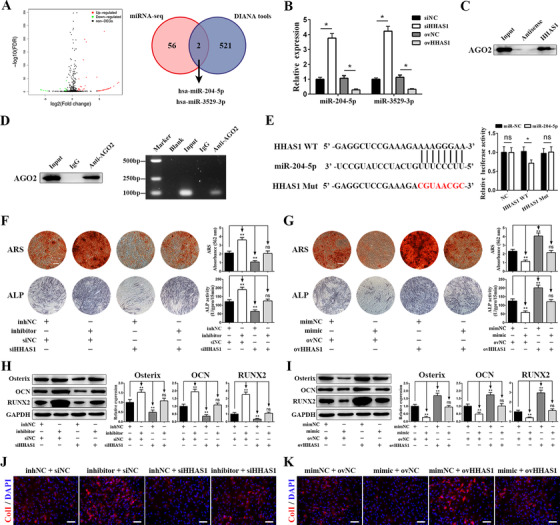
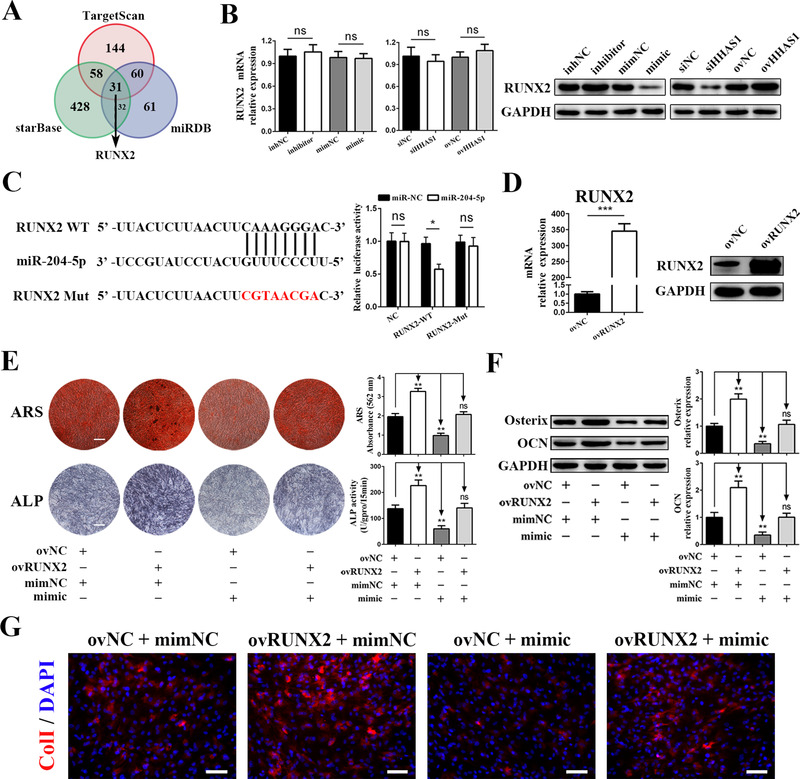
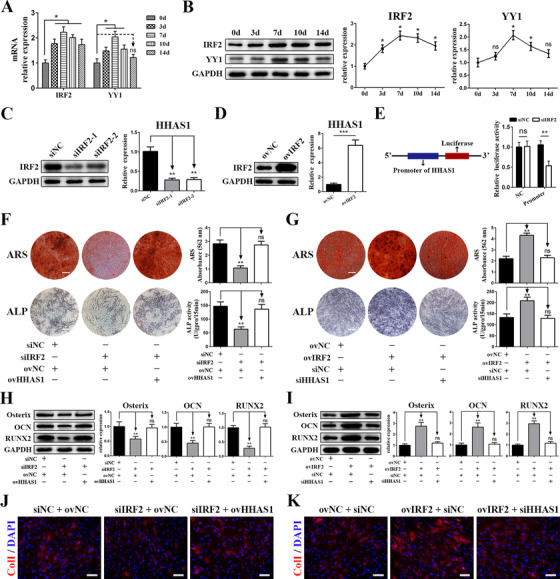
The level of lncRNA HHAS1 increased during bone marrow-derived MSC (BMSC) osteogenesis and was positively related to the levels of osteogenic genes and ARS intensity. HHAS1 was located in both the cytoplasm and the nucleus and was expressed in human bone tissue. HHAS1 facilitated BMSC osteogenic differentiation by downregulating miR-204-5p expression and enhancing the level of RUNX family transcription factor 2 (RUNX2). In addition, interferon regulatory factor 2 (IRF2) was increased during BMSC osteogenic differentiation and interacted with the promoter of HHAS1, which resulted in the transcriptional activation of HHAS1. Furthermore, IRF2 and HHAS1 helped improve bone defect repair in vivo.
Our study identified a novel lncRNA, HHAS1, that facilitates BMSC osteogenic differentiation and proposed a role for the IRF2/HHAS1/miR-204-5p/RUNX2 axis in BMSC osteogenesis regulation. These findings help elucidate the regulatory network of BMSC osteogenesis and provide potential targets for clinical application.
间充质干细胞(MSCs)是成骨细胞的主要来源。长链非编码 RNA(lncRNA)是大量表达的 RNA,缺乏蛋白编码能力,在细胞的生物学活性中发挥广泛的调节作用。然而,lncRNA 在 MSC 成骨中的调控网络需要进一步研究。
采用 QRT-PCR、western blot、免疫荧光和免疫组化等方法检测相关基因的水平。通过茜素红 S(ARS)染色、碱性磷酸酶活性检测、苏木精和伊红染色或 micro-CT 评估 MSC 的成骨分化能力。采用 RNA 荧光原位杂交(FISH)和 RNAscope 检测 HHAS1 在细胞和骨组织中的表达。进行微阵列分析以鉴定差异表达的 microRNA。采用 RNA 免疫沉淀和 RNA 下拉实验来探讨相关蛋白和核酸之间的相互作用。
lncRNA HHAS1 在骨髓间充质干细胞(BMSC)成骨过程中表达增加,与成骨基因的水平和 ARS 强度呈正相关。HHAS1 定位于细胞质和细胞核,在人骨组织中表达。HHAS1 通过下调 miR-204-5p 的表达和增强 RUNX 家族转录因子 2(RUNX2)的水平来促进 BMSC 的成骨分化。此外,BMSC 成骨分化过程中干扰素调节因子 2(IRF2)增加,并与 HHAS1 的启动子相互作用,导致 HHAS1 的转录激活。此外,IRF2 和 HHAS1 有助于体内改善骨缺损的修复。
本研究鉴定了一种新的 lncRNA HHAS1,它促进 BMSC 的成骨分化,并提出了 IRF2/HHAS1/miR-204-5p/RUNX2 轴在 BMSC 成骨调控中的作用。这些发现有助于阐明 BMSC 成骨的调控网络,并为临床应用提供潜在的靶点。