Chung Jaewoo, Ko Jung Ho
Department of Neurosurgery, Dankook University College of Medicine, Cheonan, Korea.
J Korean Neurosurg Soc. 2021 Jul;64(4):514-523. doi: 10.3340/jkns.2020.0255. Epub 2021 Jun 29.
Aneurysm volume quantification (AVQ) using the equation of ellipsoid volume is widely used although it is inaccurate. Furthermore, AVQ with 3-dimensional (3D) rendered data has limitations in general use. A novel universal method for AVQ is introduced for any diagnostic modality and application to any shape of aneurysms.
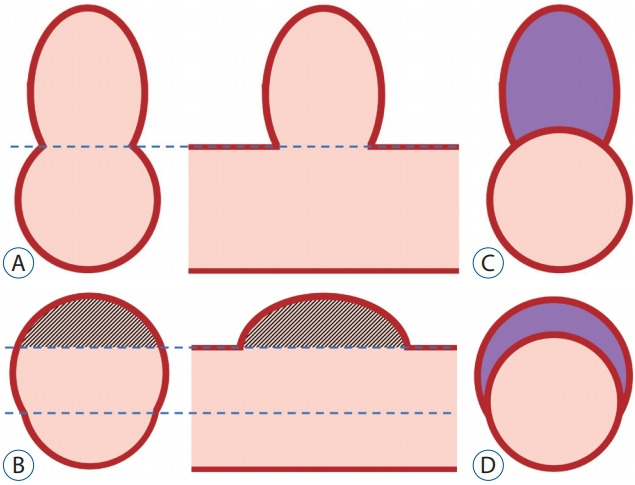
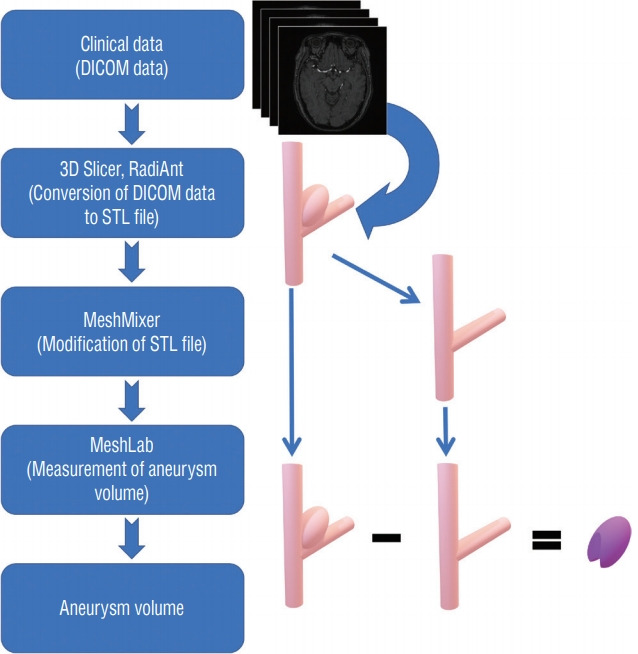
Relevant AVQ studies published from January 1997 to June 2019 were identified to determine common methods of AVQ. The basic idea is to eliminate the normal artery volume from 3D model with the aneurysm. After Digital Imaging and Communications in Medicine (DICOM) data is converted and exported to stereolithography (STL) file format, the 3D STL model is modified to remove the aneurysm and the volume difference between the 3D model with/without the aneurysm is defined as the aneurysm volume. Fifty randomly selected aneurysms from DICOM database were used to validate the different AVQ methods.
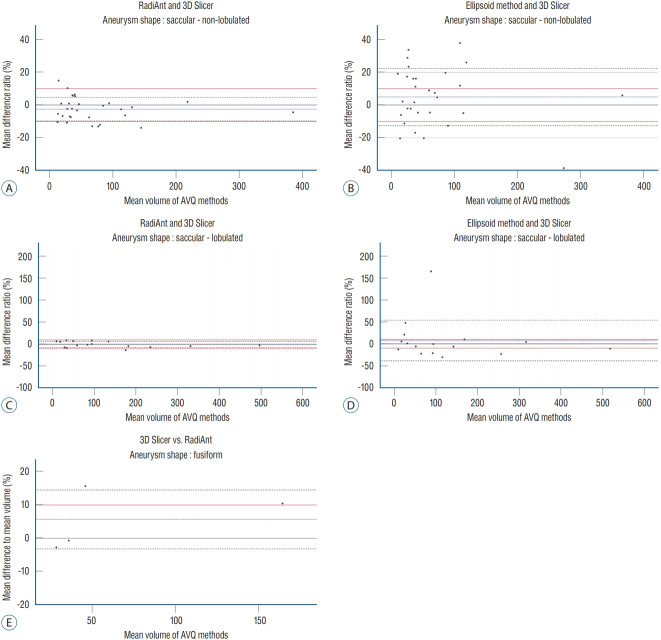
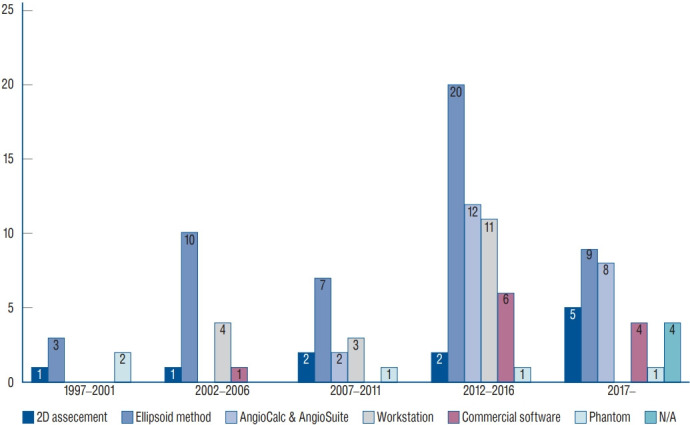
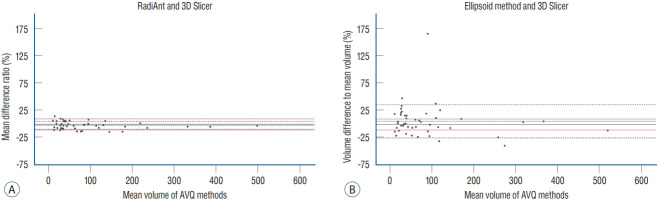
We reviewed and categorized AVQ methods in 121 studies. Approximately 60% used the ellipsoid method, while 24% used the 3D model. For 50 randomly selected aneurysms, volumes were measured using 3D Slicer, RadiAnt, and ellipsoid method. Using 3D Slicer as the reference, the ratios of mean difference to mean volume obtained by RadiAnt and ellipsoid method were -1.21±7.46% and 4.04±30.54%, respectively. The deviations between RadiAnt and 3D Slicer were small despite of aneurysm shapes, but those of ellipsoid method and 3D Slicer were large.
In spite of inaccuracy, ellipsoid method is still mostly used. We propose a novel universal method for AVQ that is valid, low cost, and easy to use.
使用椭球体体积公式进行动脉瘤体积量化(AVQ)虽不准确但应用广泛。此外,基于三维(3D)渲染数据的AVQ在一般应用中存在局限性。本文介绍一种适用于任何诊断方式且可应用于任何形状动脉瘤的新型通用AVQ方法。
检索1997年1月至2019年6月发表的相关AVQ研究,以确定常用的AVQ方法。基本思路是从包含动脉瘤的三维模型中去除正常动脉体积。将医学数字成像和通信(DICOM)数据转换并导出为立体光刻(STL)文件格式后,对三维STL模型进行修改以去除动脉瘤,将有/无动脉瘤的三维模型之间的体积差定义为动脉瘤体积。从DICOM数据库中随机选取50个动脉瘤用于验证不同的AVQ方法。
我们对121项研究中的AVQ方法进行了综述和分类。约60%使用椭球体法,24%使用三维模型法。对于随机选取的50个动脉瘤,使用三维切片软件(3D Slicer)、RadiAnt和椭球体法测量体积。以3D Slicer为参照,RadiAnt法和椭球体法获得的平均差值与平均体积的比值分别为-1.21±7.46%和4.04±30.54%。尽管动脉瘤形状各异,但RadiAnt与3D Slicer之间的偏差较小,而椭球体法与3D Slicer之间的偏差较大。
尽管不准确,但椭球体法仍被广泛使用。我们提出一种新型通用的AVQ方法,该方法有效、成本低且易于使用。