Min Jin-Young, Lee Hyeong-Seong, Choi Yeon-Soo, Min Kyoung-Bok
Veterans Medical Research Institute, Veterans Health Service Medical Center, Seoul, Republic of Korea.
Department of Statistics and Data Science, College of Commerce and Economics, Yonsei University, Seoul, Republic of Korea.
BMC Public Health. 2021 Jun 29;21(1):1264. doi: 10.1186/s12889-021-11227-4.
Given that low income worsens health outcomes, income differences may affect health disparities in weather-related illnesses. The aim of this study was to investigate the association between income levels and prevalence of heat- and cold-related illnesses among Korean adults.
The current study comprised 535,186 participants with all variables on income and health behaviors. Patients with temperature-related illnesses were defined as individuals with outpatient medical code of heat- and cold-related illnesses. We categorized individual income into three levels: "low" for the fourth quartile (0-25%), "middle" for the second and the third quartiles (25-75%), and "high" for the first quartile (75-100%). To examine income-related health disparities, Cox proportional hazard regression was performed. Hazard ratios (HRs) and 95% CI (confidence interval) for heat- and cold-related illnesses were provided. The model adjusted for age, sex, smoking status, alcohol drinking, exercise, body mass index, hypertension, hyperglycemia, and local income per capita.
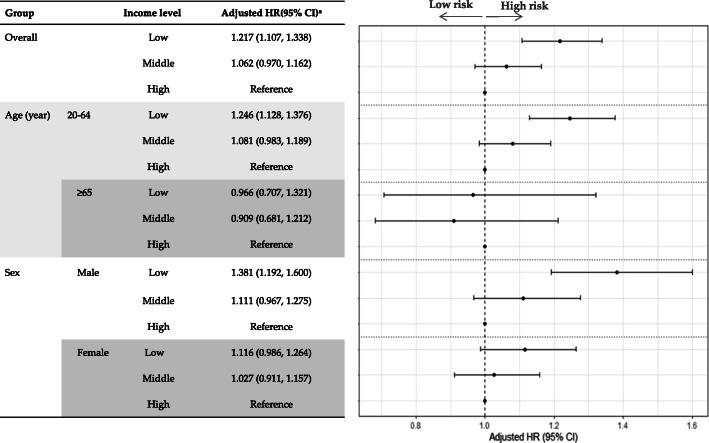
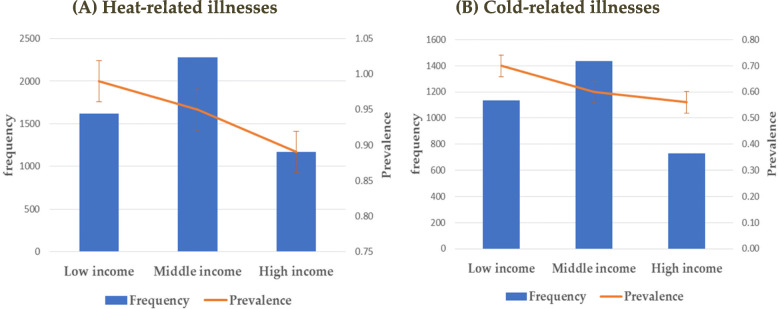
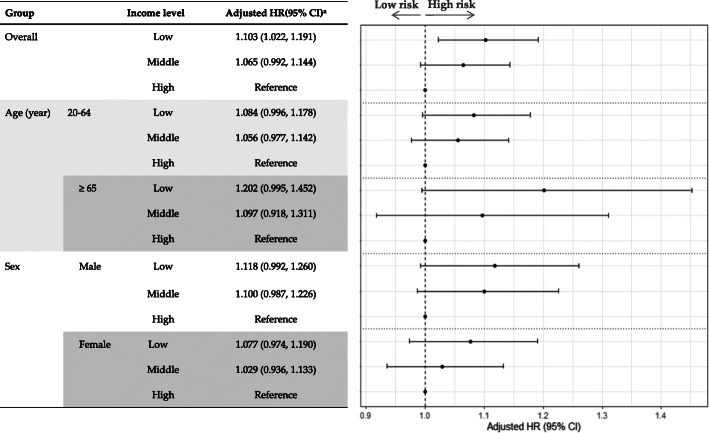
A total of 5066 (0.95%) and 3302 (0.62%) cases identified patients with heat- and cold-related illnesses, respectively. Compared with high income patients, the adjusted HR for heat-related illnesses was significantly increased in the low income (adjusted HR = 1.103; 95% CI: 1.022-1.191). For cold-related illnesses, participants with low income were likely to have 1.217 times greater likelihood than those with high income (95% CI: 1.107-1.338), after adjusting for other covariates. In the stratified analysis of age (20-64 years and over 65 years) and sex, there was no difference in the likelihood of heat-related illnesses according to income levels. On the other hand, an HR for cold-related illnesses was higher in patients aged 20 to 64 years than in those aged over 65 years. Male with low income had also a higher HR for cold-related illnesses than female with low income.
Our results showed that heat- or cold-related illnesses were more prevalent in Koreans with low income than those with high income. Strategies for low-income subgroups were needed to reduce greater damage due to the influence of extreme temperature events and to implement effective adaptation.
鉴于低收入会使健康状况恶化,收入差异可能会影响与天气相关疾病的健康差距。本研究旨在调查韩国成年人收入水平与热相关疾病和冷相关疾病患病率之间的关联。
本研究纳入了535,186名参与者,他们具有关于收入和健康行为的所有变量。与温度相关疾病的患者被定义为具有热相关疾病和冷相关疾病门诊医疗编码的个体。我们将个人收入分为三个水平:第四四分位数(0 - 25%)为“低”,第二和第三四分位数(25 - 75%)为“中”,第一四分位数(75 - 100%)为“高”。为了研究与收入相关的健康差距,进行了Cox比例风险回归分析。提供了热相关疾病和冷相关疾病的风险比(HRs)及95%置信区间(CI)。该模型对年龄、性别、吸烟状况、饮酒、运动、体重指数、高血压、高血糖和当地人均收入进行了调整。
分别有5066例(0.95%)和3302例(0.62%)病例被确定为患有热相关疾病和冷相关疾病。与高收入患者相比,低收入患者热相关疾病的调整后HR显著升高(调整后HR = 1.103;95% CI:1.022 - 1.191)。对于冷相关疾病,在调整其他协变量后,低收入参与者患病的可能性比高收入参与者高1.217倍(95% CI:1.107 - 1.338)。在按年龄(20 - 64岁和65岁以上)和性别进行的分层分析中,热相关疾病的患病可能性在不同收入水平之间没有差异。另一方面,20至64岁患者冷相关疾病的HR高于65岁以上患者。低收入男性冷相关疾病的HR也高于低收入女性。
我们的结果表明,低收入韩国人比高收入韩国人更容易患热相关疾病或冷相关疾病。需要针对低收入亚组制定策略,以减少极端温度事件影响造成的更大损害,并实施有效的适应措施。