Mountain Rescue Service Austria, Schelleingasse 26/2/2, 1040, Wien, Austria.
Department of Anaesthesiology and Intensive Care Medicine, Hospital Scheibbs, Eisenwurzenstraße 26, 3270, Scheibbs, Austria.
Scand J Trauma Resusc Emerg Med. 2021 Jun 29;29(1):84. doi: 10.1186/s13049-021-00899-x.
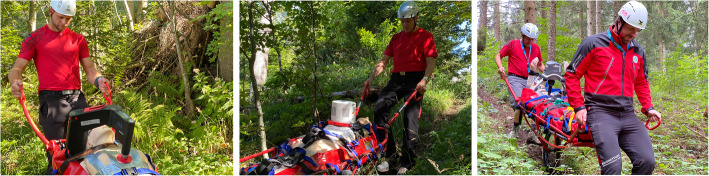
Cardiopulmonary resuscitation in mountain environment is challenging. Continuous chest compressions during transport or hoist rescue are almost impossible without mechanical chest compression devices. Current evidence is predominantly based on studies conducted by urbane ambulance service. Therefore, we aimed to investigate the feasibility of continuous mechanical chest compression during alpine terrestrial transport using three different devices.
Randomized triple crossover prospective study in an alpine environment. Nineteen teams of the Austrian Mountain Rescue Service trained according to current ERC guidelines performed three runs each of a standardised alpine rescue-scenario, using three different devices for mechanical chest compression. Quality of CPR, hands-off-time and displacement of devices were measured.
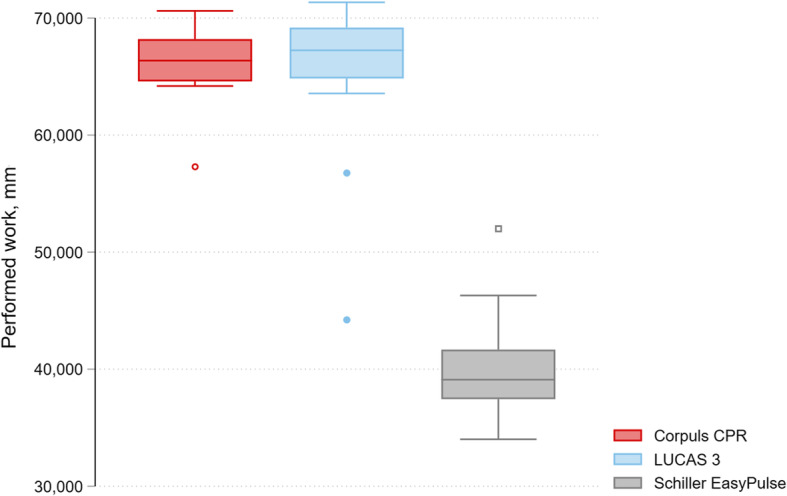
The primary outcome of performed work (defined as number of chest compressions x compression depth) was 66,062 mm (2832) with Corpuls CPR, 65,877 mm (6163) with Physio-Control LUCAS 3 and 40,177 mm (4396) with Schiller Easy Pulse. The difference both between LUCAS 3 and Easy Pulse (Δ 25,700; 95% confidence interval 21,118 - 30,282) and between Corpuls CPR and Easy Pulse (Δ 25,885; 23,590 - 28,181) was significant. No relevant differences were found regarding secondary outcomes.
Mechanical chest compression devices provide a viable option in the alpine setting. For two out of three devices (Corpuls CPR and LUCAS 3) we found adequate quality of CPR. Those devices also maintained a correct placement of the piston even during challenging terrestrial transport. Adequate hands-off-times and correct placement could be achieved even by less trained personnel.
在山区环境中进行心肺复苏具有挑战性。如果没有机械胸部按压设备,在运输或提升救援过程中几乎不可能进行连续的胸部按压。目前的证据主要基于城市救护车服务进行的研究。因此,我们旨在研究使用三种不同设备在高山陆地运输期间进行连续机械胸部按压的可行性。
在高山环境中进行的随机三交叉前瞻性研究。奥地利山地救援服务的 19 个小组按照当前 ERC 指南进行培训,使用三种不同的机械胸部按压设备进行了三次标准化高山救援场景的运行。测量 CPR 的质量、手离开时间和设备的位移。
主要结果(定义为按压次数×按压深度)为 Corpuls CPR 为 66,062 mm(2832),Physio-Control LUCAS 3 为 65,877 mm(6163),Schiller Easy Pulse 为 40,177 mm(4396)。LUCAS 3 和 Easy Pulse 之间(Δ 25,700;95%置信区间 21,118-30,282)和 Corpuls CPR 和 Easy Pulse 之间(Δ 25,885;23,590-28,181)的差异均具有统计学意义。次要结果未发现相关差异。
机械胸部按压设备在高山环境中是可行的选择。对于三种设备中的两种(Corpuls CPR 和 LUCAS 3),我们发现 CPR 的质量足够。这些设备即使在具有挑战性的陆地运输中也能保持活塞的正确位置。即使是训练较少的人员也可以实现足够的手离开时间和正确的放置。