Ramanadhan Shoba, Revette Anna C, Lee Rebekka M, Aveling Emma L
Department of Social and Behavioral Sciences, Harvard T.H. Chan School of Public Health, Boston, MA, 02115, USA.
Division of Population Sciences, Dana-Farber Cancer Institute, 450 Brookline Ave, Boston, MA, 02215, USA.
Implement Sci Commun. 2021 Jun 29;2(1):70. doi: 10.1186/s43058-021-00174-1.
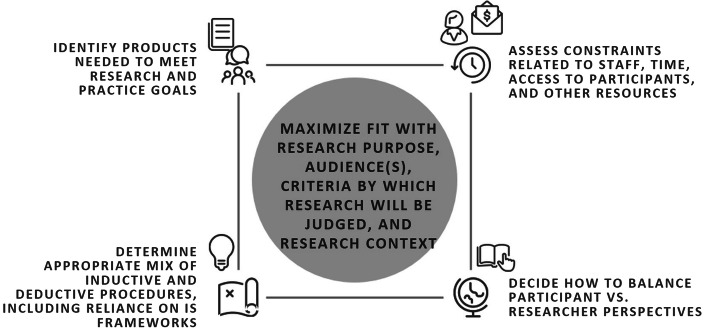
Qualitative methods are critical for implementation science as they generate opportunities to examine complexity and include a diversity of perspectives. However, it can be a challenge to identify the approach that will provide the best fit for achieving a given set of practice-driven research needs. After all, implementation scientists must find a balance between speed and rigor, reliance on existing frameworks and new discoveries, and inclusion of insider and outsider perspectives. This paper offers guidance on taking a pragmatic approach to analysis, which entails strategically combining and borrowing from established qualitative approaches to meet a study's needs, typically with guidance from an existing framework and with explicit research and practice change goals.Section 1 offers a series of practical questions to guide the development of a pragmatic analytic approach. These include examining the balance of inductive and deductive procedures, the extent to which insider or outsider perspectives are privileged, study requirements related to data and products that support scientific advancement and practice change, and strategic resource allocation. This is followed by an introduction to three approaches commonly considered for implementation science projects: grounded theory, framework analysis, and interpretive phenomenological analysis, highlighting core analytic procedures that may be borrowed for a pragmatic approach. Section 2 addresses opportunities to ensure and communicate rigor of pragmatic analytic approaches. Section 3 provides an illustrative example from the team's work, highlighting how a pragmatic analytic approach was designed and executed and the diversity of research and practice products generated.As qualitative inquiry gains prominence in implementation science, it is critical to take advantage of qualitative methods' diversity and flexibility. This paper furthers the conversation regarding how to strategically mix and match components of established qualitative approaches to meet the analytic needs of implementation science projects, thereby supporting high-impact research and improved opportunities to create practice change.
定性方法对于实施科学至关重要,因为它们为审视复杂性和纳入多样观点创造了机会。然而,要确定最适合实现特定实践驱动研究需求的方法可能具有挑战性。毕竟,实施科学家必须在速度与严谨性、对现有框架与新发现的依赖以及内部人员和外部人员观点的纳入之间找到平衡。本文就采用务实的分析方法提供指导,这需要从既定的定性方法中进行策略性的组合与借鉴,以满足研究需求,通常要在现有框架的指导下,并明确研究和实践变革目标。第1节提出了一系列实用问题,以指导务实分析方法的开发。这些问题包括审视归纳和演绎程序的平衡、内部人员或外部人员观点被优先考虑的程度、与支持科学进步和实践变革的数据及产品相关的研究要求,以及战略资源分配。接下来介绍了实施科学项目通常考虑的三种方法:扎根理论、框架分析和解释现象学分析,强调了可用于务实方法的核心分析程序。第2节讨论了确保并传达务实分析方法严谨性的机会。第3节提供了团队工作的一个示例,突出了务实分析方法是如何设计和执行的,以及所产生的研究和实践产品的多样性。随着定性探究在实施科学中日益突出,利用定性方法的多样性和灵活性至关重要。本文进一步探讨了如何从策略上混合和匹配既定定性方法的组成部分,以满足实施科学项目的分析需求,从而支持高影响力的研究,并增加创造实践变革的机会。