Department of Social and Behavioral Sciences, Harvard T. H. Chan School of Public Health, Boston, MA, United States.
Division of General Internal Medicine, Massachusetts General Hospital, Boston, MA, United States.
Front Public Health. 2020 Jun 26;8:213. doi: 10.3389/fpubh.2020.00213. eCollection 2020.
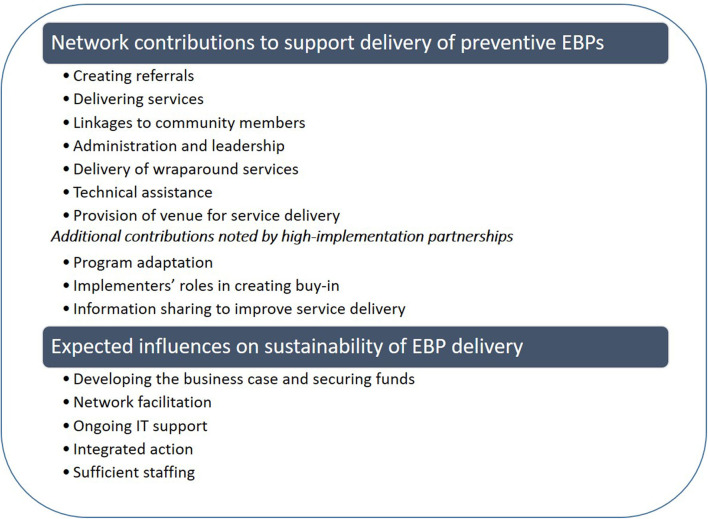
Increased delivery of evidence-based preventive services can improve population health and increase health equity. Community-clinical partnerships offer particular promise, but delivery and sustainment of preventive services through these systems face several challenges related to service integration and collaboration. We used a social network analysis perspective to explore (a) the range of contributions made by community-clinical partnership network members to support the delivery of evidence-based preventive services and (b) important influences on the ability of these partnerships to sustain service delivery. Data come from an implementation evaluation of the Prevention and Wellness Trust Fund initiative, which supported nine Massachusetts communities to coordinate delivery of evidence-based prevention and address inequities in hypertension, pediatric asthma, falls among older adults, or tobacco use. In 2016, we conducted semi-structured interviews with (a) leadership teams representing nine community-level partnerships and (b) practitioners from four high-implementation partnerships ( = 23). We managed data using NVivo11 and utilized a framework analysis approach. Key network contributions for delivery of evidence-based preventive services included creating referrals, delivering services, providing links to community members, and administration and leadership. Less emphasized contributions included wraparound services, technical assistance, and venue provision. Implementers from high-implementation partnerships also highlighted contributions such as program adaptation, creating buy-in, and sharing information to improve service delivery. Expected drivers of program sustainability included the ability to develop a business case, ongoing network facilitation, technology support, continued integrated action, and sufficient staffing to maintain programming. The study highlights the need to take a long-term, infrastructure-focused approach when designing community-clinical partnerships. Strategic partnership composition, including identifying sources of necessary network contributions, in conjunction with efforts from the outset to link systems, align effort, and build a long-term funding structure can support the required coordinated action around preventive services needed to improve health equity.
增加循证预防服务的提供可以改善人群健康并提高健康公平性。社区-临床合作伙伴关系尤其有前景,但通过这些系统提供和维持预防服务面临与服务整合和协作相关的若干挑战。我们使用社会网络分析的视角来探讨:(a)社区-临床伙伴关系网络成员为支持提供循证预防服务而做出的各种贡献;(b)这些伙伴关系维持服务提供能力的重要影响因素。数据来自预防和健康信托基金倡议的实施评估,该倡议支持马萨诸塞州的 9 个社区协调提供循证预防服务,并解决高血压、儿童哮喘、老年人跌倒和烟草使用方面的不平等问题。2016 年,我们对(a)代表 9 个社区一级伙伴关系的领导团队,以及(b)来自 4 个高实施水平伙伴关系的从业者进行了半结构化访谈(=23)。我们使用 NVivo11 管理数据,并采用框架分析方法。提供循证预防服务的关键网络贡献包括建立转介、提供服务、与社区成员建立联系,以及管理和领导。不太强调的贡献包括全面服务、技术援助和提供场地。来自高实施水平伙伴关系的实施者还强调了计划调整、建立共识和分享信息以改善服务提供等贡献。计划可持续性的预期驱动因素包括制定商业案例的能力、持续的网络促进、技术支持、持续的综合行动以及足够的人员配备以维持项目规划。该研究强调了在设计社区-临床伙伴关系时需要采取长期的、注重基础设施的方法。战略性的伙伴关系组成,包括确定必要网络贡献的来源,以及从一开始就努力连接系统、协调努力和建立长期资金结构,可以支持围绕改善健康公平所需的预防服务进行必要的协调行动。