CAS Key Laboratory of Pathogenic Microbiology and Immunology, Institute of Microbiology, Chinese Academy of Sciences (CAS), Beijing 100101, China.
Institute of Physical Science and Information Technology, Anhui University, Hefei 230039, China.
Trends Biochem Sci. 2021 Oct;46(10):848-860. doi: 10.1016/j.tibs.2021.06.001. Epub 2021 Jun 7.
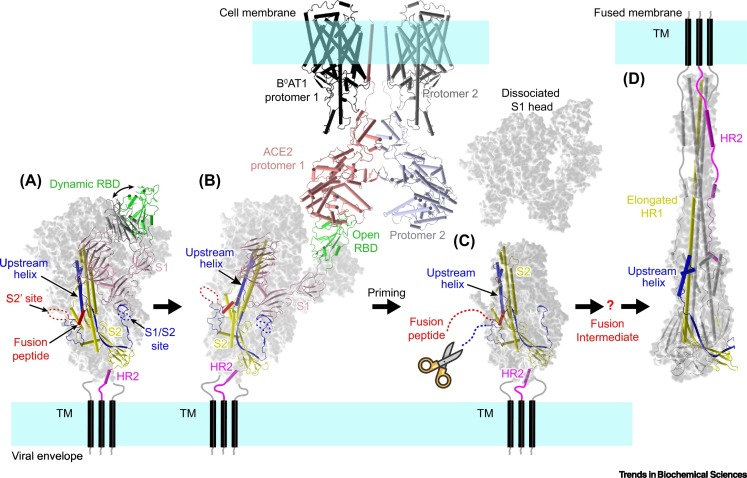
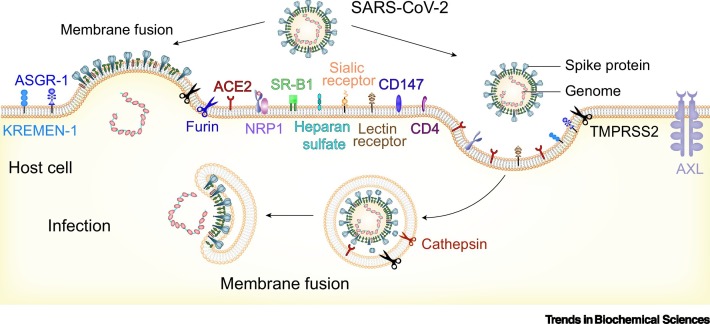
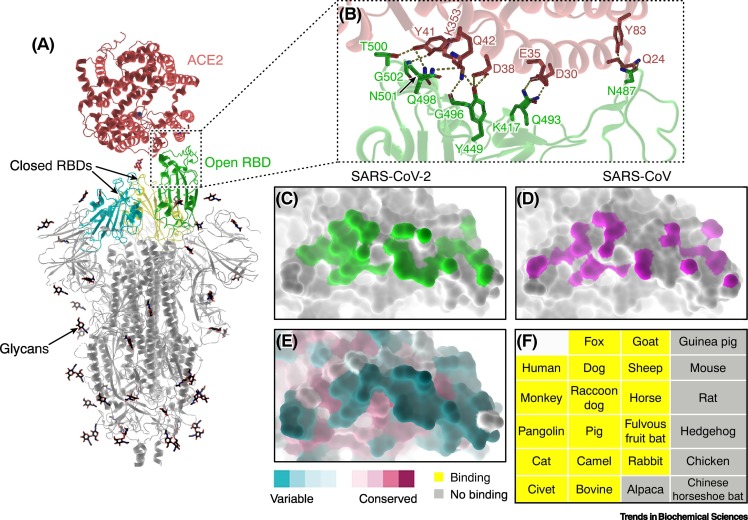
Severe acute respiratory syndrome virus 2 (SARS-CoV-2) invades host cells by interacting with receptors/coreceptors, as well as with other cofactors, via its spike (S) protein that further mediates fusion between viral and cellular membranes. The host membrane protein, angiotensin-converting enzyme 2 (ACE2), is the major receptor for SARS-CoV-2 and is a crucial determinant for cross-species transmission. In addition, some auxiliary receptors and cofactors are also involved that expand the host/tissue tropism of SARS-CoV-2. After receptor engagement, specific proteases are required that cleave the S protein and trigger its fusogenic activity. Here we discuss the recent advances in understanding the molecular events during SARS-CoV-2 entry which will contribute to developing vaccines and therapeutics.
严重急性呼吸综合征冠状病毒 2(SARS-CoV-2)通过其刺突(S)蛋白与受体/共受体以及其他辅助因子相互作用,进一步介导病毒和细胞膜之间的融合,从而入侵宿主细胞。宿主膜蛋白血管紧张素转换酶 2(ACE2)是 SARS-CoV-2 的主要受体,也是种间传播的关键决定因素。此外,还涉及一些辅助受体和辅助因子,这些因子扩大了 SARS-CoV-2 的宿主/组织嗜性。在受体结合后,需要特定的蛋白酶来切割 S 蛋白并触发其融合活性。在这里,我们讨论了对 SARS-CoV-2 进入过程中分子事件的理解的最新进展,这将有助于开发疫苗和治疗方法。