Vaquer Andreu, Alba-Patiño Alejandra, Adrover-Jaume Cristina, Russell Steven M, Aranda María, Borges Marcio, Mena Joana, Del Castillo Alberto, Socias Antonia, Martín Luisa, Arellano María Magdalena, Agudo Miguel, Gonzalez-Freire Marta, Besalduch Manuela, Clemente Antonio, Barón Enrique, de la Rica Roberto
Multidisciplinary Sepsis Group, Health Research Institute of the Balearic Islands (IdISBa), Spain.
University of the Balearic Islands, Chemistry Department, Palma de Mallorca, Spain.
Sens Actuators B Chem. 2021 Oct 15;345:130347. doi: 10.1016/j.snb.2021.130347. Epub 2021 Jun 24.
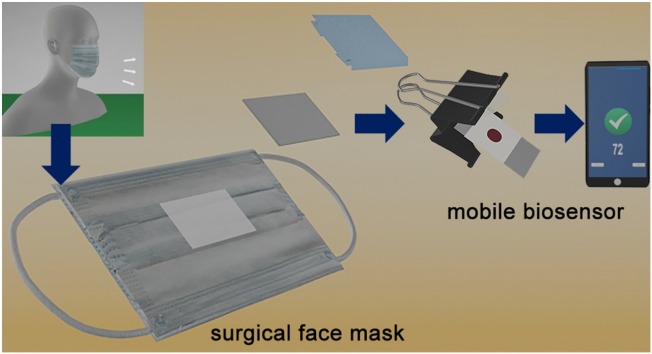
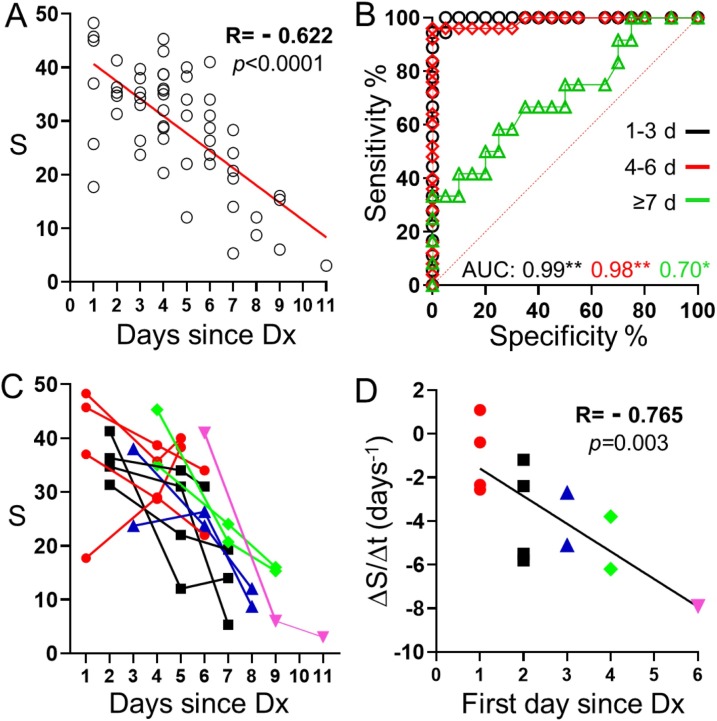
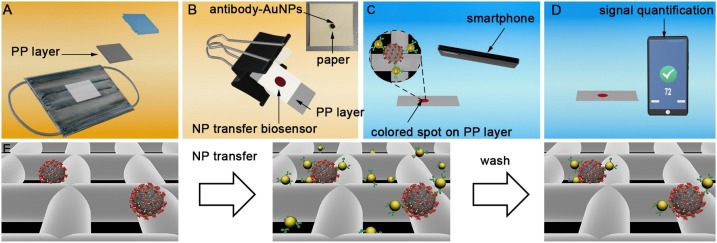
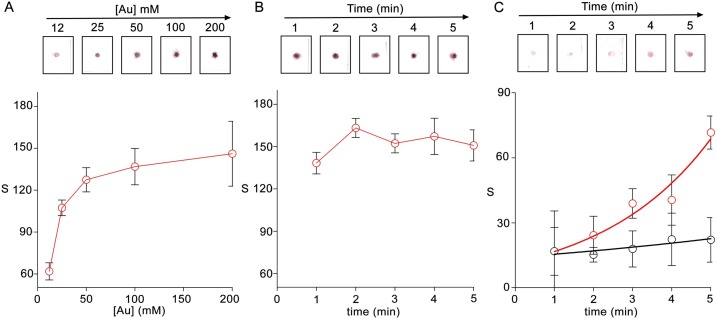
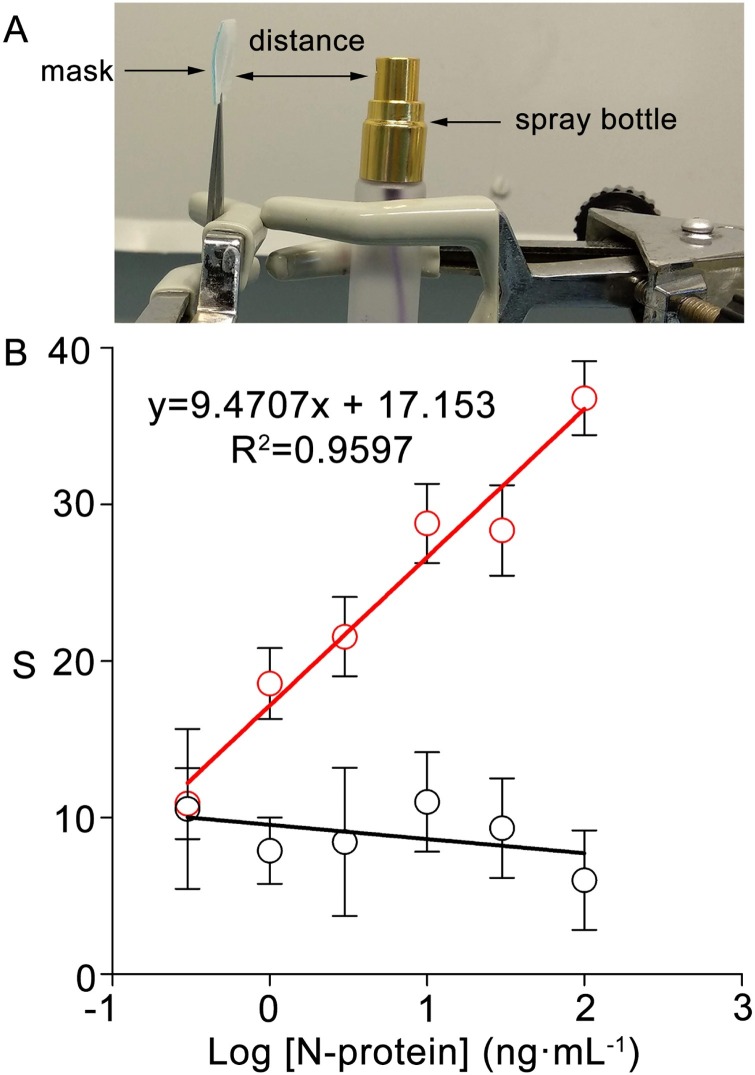
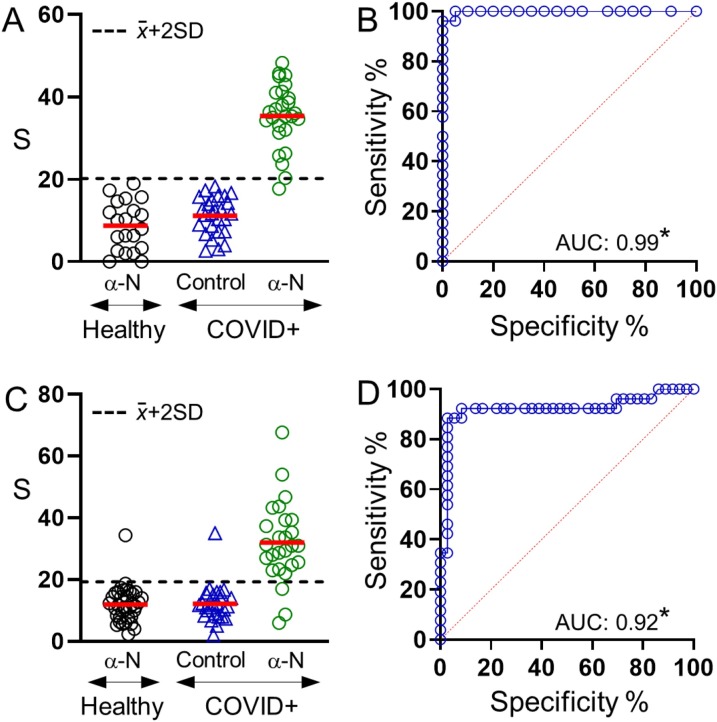
Detecting SARS-CoV-2 antigens in respiratory tract samples has become a widespread method for screening new SARS-CoV-2 infections. This requires a nasopharyngeal swab performed by a trained healthcare worker, which puts strain on saturated healthcare services. In this manuscript we describe a new approach for non-invasive COVID-19 diagnosis. It consists of using mobile biosensors for detecting viral antigens trapped in surgical face masks worn by patients. The biosensors are made of filter paper containing a nanoparticle reservoir. The nanoparticles transfer from the biosensor to the mask on contact, where they generate colorimetric signals that are quantified with a smartphone app. Sample collection requires wearing a surgical mask for 30 min, and the total assay time is shorter than 10 min. When tested in a cohort of 27 patients with mild or no symptoms, an area under the receiving operating curve (AUROC) of 0.99 was obtained (96.2 % sensitivity and 100 % specificity). Serial measurements revealed a high sensitivity and specificity when masks were worn up to 6 days after diagnosis. Surgical face masks are inexpensive and widely available, which makes this approach easy to implement anywhere. The excellent sensitivity, even when tested with asymptomatic patient samples, along with the mobile detection scheme and non-invasive sampling procedure, makes this biosensor design ideal for mass screening.
在呼吸道样本中检测严重急性呼吸综合征冠状病毒2(SARS-CoV-2)抗原已成为筛查新型SARS-CoV-2感染的一种广泛应用的方法。这需要由训练有素的医护人员进行鼻咽拭子采样,这给饱和的医疗服务带来了压力。在本手稿中,我们描述了一种用于非侵入性新型冠状病毒肺炎(COVID-19)诊断的新方法。它包括使用移动生物传感器来检测被困在患者佩戴的外科口罩中的病毒抗原。生物传感器由含有纳米颗粒储存库的滤纸制成。纳米颗粒在接触时从生物传感器转移到口罩上,在那里它们产生比色信号,并用智能手机应用程序进行定量。样本采集需要佩戴外科口罩30分钟,总检测时间短于10分钟。在一组27例轻度或无症状患者中进行测试时,获得的受试者工作特征曲线下面积(AUROC)为0.99(灵敏度为96.2%,特异性为100%)。连续测量显示,在诊断后佩戴口罩长达6天的情况下,具有高灵敏度和特异性。外科口罩价格低廉且广泛可得,这使得这种方法易于在任何地方实施。即使在对无症状患者样本进行测试时也具有出色的灵敏度,再加上移动检测方案和非侵入性采样程序,使得这种生物传感器设计成为大规模筛查的理想选择。