Lee Jordan T, Wagoner Chad W, Sullivan Stephanie A, Amatuli Dean J, Nyrop Kirsten A, Hanson Erik D, Stoner Lee, Jensen Brian C, Muss Hyman B, Battaglini Claudio L
Department of Exercise and Sport Science, University of North Carolina at Chapel Hill, Chapel Hill, NC 27599, United States.
Lineberger Comprehensive Cancer Center, University of North Carolina at Chapel Hill, Chapel Hill, NC 27599, United States.
World J Clin Oncol. 2021 Jun 24;12(6):468-481. doi: 10.5306/wjco.v12.i6.468.
Evidence for exercise as an efficacious strategy to improve aerobic capacity of breast cancer survivors (BCS) has come largely from intervention studies conducted in laboratory settings. There is an increasing need to translate to community-type settings, but the efficacy of those interventions using gold standard evaluation is not well-established.
To investigate whether similar improvement in aerobic capacity (maximal oxygen consumption [VO]) measured with gold standard testing can be achieved through a community-based setting in BCS.
A peak cardiopulmonary exercise test (VO), 6-min walk test (6MWT), and timed up and go test (TUG) were assessed pre- and post-16 wk of progressive intensity aerobic and strength training exercise at a community center.
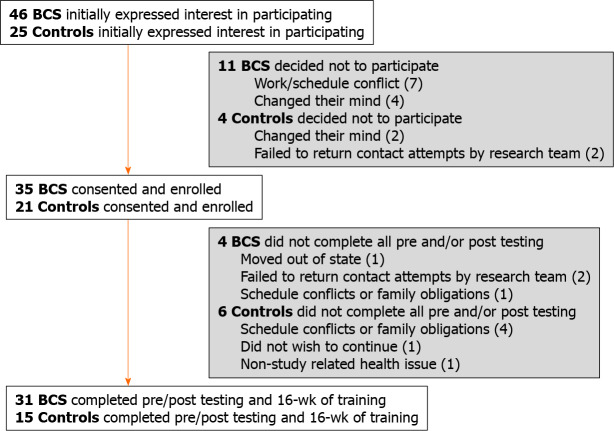
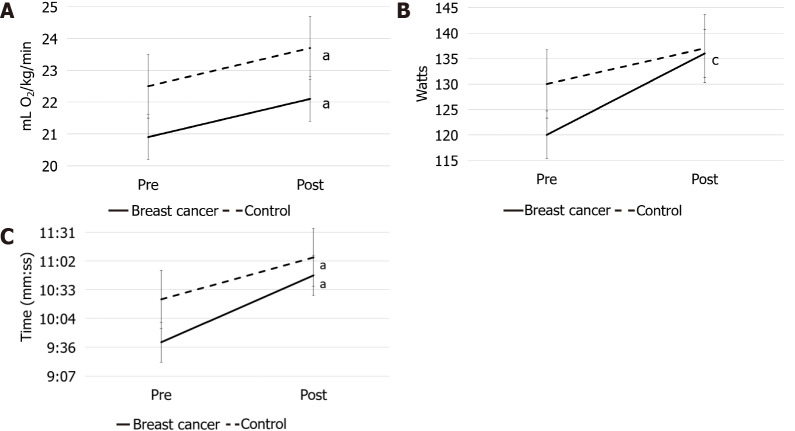
The sample consisted of 31 early BCS (< 1 year since treatment completion) and 15 controls (CTLs). Both groups significantly improved VO (+1.2 mL/kg/min; = 0.030), 6MWT (+35 meters; < 0.001), and TUG (-0.44 s; < 0.01) following training. Both groups improved peak cycling power during the cardiopulmonary exercise test with BCS improving by +10 watts more than the CTLs ( = 0.020). Average exercise attendance was 71% (34 of 48 possible days), but compliant days averaged only 60% of total days for aerobic, and < 40% for strength in both groups.
Community-based exercise programs can be an effective strategy to improve aerobic capacity and physical function for early-stage BCS but potentially not to the same extent observed in laboratory-based randomized controlled trials. Further research is needed to explore barriers and facilitators of exercise engagement in community-based centers to maximize training benefits for adults with cancer.
运动作为提高乳腺癌幸存者(BCS)有氧能力的有效策略,其证据主要来自在实验室环境中进行的干预研究。越来越需要将其转化到社区类型的环境中,但使用金标准评估的那些干预措施的效果尚未得到充分证实。
研究通过社区环境,BCS能否通过金标准测试在有氧能力(最大耗氧量[VO])方面实现类似的改善。
在社区中心对31名早期BCS(治疗完成后<1年)和15名对照组(CTLs)进行了为期16周的渐进性强度有氧和力量训练运动前后的心肺运动峰值测试(VO)、6分钟步行测试(6MWT)和定时起立行走测试(TUG)。
样本包括31名早期BCS和15名对照组。两组在训练后VO(+1.2毫升/千克/分钟;P = 0.030)、6MWT(+35米;P < 0.001)和TUG(-0.44秒;P < 0.01)均有显著改善。两组在心肺运动测试中的峰值骑行功率均有所提高,BCS组比CTLs组多提高了10瓦(P = 0.020)。平均运动参与率为71%(48个可能的日子中有34天),但两组中,有氧运动的依从天数平均仅占总天数的60%,力量训练的依从天数<40%。
基于社区的运动计划可以是提高早期BCS有氧能力和身体功能的有效策略,但可能无法达到在基于实验室的随机对照试验中观察到的相同程度。需要进一步研究以探索社区中心运动参与的障碍和促进因素,以使癌症成年患者获得最大的训练益处。