Yeung Jerf W K
Department of Social and Behavioural Sciences, City University of Hong Kong, Kowloon, Hong Kong, China.
Braz J Psychiatry. 2022 Jan-Feb;44(1):46-56. doi: 10.1590/1516-4446-2020-1576.
To investigate the effects of developing religiosity on abstinence of substance abuse among recovering addicts in a faith-based and a secular-based treatment program.
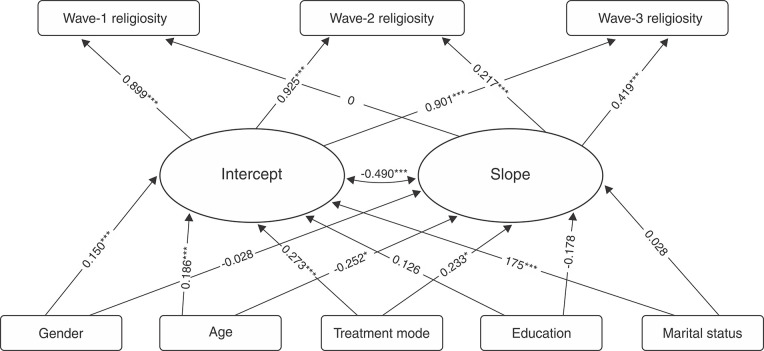
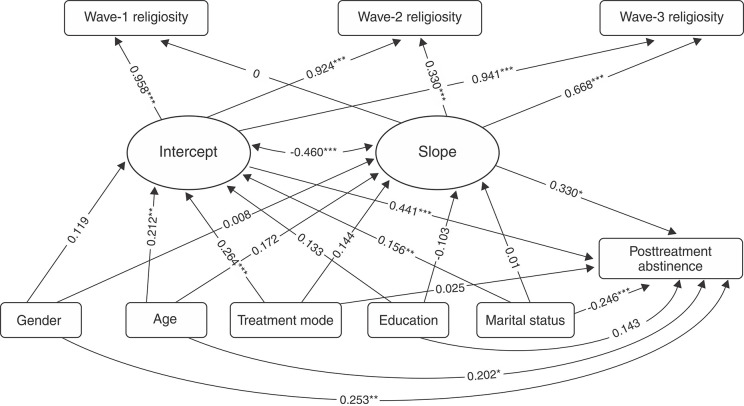
Religiosity of recovering addicts was measured using the 38-item Brief Multidimensional Measure of Religiousness/Spirituality at three points in time: at initiation of substance addiction treatment (wave 1), discharge from treatment (wave 2), and 6 months after treatment (wave 3). Latent growth curve modeling was used to assess the dynamic and developing effects of religiosity on after-treatment abstinence. Secular-based treatment emphasized the role of biological, psychological, and environmental determinants of substance abuse and provided detoxification interventions, such as counseling and group therapies, skill training, health care, and social support, however also relying on religious and spiritual growth to help recovery. Faith-based treatment fundamentally emphasized the Christian theory of addiction to consider substance abuse a sin caused by one's spiritual void and separation from God, although it also acknowledged the importance of biological, psychological, and social needs of rehabilitants.
Recovering addicts in faith-based treatment had significantly higher levels of religiosity at each wave (intercept factor) and better religious development across the three waves (slope factor). This contributed to after-treatment abstinence and mediated the effect of treatment mode on after-treatment abstinence.
Service practitioners and researchers should note the importance of dynamic and developing nature of religiosity in relation to the maintenance of abstinence after treatment is completed.
研究在基于信仰和基于世俗的治疗项目中,康复期成瘾者宗教虔诚度的发展对药物滥用戒断的影响。
使用38项宗教性/精神性简短多维量表,在三个时间点测量康复期成瘾者的宗教虔诚度:药物成瘾治疗开始时(第1波)、治疗出院时(第2波)以及治疗后6个月(第3波)。采用潜在增长曲线模型评估宗教虔诚度对治疗后戒断的动态和发展影响。基于世俗的治疗强调药物滥用的生物学、心理学和环境决定因素的作用,并提供解毒干预措施,如咨询和团体治疗、技能培训、医疗保健和社会支持,但也依赖宗教和精神成长来帮助康复。基于信仰的治疗从根本上强调基督教成瘾理论,认为药物滥用是由个人精神空虚和与上帝分离导致的罪恶,尽管它也承认康复者生物学、心理和社会需求的重要性。
接受基于信仰治疗的康复期成瘾者在每一波次(截距因子)的宗教虔诚度显著更高,并且在三个波次中宗教发展更好(斜率因子)。这有助于治疗后的戒断,并介导了治疗模式对治疗后戒断的影响。
服务从业者和研究人员应注意宗教虔诚度的动态和发展性质对于治疗完成后维持戒断的重要性。