Organização Mundial de Saúde, Oficina Central de Enfermagem, Genebra, GE, Switzerland.
Universidade do Estado do Rio de Janeiro, Instituto de Medicina Social, Rio de Janeiro, RJ, Brazil.
Rev Lat Am Enfermagem. 2021 Jun 28;29:e3417. doi: 10.1590/1518-8345.4725.3417. eCollection 2021.
this study aims to analyze and characterize the movement of expansion of Nursing undergraduate courses in Brazil since the 1990s. The characteristics of this expansion are discussed, as well as the socio-political setting where such movement occurred, and the quality of education available based on the data collected.
this is a descriptive and cross-sectional study with a quali-quantitative approach, with the use of secondary databases.
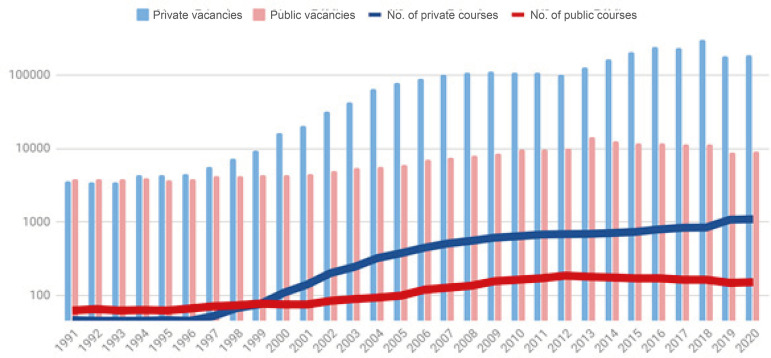
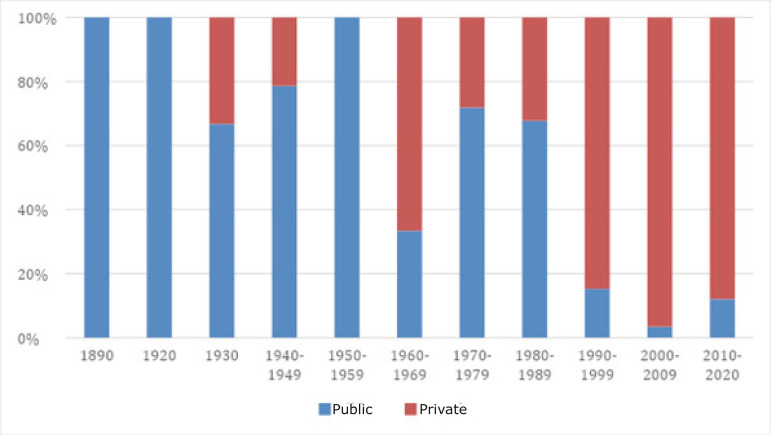
an accelerated and disordered growth of Nursing undergraduate courses was identified, as well as the number of vacancies, especially due to the participation of the private sector, especially since the year 2000. Geographical inequalities in the distribution of these courses and vacancies were also identified.
the strong expansion of higher education in Nursing, along with other health professions, resulted in the strengthening of private higher education institutions associated with economic groups, regional concentration, as well as the excessive offer of distance learning without adequate evaluation of its quality or repercussions.
本研究旨在分析和描述 20 世纪 90 年代以来巴西护理本科课程的扩张情况。讨论了这种扩张的特点,以及发生这种扩张的社会政治背景,以及根据收集的数据提供的教育质量。
这是一项描述性和横断面研究,采用定性和定量方法,并使用二级数据库。
确定了护理本科课程的加速和无序增长,以及空缺职位的数量,特别是自 2000 年以来,由于私营部门的参与,这种情况更为明显。还发现了这些课程和空缺职位在地理分布上的不平等。
护理专业以及其他卫生专业的高等教育的强劲扩张,导致了与经济集团相关的私立高等教育机构的加强,以及区域集中,以及远程教育的过度提供,而没有对其质量或影响进行适当评估。