Department of Health Psychology and Research Methodology, Faculty of Medicine, P.J. Safarik University in Kosice, Trieda SNP 1, 04011 Kosice, Slovakia.
Institute of Social Medicine and Medical Ethics, Faculty of Medicine, Comenius University in Bratislava, Sasinkova 2, 81372 Bratislava, Slovakia.
Int J Environ Res Public Health. 2021 Jun 4;18(11):6055. doi: 10.3390/ijerph18116055.
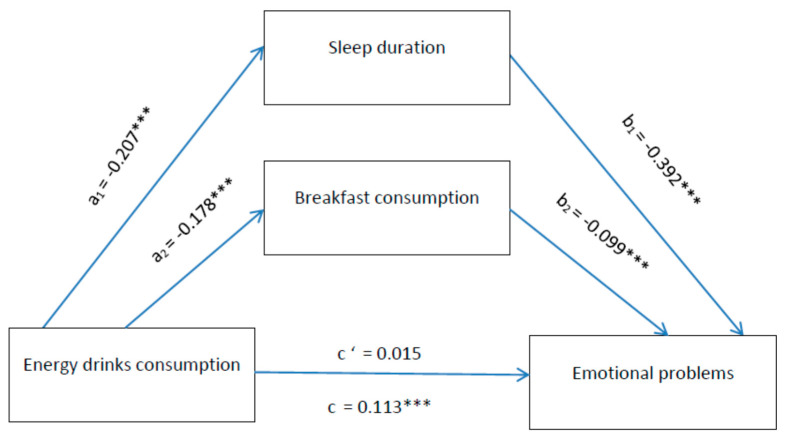
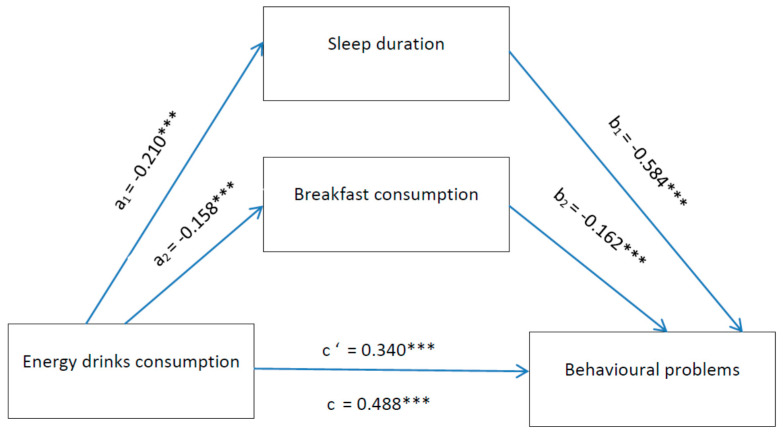
The aim of our study was to explore whether energy drink consumption is associated with both emotional and behavioural problems and whether this association might be mediated by amount of sleep and breakfast consumption among adolescents. The nationally representative Health Behaviour in School-aged Children (HBSC) study, realised in 2018 in Slovakia in schools, was used to acquire needed data, with the research sample of 8405 adolescents from 11 to 15 years old (mean age = 13.43; 50.9% boys) who completed the questionnaires on their own in a presence of researchers and research assistants. Emotional and behavioural problems were assessed by a Strengths and Difficulties Questionnaire, while energy drinks consumption, breakfast consumption and sleep duration was assessed by questions in line with the HBSC study protocol. Linear regression models assessed the associations between energy drinks consumption and emotional and behavioural problems. Mediation by sleep duration and breakfast consumption was assessed with parallel mediation models. Energy drink consumption was significantly associated with emotional ( < 0.001) and behavioural problems ( < 0.001), with higher consumption of energy drinks leading to more emotional and behavioural problems. Results from a parallel mediation analysis indicated that energy drink consumption is indirectly related to both emotional and behavioural problems through its relationship with the amount of sleep and breakfast consumption. Parents and professionals working with adolescents should be aware that unhealthy dietary habits and lack of sleep might be related to emotional and behavioural problems.
本研究旨在探讨青少年能量饮料的消费是否与情绪和行为问题有关,以及这种关联是否可以通过睡眠量和早餐摄入量来解释。研究使用了在 2018 年于斯洛伐克学校进行的具有全国代表性的青少年健康行为调查(HBSC)的数据,研究样本为 8405 名 11 至 15 岁的青少年(平均年龄=13.43;50.9%为男性),他们在研究人员和研究助理的陪同下独立完成了问卷。情绪和行为问题通过《长处和困难问卷》进行评估,而能量饮料消费、早餐消费和睡眠时间则通过符合 HBSC 研究方案的问题进行评估。线性回归模型评估了能量饮料消费与情绪和行为问题之间的关联。通过平行中介模型评估了睡眠持续时间和早餐消费的中介作用。能量饮料的消费与情绪(<0.001)和行为问题(<0.001)显著相关,能量饮料消费越高,情绪和行为问题越多。平行中介分析的结果表明,能量饮料的消费通过与睡眠量和早餐消费的关系,间接地与情绪和行为问题相关。与青少年一起工作的家长和专业人士应该意识到,不健康的饮食习惯和睡眠不足可能与情绪和行为问题有关。