Ohgitani Eriko, Shin-Ya Masaharu, Ichitani Masaki, Kobayashi Makoto, Takihara Takanobu, Kawamoto Masaya, Kinugasa Hitoshi, Mazda Osam
Department of Immunology, Kyoto Prefectural University of Medicine, Kamigyo, Kyoto 602-8566, Japan.
Central Research Institute, ITO EN, Ltd., Makinohara, Shizuoka 421-0516, Japan.
Pathogens. 2021 Jun 8;10(6):721. doi: 10.3390/pathogens10060721.
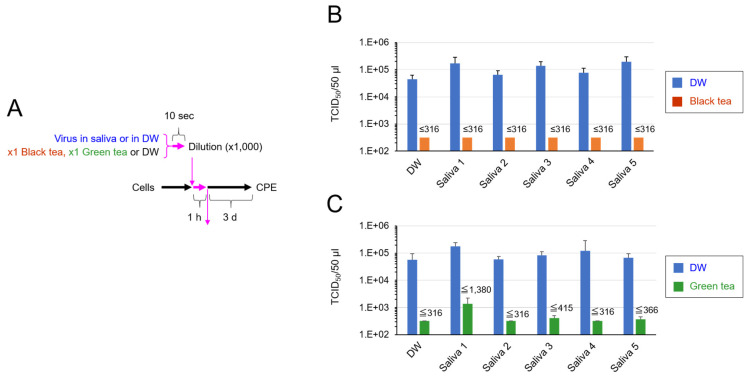
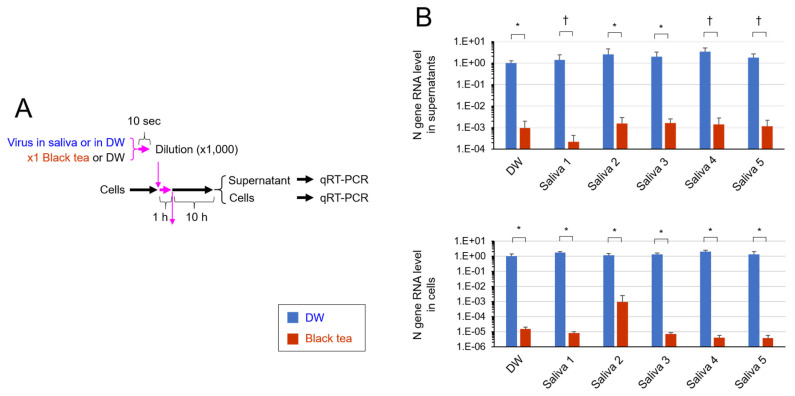
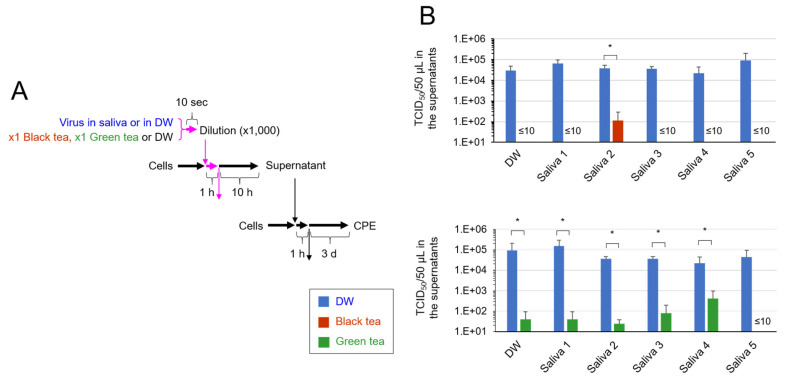
Saliva plays major roles in the human-to-human transmission of SARS-CoV-2. If the virus in saliva in SARS-CoV-2-infected individuals can be rapidly and efficiently inactivated by a beverage, the ingestion of the beverage may attenuate the spread of virus infection within a population. Recently, we reported that SARS-CoV-2 was significantly inactivated by treatment with black tea, green tea, roasted green tea and oolong tea, as well as their constituents, (-) epigallocatechin gallate (EGCG), theasinensin A (TSA), and galloylated theaflavins. However, it remains unclear to what extent tea inactivates the virus present in saliva, because saliva contains various proteins, nitrogenous products, electrolytes, and so on, which could influence the antivirus effect of tea. Here, we assessed whether tea inactivated the SARS-CoV-2 which was added in human saliva. A virus was added in healthy human saliva in vitro, and after treatment with black tea or green tea, the infectivity of the virus was evaluated by TCID assays. The virus titer fell below the detectable level or less than 1/100 after treatment with black tea or green tea for 10 s. The black tea-treated virus less remarkably replicated in cells compared with the untreated virus. These findings suggest the possibility that the ingestion of tea may inactivate SARS-CoV-2 in saliva in infected individuals, although clinical studies are required to determine the intensity and duration of the anti-viral effect of tea in saliva in humans.
唾液在严重急性呼吸综合征冠状病毒2(SARS-CoV-2)的人际传播中起主要作用。如果一种饮料能快速有效地灭活SARS-CoV-2感染个体唾液中的病毒,那么摄入这种饮料可能会减弱病毒在人群中的传播。最近,我们报道了红茶、绿茶、烤绿茶和乌龙茶及其成分(-)表没食子儿茶素没食子酸酯(EGCG)、茶黄素A(TSA)和没食子酰化茶黄素能显著灭活SARS-CoV-2。然而,尚不清楚茶在多大程度上能灭活唾液中存在的病毒,因为唾液含有各种蛋白质、含氮产物、电解质等,这些可能会影响茶的抗病毒效果。在此,我们评估了茶是否能灭活添加到人类唾液中的SARS-CoV-2。在体外将病毒添加到健康人的唾液中,用红茶或绿茶处理后,通过半数组织培养感染剂量(TCID)试验评估病毒的感染性。用红茶或绿茶处理10秒后,病毒滴度降至检测水平以下或低于1/100。与未处理的病毒相比,经红茶处理的病毒在细胞中的复制明显减少。这些发现表明,摄入茶可能会灭活感染个体唾液中的SARS-CoV-2,不过还需要临床研究来确定茶对人类唾液中病毒的抗病毒作用强度和持续时间。