
通过下调根部的 和 以及上调 和 来限制糖分向定殖菌株的流失。
Restricts Sugar Loss to a Colonizing Strain by Downregulating and and Upregulation of and in the Roots.
作者信息
Rouina Hamid, Tseng Yu-Heng, Nataraja Karaba N, Uma Shaanker Ramanan, Oelmüller Ralf
机构信息
Department of Plant Physiology, Matthias Schleiden Institute of Genetics, Bioinformatics and Molecular Botany, Friedrich-Schiller-University Jena, 07743 Jena, Germany.
Department of Crop Physiology, University of Agricultural Sciences, GKVK, Bangalore 560065, Karnataka, India.
出版信息
Microorganisms. 2021 Jun 8;9(6):1246. doi: 10.3390/microorganisms9061246.
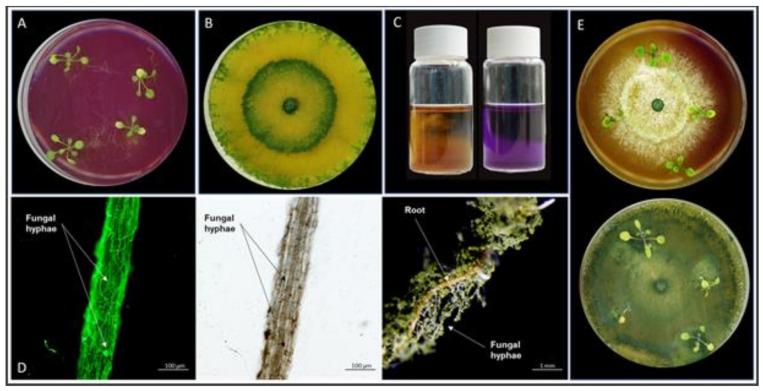
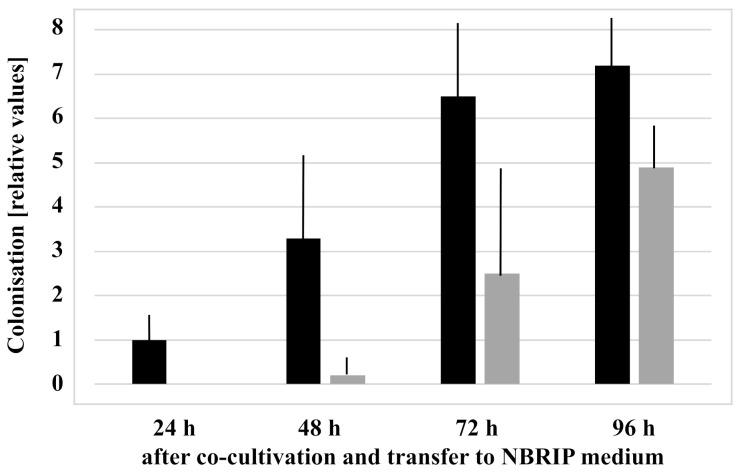
Phosphate (Pi) availability has a strong influence on the symbiotic interaction between and a recently described root-colonizing beneficial strain. When transferred to media with insoluble Ca(PO) as a sole Pi source, seedlings died after 10 days. grew on the medium containing Ca(PO) and the fungus did colonize in roots, stems, and shoots of the host. The efficiency of the photosynthetic electron transport of the colonized seedlings grown on Ca(PO) medium was reduced and the seedlings died earlier, indicating that the fungus exerts an additional stress to the plant. Interestingly, the fungus initially alleviated the Pi starvation response and did not activate defense responses against the hyphal propagation. However, in colonized roots, the sucrose transporter genes and - were strongly down-regulated, restricting the unloading of sucrose from the phloem parenchyma cells to the apoplast. Simultaneously, up-regulation of promoted sucrose uptake from the apoplast into the parenchyma cells and of sequestration of sucrose in the vacuole of the root cells. We propose that the fungus tries to escape from the Ca(PO) medium and colonizes the entire host. To prevent excessive sugar consumption by the propagating hyphae, the host restricts sugar availability in its apoplastic root space by downregulating sugar transporter genes for phloem unloading, and by upregulating transporter genes which maintain the sugar in the root cells.
磷酸盐(Pi)的可利用性对[植物名称]与最近描述的一种定殖于根部的有益[真菌名称]菌株之间的共生相互作用有强烈影响。当转移到以不溶性Ca₃(PO₄)₂作为唯一Pi来源的培养基中时,[植物名称]幼苗在10天后死亡。[真菌名称]在含有Ca₃(PO₄)₂的培养基上生长,并且该真菌确实定殖于宿主的根、茎和叶中。在Ca₃(PO₄)₂培养基上生长的定殖幼苗的光合电子传递效率降低,并且幼苗更早死亡,这表明该真菌对植物施加了额外的胁迫。有趣的是,该真菌最初减轻了Pi饥饿反应,并且没有激活针对菌丝繁殖的防御反应。然而,在定殖的根中,蔗糖转运蛋白基因[基因名称1]和[基因名称2]被强烈下调,限制了蔗糖从韧皮薄壁细胞卸载到质外体。同时,[基因名称3]的上调促进了蔗糖从质外体吸收到薄壁细胞中,以及[基因名称4]的上调促进了蔗糖在根细胞液泡中的隔离。我们提出,该真菌试图逃离Ca₃(PO₄)₂培养基并定殖于整个宿主。为了防止繁殖的菌丝过度消耗糖分,宿主通过下调用于韧皮部卸载的糖转运蛋白基因以及上调将糖维持在根细胞中的转运蛋白基因,来限制其根质外体空间中的糖可用性。




 Zotero 插件