Lau Siew Wen, Chong Ann Qi, Chin Nyuk Ling, Talib Rosnita A, Basha Roseliza Kadir
Department of Process and Food Engineering, Faculty of Engineering, Universiti Putra Malaysia, Serdang 43400, Selangor, Malaysia.
Microorganisms. 2021 Jun 23;9(7):1355. doi: 10.3390/microorganisms9071355.
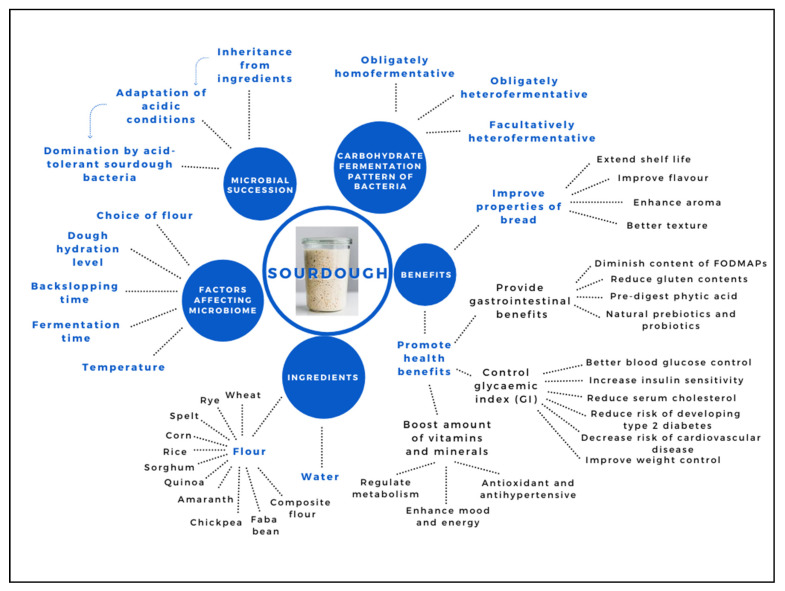
Sourdough is the oldest form of leavened bread used as early as 2000 BC by the ancient Egyptians. It may have been discovered by accident when wild yeast drifted into dough that had been left out resulting in fermentation of good microorganisms, which made bread with better flavour and texture. The discovery was continued where sourdough was produced as a means of reducing wastage with little known (at that point of time) beneficial effects to health. With the progress and advent of science and technology in nutrition, sourdough fermentation is now known to possess many desirable attributes in terms of health benefits. It has become the focus of attention and practice in modern healthy eating lifestyles when linked to the secret of good health. The sourdough starter is an excellent habitat where natural and wild yeast plus beneficial bacteria grow by ingesting only water and flour. As each sourdough starter is unique, with different activities, populations and interactions of yeast and bacteria due to different ingredients, environment, fermentation time and its carbohydrate fermentation pattern, there is no exact elucidation on the complete make-up of the sourdough microbiome. Some lactic acid bacteria (LAB) strains that are part of the sourdough starter are considered as probiotics which have great potential for improving gastrointestinal health. Hence, from a wide literature surveyed, this paper gives an overview of microbial communities found in different sourdough starters. This review also provides a systematic analysis that identifies, categorises and compares these microbes in the effort of linking them to specific functions, particularly to unlock their health benefits.
酸面团是最古老的发酵面包形式,早在公元前2000年古埃及人就开始使用。它可能是在野生酵母偶然飘入放置在外的面团中时被发现的,这导致了有益微生物的发酵,从而使面包具有更好的风味和口感。随着这一发现的延续,酸面团被生产出来,作为一种减少浪费的方法,而当时人们对其对健康的有益影响知之甚少。随着营养科学技术的进步和出现,现在已知酸面团发酵在健康益处方面具有许多理想的特性。当与健康的秘诀联系起来时,它已成为现代健康饮食生活方式中的关注焦点和实践方式。酸面团发酵剂是一个绝佳的栖息地,天然和野生酵母以及有益细菌仅通过摄入水和面粉就能生长。由于不同的成分、环境、发酵时间及其碳水化合物发酵模式,每个酸面团发酵剂都是独特的,酵母和细菌具有不同的活性、数量和相互作用,因此酸面团微生物群的完整组成尚无确切的阐释。作为酸面团发酵剂一部分的一些乳酸菌菌株被认为是益生菌,对改善胃肠道健康具有巨大潜力。因此,通过广泛查阅文献,本文概述了在不同酸面团发酵剂中发现的微生物群落。本综述还提供了一种系统分析,对这些微生物进行识别、分类和比较,以便将它们与特定功能联系起来,特别是为了揭示它们的健康益处。