CIRI-Centre International de Recherche en Infectiologie, Université de Lyon, Université Claude Bernard Lyon 1, Inserm, U1111, CNRS, UMR5308, ENS Lyon, 46 allée d'Italie, F-69007 Lyon, France.
LBBE UMR5558 CNRS-Centre National de la Recherche Scientifique, Université de Lyon 1-48 bd du 11 Novembre 1918, 69100 Villeurbanne, France.
Viruses. 2021 Jun 23;13(7):1207. doi: 10.3390/v13071207.
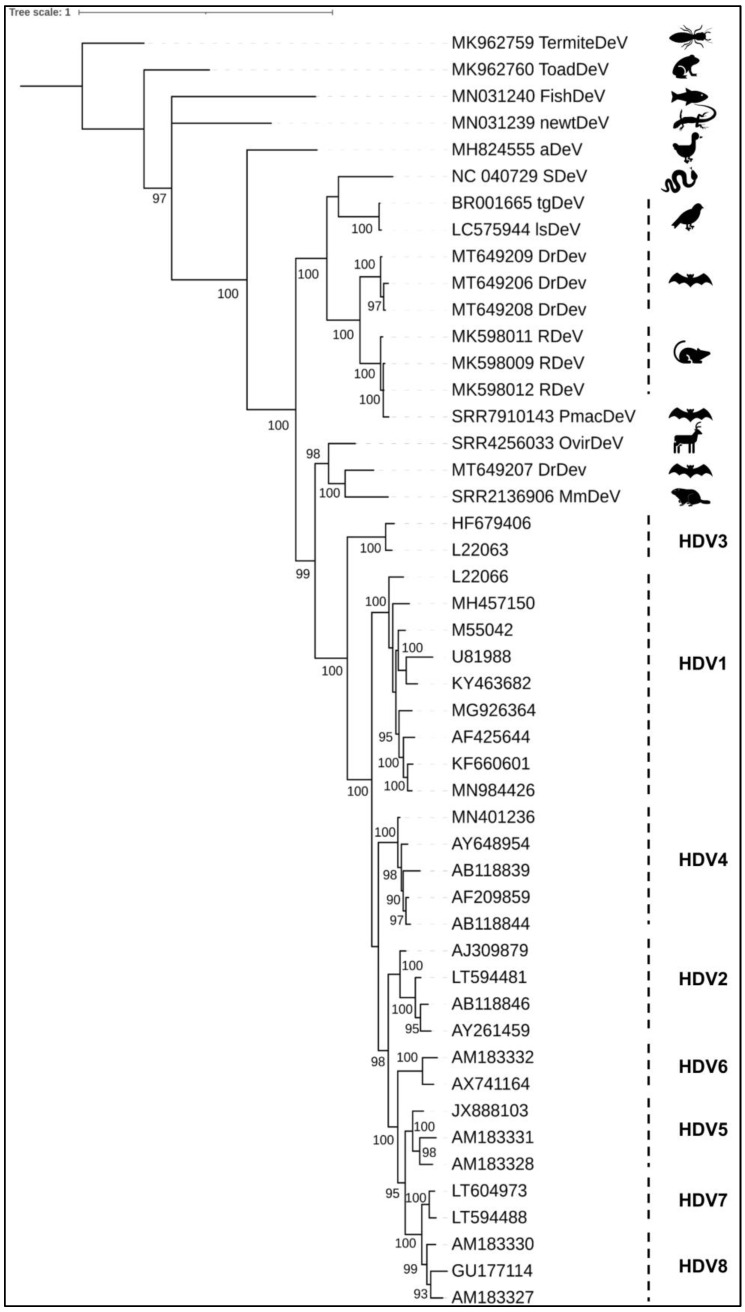
Hepatitis delta virus (HDV) is a defective human virus that lacks the ability to produce its own envelope proteins and is thus dependent on the presence of a helper virus, which provides its surface proteins to produce infectious particles. Hepatitis B virus (HBV) was so far thought to be the only helper virus described to be associated with HDV. However, recent studies showed that divergent HDV-like viruses could be detected in fishes, birds, amphibians, and invertebrates, without evidence of any HBV-like agent supporting infection. Another recent study demonstrated that HDV can be transmitted and propagated in experimental infections ex vivo and in vivo by different enveloped viruses unrelated to HBV, including hepatitis C virus (HCV) and flaviviruses such as Dengue and West Nile virus. All this new evidence, in addition to the identification of novel virus species within a large range of hosts in absence of HBV, suggests that deltaviruses may take advantage of a large spectrum of helper viruses and raises questions about HDV origins and evolution.
丁型肝炎病毒 (HDV) 是一种缺陷型人类病毒,它缺乏产生自身包膜蛋白的能力,因此依赖于辅助病毒的存在,辅助病毒提供其表面蛋白以产生感染性颗粒。乙型肝炎病毒 (HBV) 是迄今为止被认为与 HDV 相关的唯一辅助病毒。然而,最近的研究表明,在鱼类、鸟类、两栖动物和无脊椎动物中可以检测到不同的丁型肝炎病毒样病毒,而没有任何 HBV 样物质支持感染的证据。另一项最近的研究表明,HDV 可以通过不同的包膜病毒在实验感染中体外和体内传播和繁殖,这些病毒与 HBV 无关,包括丙型肝炎病毒 (HCV) 和黄病毒,如登革热和西尼罗河病毒。除了在没有 HBV 的情况下在大量宿主中鉴定出新型病毒外,所有这些新证据表明,丁型肝炎病毒可能利用大量的辅助病毒,并对 HDV 的起源和进化提出了质疑。