College of Pharmacy and Nutrition, University of Saskatchewan, Saskatoon, SK S7N 5E5, Canada.
Department of Plant Sciences, University of Saskatchewan, Saskatoon, SK S7N 5A8, Canada.
Molecules. 2021 Jun 23;26(13):3833. doi: 10.3390/molecules26133833.
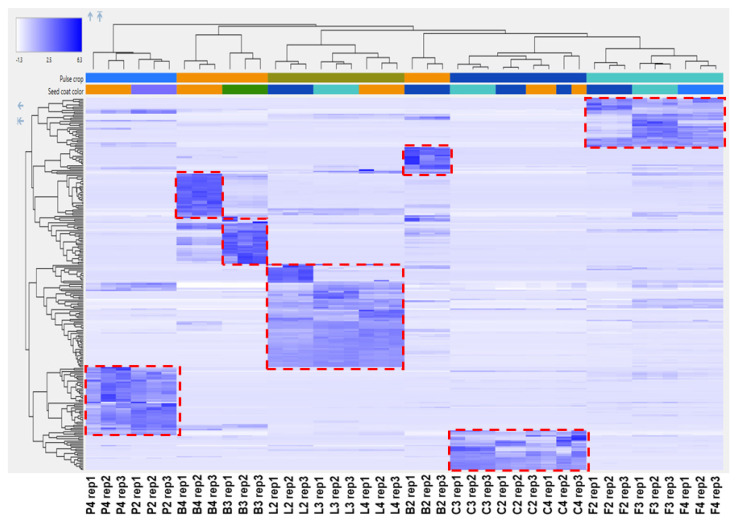
Pulse crop seed coats are a sustainable source of antioxidant polyphenols, but are typically treated as low-value products, partly because some polyphenols reduce iron bioavailability in humans. This study correlates antioxidant/iron chelation capabilities of diverse seed coat types from five major pulse crops (common bean, lentil, pea, chickpea and faba bean) with polyphenol composition using mass spectrometry. Untargeted metabolomics was used to identify key differences and a hierarchical analysis revealed that common beans had the most diverse polyphenol profiles among these pulse crops. The highest antioxidant capacities were found in seed coats of black bean and all tannin lentils, followed by maple pea, however, tannin lentils showed much lower iron chelation among these seed coats. Thus, tannin lentils are more desirable sources as natural antioxidants in food applications, whereas black bean and maple pea are more suitable sources for industrial applications. Regardless of pulse crop, proanthocyanidins were primary contributors to antioxidant capacity, and to a lesser extent, anthocyanins and flavan-3-ols, whereas glycosylated flavonols contributed minimally. Higher iron chelation was primarily attributed to proanthocyanidin composition, and also myricetin 3--glucoside in black bean. Seed coats having proanthocyanidins that are primarily prodelphinidins show higher iron chelation compared with those containing procyanidins and/or propelargonidins.
谷物种子种皮是抗氧化多酚的可持续来源,但通常被视为低价值产品,部分原因是一些多酚会降低人类铁的生物利用度。本研究使用质谱法将来自五种主要豆类作物(菜豆、小扁豆、豌豆、鹰嘴豆和蚕豆)的不同种皮类型的抗氧化/铁螯合能力与多酚组成相关联。非靶向代谢组学用于鉴定关键差异,层次分析表明,在这些豆类作物中,菜豆具有最多样的多酚谱。黑大豆和所有单宁小扁豆的种皮具有最高的抗氧化能力,其次是枫豆,但在这些种皮中,单宁小扁豆的铁螯合能力要低得多。因此,单宁小扁豆是食品应用中作为天然抗氧化剂的更理想来源,而黑大豆和枫豆则更适合工业应用。无论豆类作物如何,原花青素都是抗氧化能力的主要贡献者,其次是花青素和黄烷-3-醇,而糖苷化黄酮醇的贡献较小。更高的铁螯合主要归因于原花青素的组成,黑大豆中的杨梅素 3--葡萄糖苷也是如此。主要含有原花青素的种皮比含有原花青素和/或原儿茶素的种皮具有更高的铁螯合能力。