Norsworthy Jason K, Varanasi Vijay K, Bagavathiannan Muthukumar, Brabham Chad
Department of Crop, Soil, and Environmental Sciences, University of Arkansas, Fayetteville, AR 72701, USA.
Department of Soil and Crop Sciences, Texas A & M University, College Station, TX 77843, USA.
Plants (Basel). 2021 Jun 25;10(7):1293. doi: 10.3390/plants10071293.
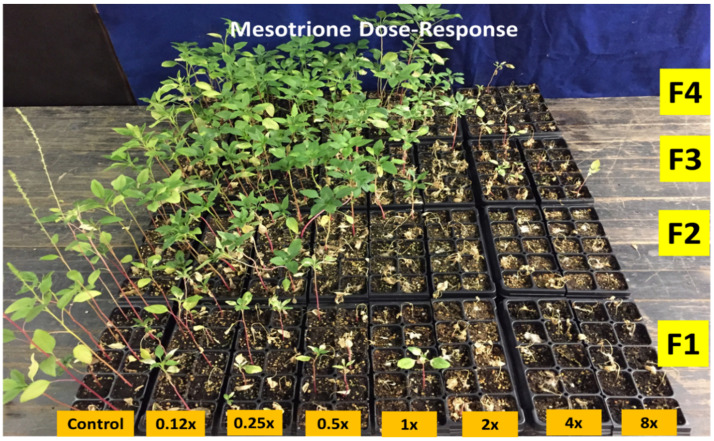
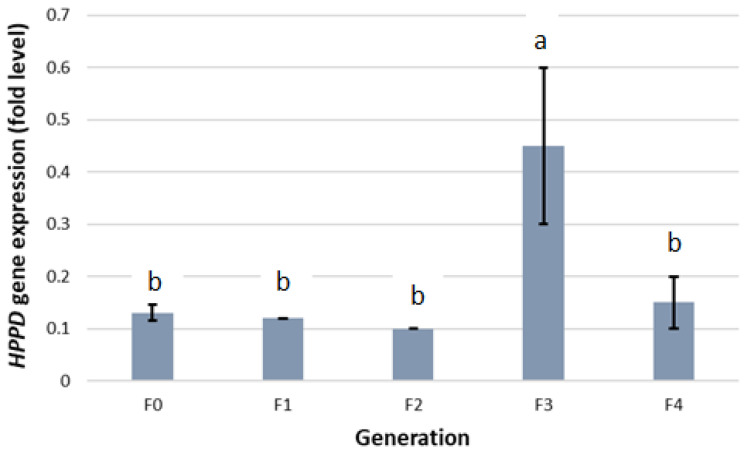
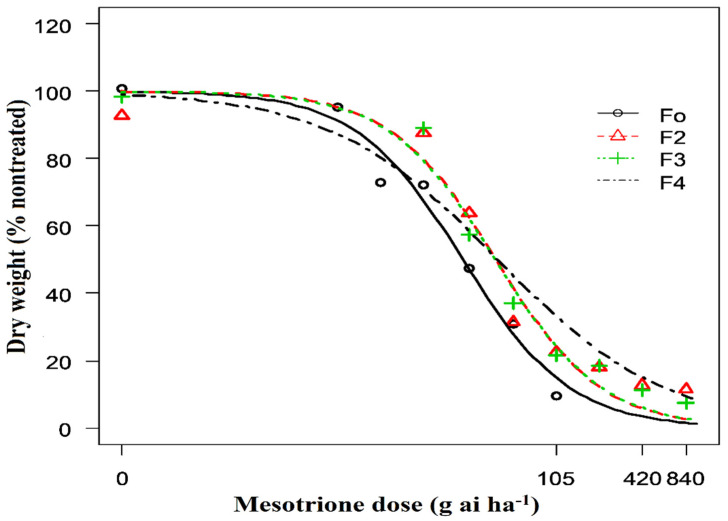
, ranked as the most prolific and troublesome weed in North America, has evolved resistance to several herbicide sites of action. Repeated use of any one herbicide, especially at lower than recommended doses, can lead to evolution of weed resistance, and, therefore, a better understanding of the process of resistance evolution is essential for the management of and other difficult-to-control weed species. rapidly developed resistance to 4-hydroxyphenylpyruvate dioxygenase (HPPD) inhibitors such as mesotrione. The objective of this study was to test the potential for low-dose applications of mesotrione to select for reduced susceptibility over multiple generations in an population collected from an agricultural field in 2001. F plants from the population were initially treated with sub-lethal mesotrione rates and evaluated for survival three weeks after treatment. All F plants were controlled at the 1× rate (x = 105 g ai ha). However, 2.5% of the F plants survived the 0.5× treatment. The recurrent selection process using plants surviving various mesotrione rates was continued until the F generation was reached. Based on the GR values, the sensitivity index was determined to be 1.7 for the F generation. Compared to F, HPPD gene expression level in the F population increased. Results indicate that after several rounds of recurrent selection, the successive generations of became less responsive to mesotrione, which may explain the reduced sensitivity of this weed to HPPD-inhibiting herbicides. The results have significance in light of the recently released soybean and soon to be released cotton varieties with resistance to HPPD inhibitors.
在北美被列为繁殖力最强且最棘手的杂草,已经对几种除草剂作用位点产生了抗性。反复使用任何一种除草剂,尤其是低于推荐剂量使用,都可能导致杂草产生抗性,因此,更好地了解抗性进化过程对于管理该杂草及其他难以控制的杂草种类至关重要。该杂草迅速对4-羟基苯丙酮酸双加氧酶(HPPD)抑制剂如甲基磺草酮产生了抗性。本研究的目的是测试在2001年从一块农田采集的该杂草种群中,低剂量甲基磺草酮多次施用是否会导致其敏感性降低。该种群的F植株最初用亚致死剂量的甲基磺草酮处理,并在处理三周后评估其存活率。所有F植株在1×剂量(x = 105 g ai/ha)下都被防除。然而,2.5%的F植株在0.5×剂量处理下存活。使用在不同甲基磺草酮剂量下存活的植株进行轮回选择过程,持续到F代。根据GR值,确定F代的敏感性指数为1.7。与F代相比,F种群中HPPD基因表达水平有所提高。结果表明,经过几轮轮回选择后,该杂草的连续几代对甲基磺草酮的反应性降低,这可能解释了这种杂草对HPPD抑制型除草剂敏感性降低的原因。鉴于最近发布的对HPPD抑制剂具有抗性的大豆品种以及即将发布的棉花品种,这些结果具有重要意义。