Schrödinger, Inc., 120 West 45th St., New York, NY 10036, USA.
D.E. Shaw India Private Ltd., Hyderabad 500096, India.
Mar Drugs. 2021 Jun 25;19(7):367. doi: 10.3390/md19070367.
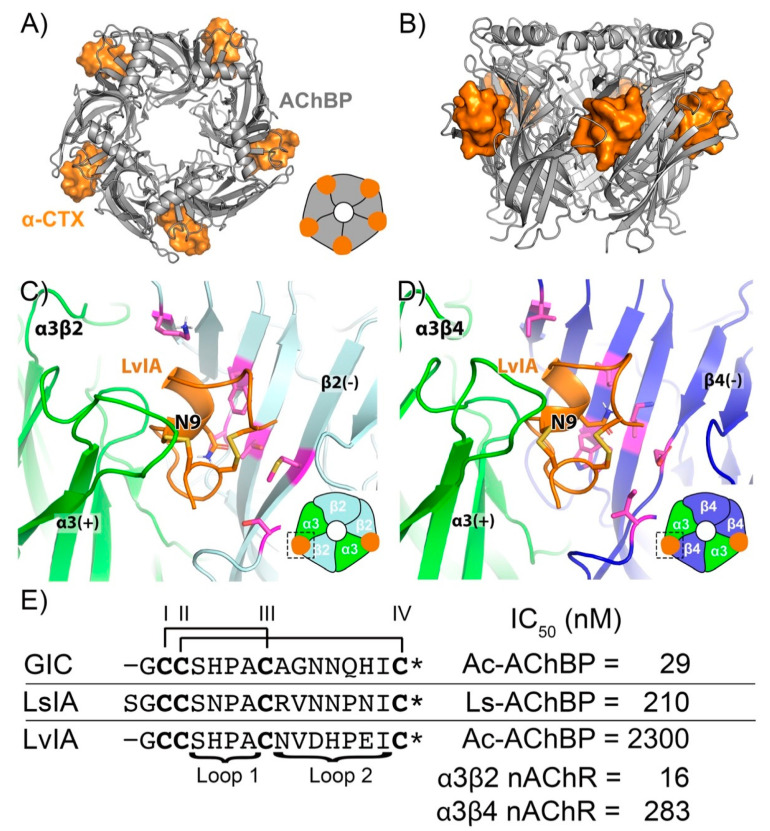
Nicotinic acetylcholine receptor (nAChR) subtypes are key drug targets, but it is challenging to pharmacologically differentiate between them because of their highly similar sequence identities. Furthermore, α-conotoxins (α-CTXs) are naturally selective and competitive antagonists for nAChRs and hold great potential for treating nAChR disorders. Identifying selectivity-enhancing mutations is the chief aim of most α-CTX mutagenesis studies, although doing so with traditional docking methods is difficult due to the lack of α-CTX/nAChR crystal structures. Here, we use homology modeling to predict the structures of α-CTXs bound to two nearly identical nAChR subtypes, α3β2 and α3β4, and use free-energy perturbation (FEP) to re-predict the relative potency and selectivity of α-CTX mutants at these subtypes. First, we use three available crystal structures of the nAChR homologue, acetylcholine-binding protein (AChBP), and re-predict the relative affinities of twenty point mutations made to the α-CTXs LvIA, LsIA, and GIC, with an overall root mean square error (RMSE) of 1.08 ± 0.15 kcal/mol and an R of 0.62, equivalent to experimental uncertainty. We then use AChBP as a template for α3β2 and α3β4 nAChR homology models bound to the α-CTX LvIA and re-predict the potencies of eleven point mutations at both subtypes, with an overall RMSE of 0.85 ± 0.08 kcal/mol and an R of 0.49. This is significantly better than the widely used molecular mechanics-generalized born/surface area (MM-GB/SA) method, which gives an RMSE of 1.96 ± 0.24 kcal/mol and an R of 0.06 on the same test set. Next, we demonstrate that FEP accurately classifies α3β2 nAChR selective LvIA mutants while MM-GB/SA does not. Finally, we use FEP to perform an exhaustive amino acid mutational scan of LvIA and predict fifty-two mutations of LvIA to have greater than 100X selectivity for the α3β2 nAChR. Our results demonstrate the FEP is well-suited to accurately predict potency- and selectivity-enhancing mutations of α-CTXs for nAChRs and to identify alternative strategies for developing selective α-CTXs.
烟碱型乙酰胆碱受体 (nAChR) 亚型是关键的药物靶点,但由于它们具有高度相似的序列同一性,因此在药理学上区分它们具有挑战性。此外,α- 芋螺毒素 (α-CTX) 是 nAChR 的天然选择性和竞争性拮抗剂,在治疗 nAChR 疾病方面具有巨大潜力。尽管如此,由于缺乏 α-CTX/nAChR 晶体结构,大多数 α-CTX 诱变研究的主要目标仍然是确定选择性增强突变。在这里,我们使用同源建模来预测与两种几乎相同的 nAChR 亚型 α3β2 和 α3β4 结合的 α-CTX 的结构,并使用自由能微扰 (FEP) 重新预测这些亚型中 α-CTX 突变体的相对效力和选择性。首先,我们使用三种现有的烟碱型乙酰胆碱受体同源物,乙酰胆碱结合蛋白 (AChBP) 的晶体结构,重新预测了对 α-CTXs LvIA、LsIA 和 GIC 进行的二十个点突变的相对亲和力,总体均方根误差 (RMSE) 为 1.08 ± 0.15 kcal/mol,R 为 0.62,相当于实验不确定性。然后,我们将 AChBP 用作 α3β2 和 α3β4 nAChR 同源模型的模板,与 α-CTX LvIA 结合,并重新预测了这两种亚型的十一个点突变的效力,总体 RMSE 为 0.85 ± 0.08 kcal/mol,R 为 0.49。这明显优于广泛使用的分子力学-广义 Born/表面积 (MM-GB/SA) 方法,该方法在相同的测试集上给出的 RMSE 为 1.96 ± 0.24 kcal/mol,R 为 0.06。接下来,我们证明 FEP 可以准确地对 α3β2 nAChR 选择性 LvIA 突变体进行分类,而 MM-GB/SA 则不能。最后,我们使用 FEP 对 LvIA 进行了详尽的氨基酸突变扫描,并预测了 LvIA 的 52 个突变,这些突变对 α3β2 nAChR 的选择性大于 100X。我们的结果表明,FEP 非常适合准确预测 nAChR 的 α-CTX 效力增强和选择性增强突变,并确定开发选择性 α-CTX 的替代策略。