College of Pharmacy and Integrated Research Institute of Pharmaceutical Sciences, The Catholic University of Korea, 43 Jibong-ro, Wonmi-gu, Bucheon 14662, Korea.
Int J Mol Sci. 2021 Jun 28;22(13):6932. doi: 10.3390/ijms22136932.
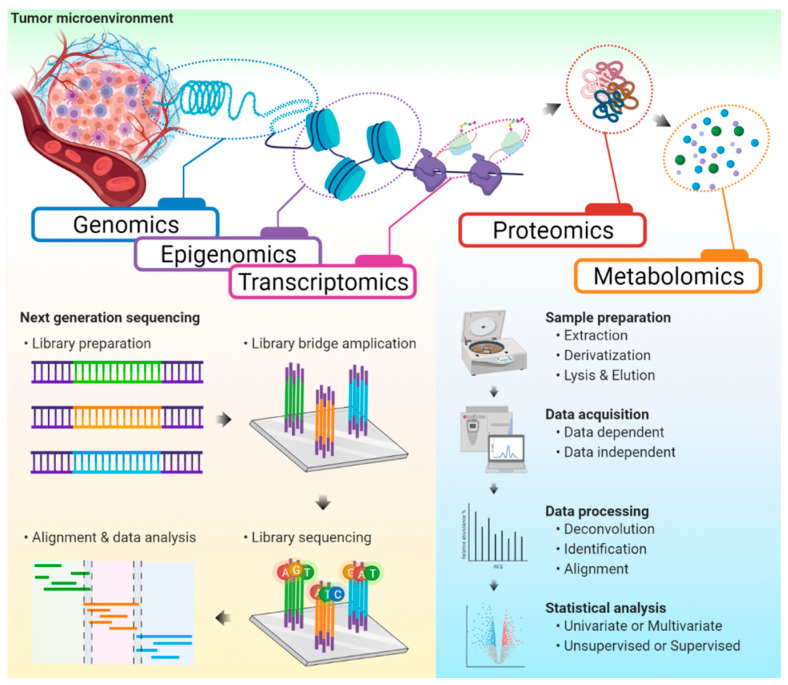
In the past decade, immunotherapies have been emerging as an effective way to treat cancer. Among several categories of immunotherapies, immune checkpoint inhibitors (ICIs) are the most well-known and widely used options for cancer treatment. Although several studies continue, this treatment option has yet to be developed into a precise application in the clinical setting. Recently, omics as a high-throughput technique for understanding the genome, transcriptome, proteome, and metabolome has revolutionized medical research and led to integrative interpretation to advance our understanding of biological systems. Advanced omics techniques, such as multi-omics, single-cell omics, and typical omics approaches, have been adopted to investigate various cancer immunotherapies. In this review, we highlight metabolomic studies regarding the development of ICIs involved in the discovery of targets or mechanisms of action and assessment of clinical outcomes, including drug response and resistance and propose biomarkers. Furthermore, we also discuss the genomics, proteomics, and advanced omics studies providing insights and comprehensive or novel approaches for ICI development. The overview of ICI studies suggests potential strategies for the development of other cancer immunotherapies using omics techniques in future studies.
在过去的十年中,免疫疗法已成为治疗癌症的有效方法。在几种免疫疗法中,免疫检查点抑制剂(ICI)是癌症治疗中最知名和广泛使用的选择。尽管有几项研究仍在继续,但这种治疗选择尚未在临床环境中发展成为一种精确的应用。最近,组学作为一种用于了解基因组、转录组、蛋白质组和代谢组的高通量技术,彻底改变了医学研究,并进行了综合解读,以增进我们对生物系统的理解。多组学、单细胞组学和典型组学方法等先进的组学技术已被用于研究各种癌症免疫疗法。在这篇综述中,我们强调了代谢组学研究在发现 ICI 作用靶点或作用机制以及评估临床结果(包括药物反应和耐药性以及提出生物标志物)方面的发展。此外,我们还讨论了基因组学、蛋白质组学和先进的组学研究,为 ICI 的发展提供了见解和全面或新颖的方法。ICI 研究的综述表明,未来的研究中可以使用组学技术为其他癌症免疫疗法的发展提供潜在的策略。