Brescia Francesca, Vlassi Anthi, Bejarano Ana, Seidl Bernard, Marchetti-Deschmann Martina, Schuhmacher Rainer, Puopolo Gerardo
Research and Innovation Centre, Department of Sustainable Agro-Ecosystems and Bioresources, Fondazione Edmund Mach, 38098 San Michele all'Adige, Italy.
Department of Agricultural, Forest and Food Sciences (DISAFA), University of Torino, Largo Paolo Braccini 2, 10095 Grugliasco, Torino, Italy.
Microorganisms. 2021 Jun 17;9(6):1320. doi: 10.3390/microorganisms9061320.
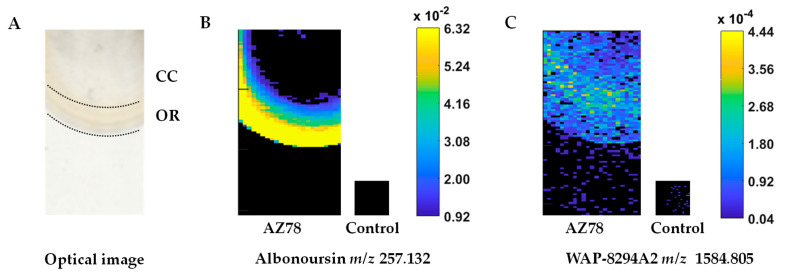
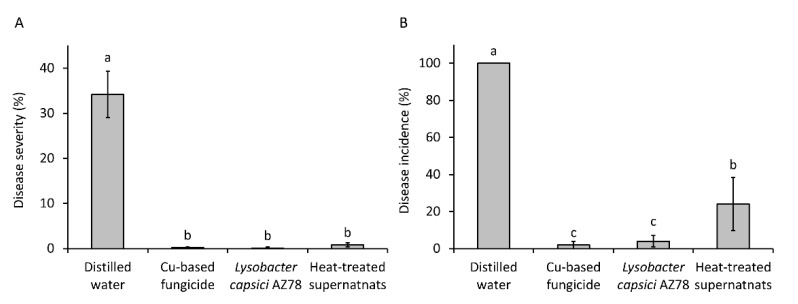
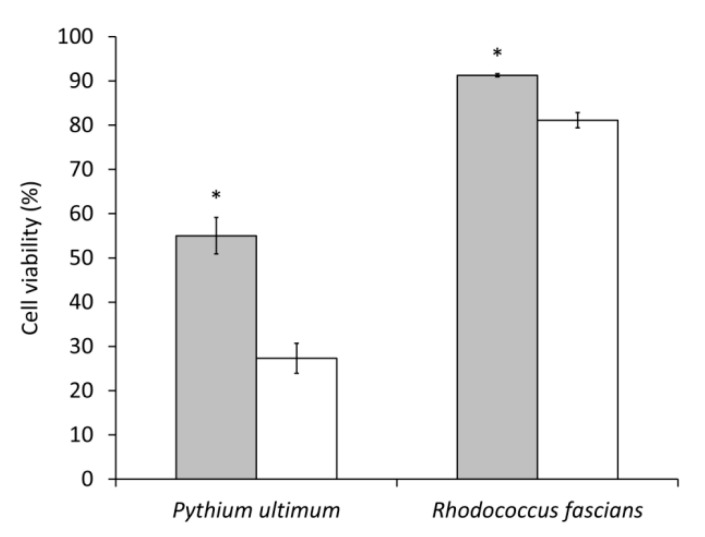
Determining the mode of action of microbial biocontrol agents plays a key role in their development and registration as commercial biopesticides. The biocontrol rhizobacterium AZ78 (AZ78) is able to inhibit a vast array of plant pathogenic oomycetes and Gram-positive bacteria due to the release of antimicrobial secondary metabolites. A combination of MALDI-qTOF-MSI and UHPLC-HRMS/M was applied to finely dissect the AZ78 metabolome and identify the main secondary metabolites involved in the inhibition of plant pathogenic microorganisms. Under nutritionally limited conditions, MALDI-qTOF-MSI revealed that AZ78 is able to release a relevant number of antimicrobial secondary metabolites belonging to the families of 2,5-diketopiperazines, cyclic lipodepsipeptides, macrolactones and macrolides. In vitro tests confirmed the presence of secondary metabolites toxic against and in AZ78 cell-free extracts. Subsequently, UHPLC-HRMS/MS was used to confirm the results achieved with MALDI-qTOF-MSI and investigate for further putative antimicrobial secondary metabolites known to be produced by spp. This technique confirmed the presence of several 2,5-diketopiperazines in AZ78 cell-free extracts and provided the first evidence of the production of the cyclic depsipeptide WAP-8294A2 in a member of species. Moreover, UHPLC-HRMS/MS confirmed the presence of dihydromaltophilin/Heat Stable Antifungal Factor (HSAF) in AZ78 cell-free extracts. Due to the production of HSAF by AZ78, cell-free supernatants were effective in controlling on grapevine leaf disks after exposure to high temperatures. Overall, our work determined the main secondary metabolites involved in the biocontrol activity of AZ78 against plant pathogenic oomycetes and Gram-positive bacteria. These results might be useful for the future development of this bacterial strain as the active ingredient of a microbial biopesticide that might contribute to a reduction in the chemical input in agriculture.
确定微生物生物防治剂的作用模式对其作为商业生物农药的开发和注册起着关键作用。生防根际细菌AZ78能够抑制多种植物病原卵菌和革兰氏阳性细菌,这归因于其抗菌次生代谢产物的释放。将基质辅助激光解吸电离飞行时间质谱成像(MALDI-qTOF-MSI)与超高效液相色谱-高分辨质谱联用(UHPLC-HRMS/M)相结合,以精细剖析AZ78的代谢组,并鉴定参与抑制植物病原微生物的主要次生代谢产物。在营养受限条件下,MALDI-qTOF-MSI显示AZ78能够释放大量属于2,5-二酮哌嗪、环状脂肽、大环内酯和大环内酯类家族的抗菌次生代谢产物。体外试验证实了AZ78无细胞提取物中存在对[具体微生物1]和[具体微生物2]有毒的次生代谢产物。随后,使用UHPLC-HRMS/MS来确认MALDI-qTOF-MSI获得的结果,并进一步研究已知由[相关菌种]产生的其他假定抗菌次生代谢产物。该技术证实了AZ78无细胞提取物中存在几种2,5-二酮哌嗪,并首次证明了环状脂肽WAP-8294A2在[相关菌种]的一个成员中产生。此外,UHPLC-HRMS/MS证实了AZ78无细胞提取物中存在二氢麦芽酚/热稳定抗真菌因子(HSAF)。由于AZ78产生HSAF,无细胞上清液在高温处理后对葡萄叶片圆片上的[具体病害]具有有效的防治作用。总体而言,我们的工作确定了参与AZ78对植物病原卵菌和革兰氏阳性细菌生物防治活性的主要次生代谢产物。这些结果可能有助于该菌株未来作为微生物生物农药的活性成分进行开发,从而有助于减少农业中的化学投入。