van Loon Johannes P A M, Macri Lucia
Department of Equine Sciences, Faculty of Veterinary Medicine, Utrecht University, 3584 CM Utrecht, The Netherlands.
Equine Department, Vetsuisse Faculty, University of Zürich, CH-8057 Zürich, Switzerland.
Animals (Basel). 2021 Jun 18;11(6):1826. doi: 10.3390/ani11061826.
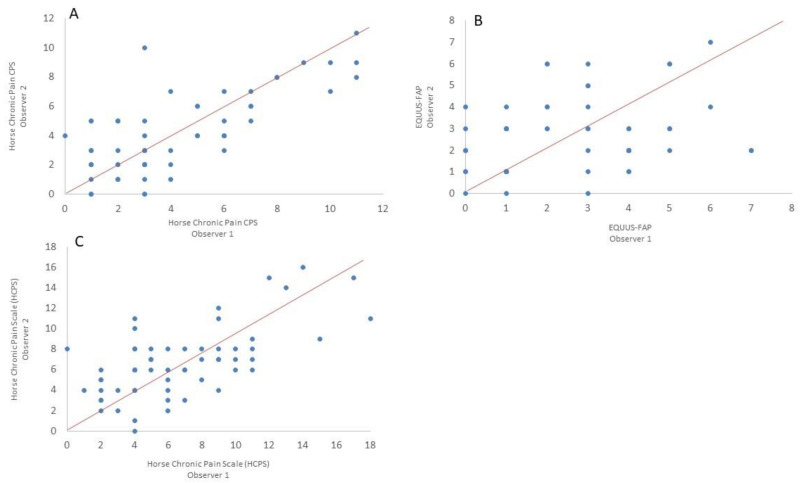
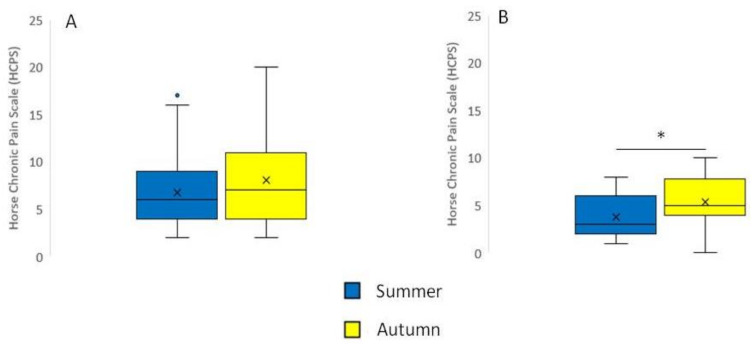
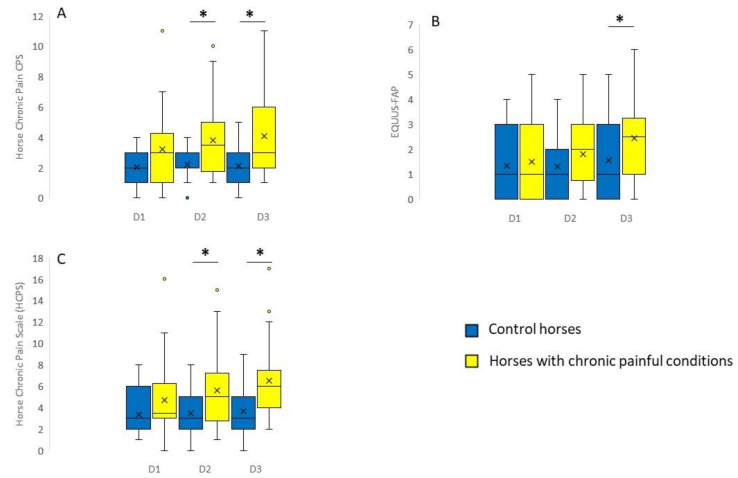
The objective assessment of chronic pain is of utmost importance for improving welfare and quality of life in horses. Freedom from disease and pain is one of the 'five freedoms' that are necessary for animal welfare. The aim of this study was to develop a pain scale for the assessment of chronic pain in horses (Horse Chronic Pain Scale; HCPS), which is based on behavioural and facial expressions. The scale was used to assess 53 horses (26 horses diagnosed with chronic painful conditions by means of clinical examination and additional diagnostic procedures (consisting of osteoarthritis, chronic laminitis, chronic back and neck problems, chronic dental disorders) and 27 healthy control animals). Animals were assessed once daily for three consecutive days by two observers that were blinded to the condition of the animals and were unaware of any analgesic treatment regimens. The HCPS consists of two parts, the Horse Chronic Pain Composite Pain Scale (HCP CPS, with behavioural parameters) and the EQUUS-FAP (Equine Utrecht University Scale for Facial Assessment of Pain). The HCP CPS had good inter-observer reliability (intraclass correlation coefficient (ICC) = 0.84, < 0.001), while the EQUUS-FAP component (with facial expression-based parameters) had poor inter-observer reliability (ICC = 0.45, < 0.05). The inter-observer reliability of the combined HCPS was good (ICC = 0.78, < 0.001). The HCPS revealed significant differences between horses with chronic painful conditions and control horses on 2 out of 3 days ( < 0.05). In conclusion, we tested a composite pain scale for the assessment of chronic pain in horses based on behavioural and facial expression-based parameters. Further studies are needed to validate this pain scale before it can be used in practice.
慢性疼痛的客观评估对于提高马匹的健康水平和生活质量至关重要。免于疾病和疼痛是动物福利所需的“五项自由”之一。本研究的目的是开发一种基于行为和面部表情的马匹慢性疼痛评估量表(马慢性疼痛量表;HCPS)。该量表用于评估53匹马(26匹通过临床检查和额外诊断程序(包括骨关节炎、慢性蹄叶炎、慢性背部和颈部问题、慢性牙齿疾病)被诊断患有慢性疼痛疾病的马,以及27匹健康对照动物)。由两名对动物状况不知情且不知道任何镇痛治疗方案的观察者连续三天每天对动物进行一次评估。HCPS由两部分组成,马慢性疼痛综合疼痛量表(HCP CPS,包含行为参数)和EQUUS - FAP(乌得勒支大学马面部疼痛评估量表)。HCP CPS具有良好的观察者间信度(组内相关系数(ICC)= 0.84,< 0.001),而EQUUS - FAP部分(基于面部表情的参数)观察者间信度较差(ICC = 0.45,< 0.05)。联合的HCPS观察者间信度良好(ICC = 0.78,< 0.001)。HCPS显示,在三天中的两天,患有慢性疼痛疾病的马和对照马之间存在显著差异(< 0.05)。总之,我们测试了一种基于行为和面部表情参数的用于评估马匹慢性疼痛的综合疼痛量表。在该疼痛量表可用于实际应用之前,还需要进一步研究来验证它。