Torcivia Catherine, McDonnell Sue
Department of Clinical Studies, University of Pennsylvania School of Veterinary Medicine, New Bolton Center, 382 W Street Road, Kennett Square, PA 19348, USA.
Havemeyer Equine Behavior Lab and Clinic, Department of Clinical Studies, University of Pennsylvania School of Veterinary Medicine, New Bolton Center, 382 W Street Road, Kennett Square, PA 19348, USA.
Animals (Basel). 2020 Jan 27;10(2):210. doi: 10.3390/ani10020210.
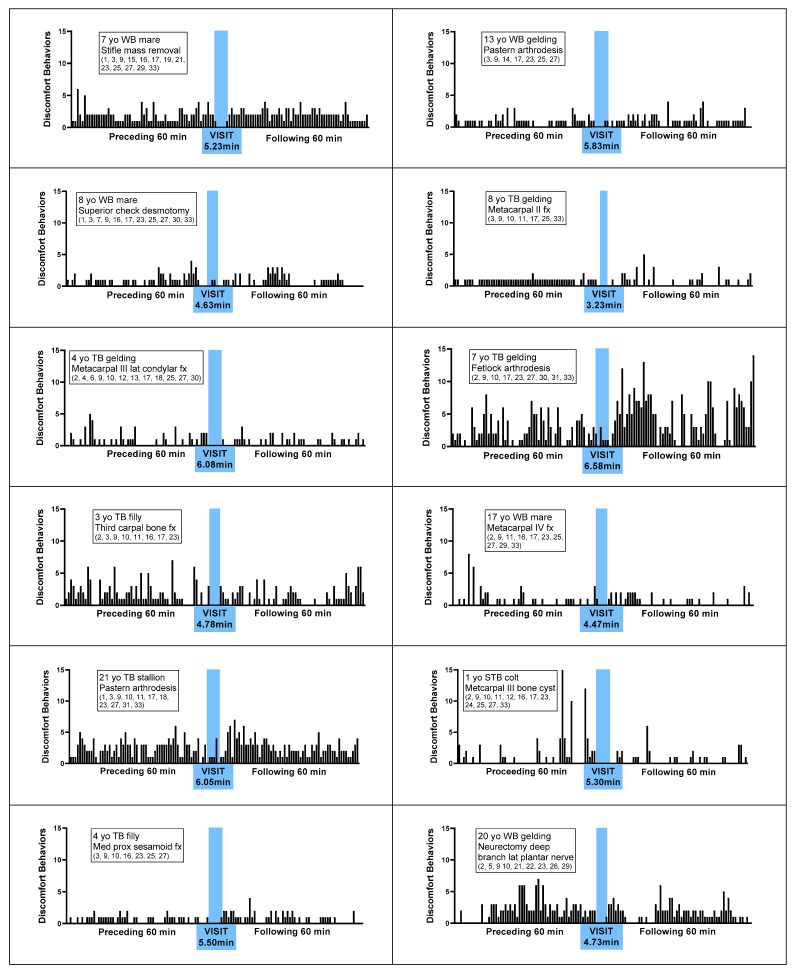
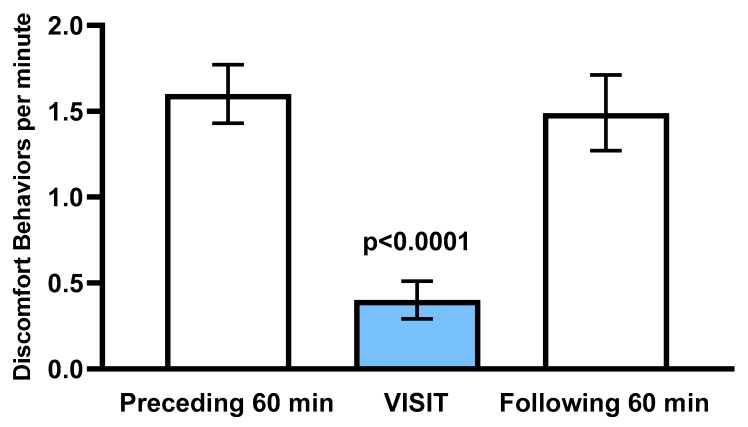
Horses have evolved to show little indication of discomfort or disability when in the presence of potential predators, including humans. This natural characteristic complicates the recognition of pain in equine patients. It has been our clinical impression that, whenever a person is present, horses tend to "perk up" and ongoing discomfort behavior (DB) more or less ceases. The objective of this study was to quantitatively evaluate and describe this effect. For each of 20 orthopedic surgical patients, continuous 24-h video was reviewed to record all occurrences of DB during a caretaker visit (3.23 to 7.75 min), for comparison to the hour preceding as well as the hour following when undisturbed. The mean ± S.E. DB observed per minute during the preceding and following hours, respectively, were 1.65 ± 0.17 and 1.49 ± 0.22. The difference was not significant ( > 0.05). In contrast, mean DB per minute during the visit was 0.40 ± 0.11. This was significantly lower than during both the preceding and following hours ( < 0.0001). All 20 patients expressed fewer observable DB per minute during the visit, with a mean reduction of 77.4% ± 0.17%. For 30% of these patients, ongoing DB ceased altogether during the visit. These findings confirm our clinical impression that caretaker visits interrupt DB, resulting in under-appreciation of discomfort.
马在有包括人类在内的潜在捕食者在场时,进化出了几乎不表现出不适或残疾迹象的特性。这种自然特征使得识别马类患者的疼痛变得复杂。我们的临床印象是,只要有人在场,马往往会“振作起来”,持续的不适行为(DB)或多或少会停止。本研究的目的是定量评估和描述这种效应。对于20名接受骨科手术的患者,回顾了连续24小时的视频,以记录护理人员探访期间(3.23至7.75分钟)所有DB的发生情况,以便与探访前一小时以及无人打扰时的后一小时进行比较。探访前一小时和后一小时每分钟观察到的平均±标准误DB分别为1.65±0.17和1.49±0.22。差异不显著(>0.05)。相比之下,探访期间每分钟的平均DB为0.40±0.11。这显著低于探访前和探访后的小时数(<0.0001)。所有20名患者在探访期间每分钟表现出的可观察到的DB较少,平均减少了77.4%±0.17%。在这些患者中,30%的患者在探访期间持续的DB完全停止。这些发现证实了我们的临床印象,即护理人员的探访会打断DB,导致对不适的认识不足。