Institute of Food Chemistry, Westfälische Wilhelms-Universität Münster, Corrensstraße 45, 48149 Münster, Germany.
Maryland Institute for Applied Environmental Health, School of Public Health, University of Maryland, College Park, MD 20742, USA.
Toxins (Basel). 2021 Jun 11;13(6):418. doi: 10.3390/toxins13060418.
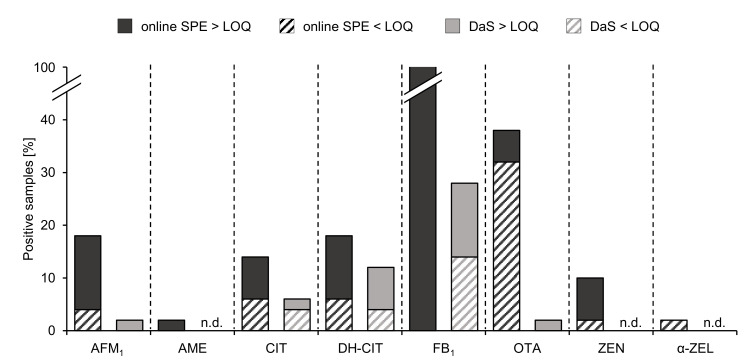
In the course of assessing the human exposure to mycotoxins, biomarker-based approaches have proven to be important tools. Low concentration levels, complex matrix compositions, structurally diverse analytes, and the large size of sample cohorts are the main challenges of analytical procedures. For that reason, an online solid phase extraction-ultra high-performance liquid chromatography-tandem mass spectrometry (online SPE-UHPLC-MS/MS) method was developed, allowing for the sensitive, robust, and rapid analysis of 11 relevant mycotoxins and mycotoxin metabolites in human urine. The included spectrum of analytes comprises aflatoxin M (AFM), altenuene (ALT), alternariol monomethyl ether (AME), alternariol (AOH), citrinin (CIT) and its metabolite dihydrocitrinone (DH-CIT), fumonisin B (FB), ochratoxin A (OTA), and zearalenone (ZEN) as well as α- and β-zearalenol (α- and β-ZEL). Reliable quantitation was achieved by means of stable isotope dilution, except for ALT, AME and AOH using matrix calibrations. The evaluation of method performance displayed low limits of detection in the range of pg/mL urine, satisfactory apparent recovery rates as well as high accuracy and precision during intra- and interday repeatability. Within the analysis of Zimbabwean urine samples ( = 50), the applicability of the newly developed method was shown. In addition to FB being quantifiable in all analyzed samples, six other mycotoxin biomarkers were detected. Compared to the occurrence rates obtained after analyzing the same sample set using an established dilute and shoot (DaS) approach, a considerably higher number of positive samples was observed when applying the online SPE method. Owing to the increased sensitivity, less need of sample handling, and low time effort, the herein presented online SPE approach provides a valuable contribution to human biomonitoring of mycotoxin exposure.
在评估人类接触真菌毒素的过程中,基于生物标志物的方法已被证明是重要的工具。低浓度水平、复杂的基质组成、结构多样的分析物以及大量的样本队列是分析程序的主要挑战。为此,开发了一种在线固相萃取-超高效液相色谱-串联质谱(online SPE-UHPLC-MS/MS)方法,能够灵敏、稳健、快速地分析人尿液中的 11 种相关真菌毒素和真菌毒素代谢物。所包含的分析物谱包括黄曲霉毒素 M(AFM)、Alternuene(ALT)、Alternariol monomethyl ether(AME)、Alternariol(AOH)、桔青霉素(CIT)及其代谢物二氢桔青霉素酮(DH-CIT)、伏马菌素 B(FB)、赭曲霉毒素 A(OTA)和玉米赤霉烯酮(ZEN)以及α-和β-玉米赤霉烯醇(α-和 β-ZEL)。除 ALT、AME 和 AOH 采用基质校准外,其他分析物均通过稳定同位素稀释进行可靠定量。方法性能评估显示,尿液中 pg/mL 级别的检测限较低,日内和日间重复性的表观回收率令人满意,准确度和精密度较高。在对津巴布韦尿液样本(n=50)的分析中,展示了新方法的适用性。除所有分析样本中均可定量检测到 FB 外,还检测到了另外 6 种真菌毒素生物标志物。与使用既定的稀释和进样(DaS)方法分析同一样本集获得的发生率相比,当应用在线 SPE 方法时,观察到更多的阳性样本。由于灵敏度提高、对样本处理的需求减少以及时间投入减少,本文所述的在线 SPE 方法为人类真菌毒素暴露的生物监测提供了有价值的贡献。