Galland Loïck, Lecuelle Julie, Favier Laure, Fraisse Cléa, Lagrange Aurélie, Kaderbhai Courèche, Truntzer Caroline, Ghiringhelli François
Platform of Transfer in Biological Oncology, Georges François Leclerc Cancer Center-UNICANCER, 21000 Dijon, France.
University of Burgundy-Franche Comté, Maison de l'université Esplanade Erasme, 21000 Dijon, France.
Cancers (Basel). 2021 Jun 16;13(12):3020. doi: 10.3390/cancers13123020.
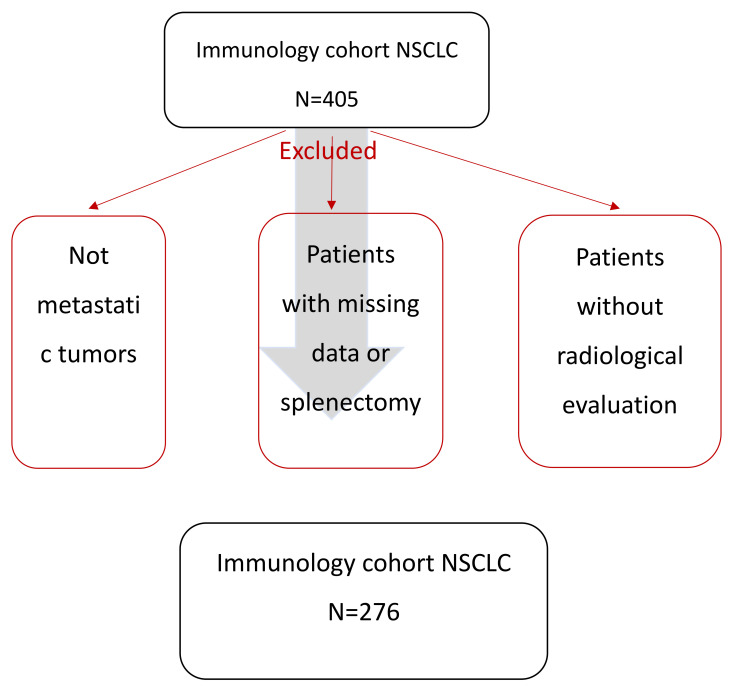
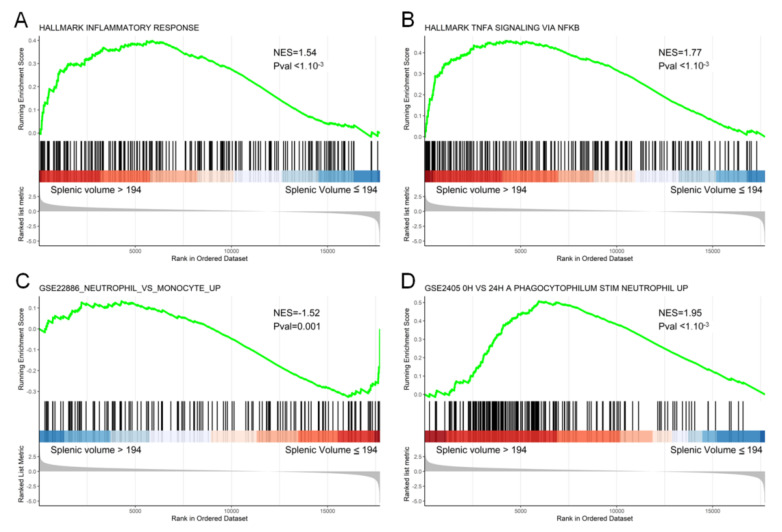
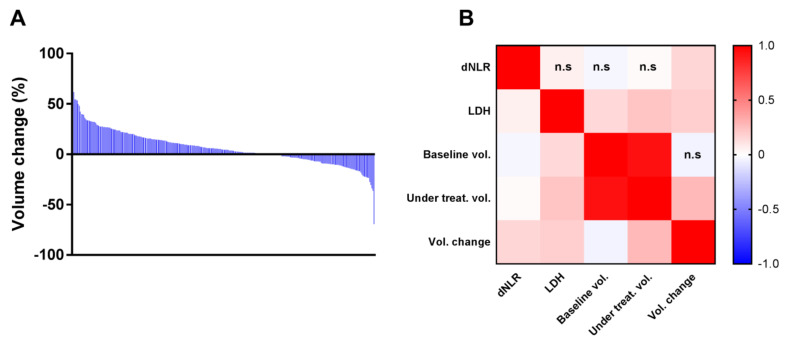
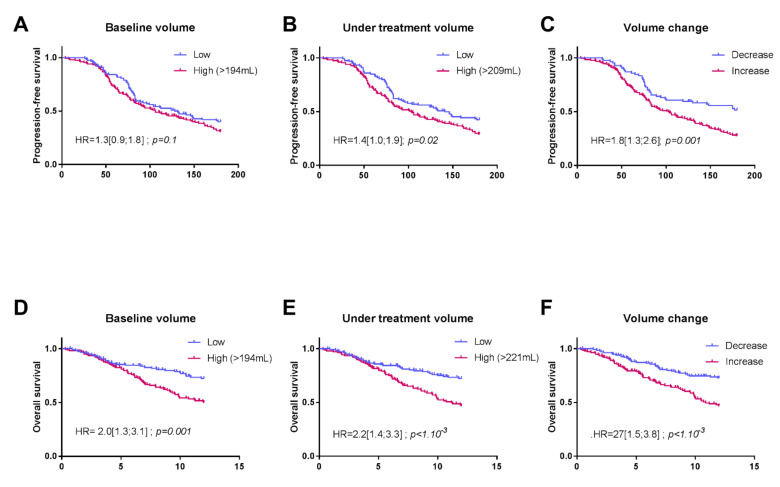
Monoclonal antibodies targeting PD1/PD-L1 are game changers in advanced non-small cell lung cancer (NSCLC), but biomarkers are lacking. We previously reported the prognostic role of splenic volume in digestive cancer and its correlation with the presence of immunosuppressive cells. The aim of this study was to evaluate the prognostic role of splenic volume in NSCLC patients treated with immune checkpoint inhibitors (ICIs). We conducted a retrospective study of 276 patients receiving ICIs for advanced NSCLC in the Georges François Leclerc Cancer Center. The association between splenic volume at baseline and at two months of therapy and progression-free survival (PFS) during ICI treatment or overall survival (OS) from ICI initiation was evaluated using univariate and multivariable Cox analyses. Splenic volume during treatment and the change in splenic volume were associated with poor PFS (respectively = 0.02 and = 0.001) and with OS (respectively < 1.10 and < 1.10). Baseline splenic volume at the first evaluation was also associated with poor OS ( = 0.001). LDH rate and dNLR were positively correlated with splenic volume, as well as with its evolution. After the adjustment of clinical variables, splenic volumes remained a predictive marker of immunotherapy efficacy. Splenic volume is a prognostic biomarker in patients with advanced NSCLC treated with ICIs.
靶向PD1/PD-L1的单克隆抗体是晚期非小细胞肺癌(NSCLC)治疗的变革者,但目前缺乏生物标志物。我们之前报道了脾脏体积在消化道癌症中的预后作用及其与免疫抑制细胞存在的相关性。本研究的目的是评估脾脏体积在接受免疫检查点抑制剂(ICI)治疗的NSCLC患者中的预后作用。我们对乔治·弗朗索瓦·勒克莱尔癌症中心276例接受ICI治疗的晚期NSCLC患者进行了一项回顾性研究。使用单变量和多变量Cox分析评估基线和治疗两个月时的脾脏体积与ICI治疗期间无进展生存期(PFS)或ICI开始后的总生存期(OS)之间的关联。治疗期间的脾脏体积和脾脏体积变化与较差的PFS(分别为 = 0.02和 = 0.001)以及OS(分别为 < 1.10和 < 1.10)相关。首次评估时的基线脾脏体积也与较差的OS相关( = 0.001)。乳酸脱氢酶(LDH)率和中性粒细胞与淋巴细胞比值(dNLR)与脾脏体积及其变化呈正相关。在调整临床变量后,脾脏体积仍然是免疫治疗疗效的预测标志物。脾脏体积是接受ICI治疗的晚期NSCLC患者预后的生物标志物。